
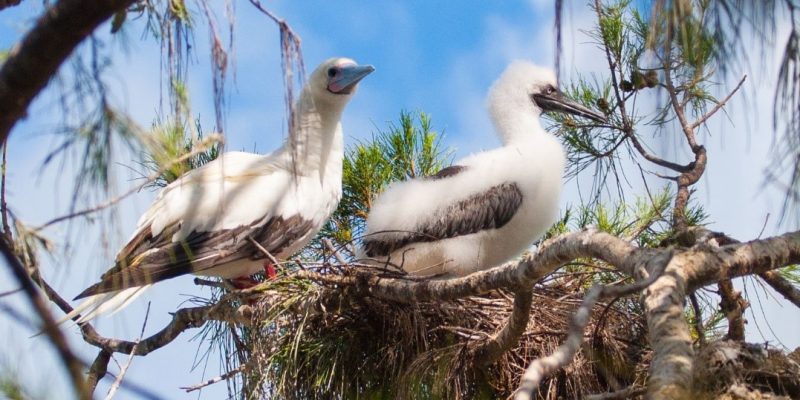
Red-footed Boobies have roosted on St Francois Atoll in the tens of thousands for as long as anybody has been counting. Nesting there is new. The Island Conservation Society recorded the first breeding attempt in the Alphonse Group in 2019, counted 15 pairs by 2023, and this season counted 213 nests.
That is a fourteenfold increase in nests in two seasons on an atoll the society has been monitoring since 2007. It is also the smaller of the two numbers the survey produced.
Sixty-three plots, five hours, 82,794 birds
Counting roosting seabirds is a night job, because a good number of Red-footed Boobies are out over the water during the day and only return to the island in the late evening. So the Alphonse conservation team camped overnight on St Francois in September and worked between 10 p.m. and 3 a.m., counting every bird inside each of 63 plots and then scaling the plot counts across the atoll’s suitable habitat. The estimate that came out was 82,794 roosting individuals.
The society is careful with that figure rather than pleased with it. Sea conditions pushed the census later than planned, so it missed what the data suggest is the peak roosting period in July and August. The last census, run in July 2016, estimated more than 250,000 roosting birds. The team’s own reading is that the timing accounts for the gap, and they intend to test that by counting in the peak window next season if conditions allow.
This is the part of seabird monitoring that rarely makes it into a press release. A number three times smaller than the last one is not automatically a decline, and a survey that reports its own timing problem alongside its result is doing something more useful than a survey that reports only the result.
Nests are the number that is not in doubt
Roost counts move with the season. Nests do not, and the nest series is unambiguous: none before 2019, 15 pairs in 2023, 213 nests this season. The society notes that fledging and failure make the exact breeding population hard to pin down, so 213 nests is a floor on the number of breeding pairs rather than a headcount.
St Francois Atoll covers roughly 5,400 hectares of lagoon and reef flats, and the birds nest in the trees on the islands within it. A colony establishing itself where a species has only ever roosted is the kind of change that takes a decade of consistent presence to notice at all, which is the argument for outstations that stay put.
What the Red List says
Sula sula is Least Concern on the IUCN Red List, which is the category the Island Conservation Society gives it, and the global population trend on the current assessment is decreasing. The society does not mention the trend, and it is worth adding rather than correcting: a Least Concern species that is declining globally is precisely the case where a new colony at the edge of the range is worth the five hours in the dark.
Research elsewhere has tracked the foraging behavior of Seychelles sub-colonies to inform marine protected area planning, which is the other reason the society keeps the series going. Where the birds go to feed decides which water needs protecting.
Who paid for it
We trace the zoos and aquariums behind conservation work in this region as a matter of routine. For the Alphonse monitoring program we did not find one. The Island Conservation Society is a Seychellois non-governmental organization founded in 2001, running conservation centers on five islands, and neither its account of this survey nor its description of the Alphonse outstation names an accredited zoological institution among the funders.
Publishing that is more honest than reaching for a connection. The same trace came up empty on the society’s first breeding record of the Red-billed Tropicbird on Platte, and empty again on Nature Seychelles’ coral work on Praslin. Three Seychellois organizations, three conservation outcomes, no zoo money that we could verify behind any of them. That is worth knowing on its own.
The next count is the one that matters
A single census in the wrong month cannot settle whether the roost has shrunk since 2016 or simply moved in time. A census in July or August next year can. The nests, meanwhile, keep being built, and the society’s hope is stated plainly in its own write-up: that St Francois becomes another established breeding ground for the species rather than a place the birds sleep.
The Island Conservation Society’s report is published on its own site.
Quick answers
- What did the survey find?
213 Red-footed Booby nests on St Francois Atoll in the Alphonse Group, Seychelles, up from 15 pairs in 2023 and from no breeding at all before 2019. A separate overnight roost census estimated 82,794 roosting individuals.
- How was the roost counted?
The Island Conservation Society's Alphonse team camped overnight on St Francois in September and counted between 10 p.m. and 3 a.m., because most of the birds are out over the water during the day. They counted every bird inside each of 63 plots and scaled the result across the atoll's suitable habitat.
- Why is the roost estimate lower than the last one?
The 2016 census estimated more than 250,000 roosting birds, but it was run in July. Sea conditions delayed this one past what the society's own data suggest is the peak roosting period of July and August. The team's reading is that timing accounts for the difference, and it plans to count inside the peak window next season to test that.
- How threatened is the Red-footed Booby?
Sula sula is Least Concern on the IUCN Red List, which is the category the Island Conservation Society gives it, and the global population trend on the current assessment is decreasing.
- Which zoo or aquarium funded the monitoring?
None that we could verify. The Island Conservation Society is a Seychellois non-governmental organization founded in 2001 that runs conservation centres on five islands, and neither its account of this survey nor its description of the Alphonse outstation names an accredited zoological institution among the funders.