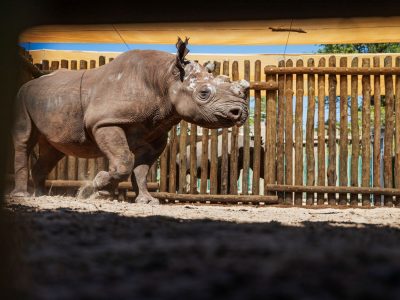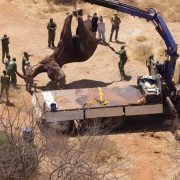

A year ago today, rangers found a black rhino calf at the bottom of a cliff in Kenya. He had been there two nights, beside the body of his mother, who had fallen. The Kenya Wildlife Service brought him out and handed him to the Sheldrick Wildlife Trust’s Nairobi Nursery. He weighed 300 kilograms, about 660 pounds, and he was still on milk.
On September 9, 2026, the Trust published his first year. He now weighs close to 450 kilograms, roughly 990 pounds, and the most interesting thing in the update is not the weight. It is how ordinary his days have become.
What a year of hand-rearing a rhino actually looks like
Raising a milk-dependent rhino calf is a long job measured in stages rather than months. The Trust’s own account of the process puts the first turning point at three to four years old, when a calf’s stockade doors can be left open at night so it can walk out and meet the wild rhinos of Nairobi National Park on its own terms, with a familiar base to come back to. Full independence can take up to eight years.
Tytan is one year into that. He spends his days grazing in the forest and crunching thorny bush, and he takes naps on the forest floor with his Keepers sitting watch. Three months ago he had an operation to remove a suspected granuloma from his mouth, a growth of inflamed tissue. The Trust reports him eating without any sign of discomfort since, and still checking the mouth regularly, which is the part of veterinary care that never makes a headline and is most of the work.
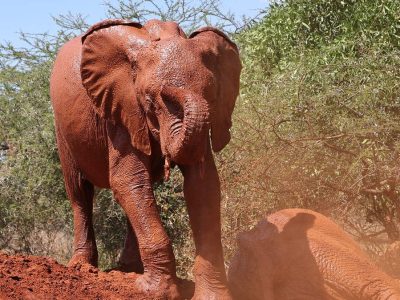
He is also, by the Trust’s description, becoming a black rhino rather than a pet. He ignores the orphaned elephants and occasionally charges at them. One morning last month, five of them, Muridjo, Mzinga, Zuri, Daba and Kipekee, gathered outside his gate and put their trunks through the gaps to steal his lucerne. Tytan watched from a corner and let them. On another morning, Arthi reached under the gate for extra range cubes, and Tytan charged, and Arthi withdrew his trunk.
The zebra who was rescued a week later
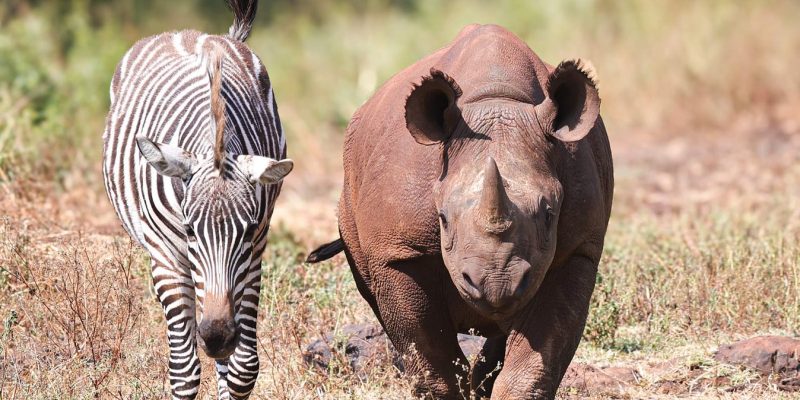
One week after Tytan arrived, a zebra foal came into the Nursery. Her mother had died the same way, falling from a cliff. The Keepers named her Notty, and the two of them became inseparable.
A year on, they still spend their days together and are growing apart in the only way that matters, which is that each is turning into its own species. Tytan lumbers and rarely breaks into a jog. Notty skips, canters off to look at wild zebra, and hovers at the edge of the elephant herd because she finds elephants interesting. Tytan does not.
That divergence is the point of the whole exercise. A hand-reared animal that stays fixed on people, or on the wrong species, is a hand-reared animal that cannot be released. Two orphans keeping each other company while separately learning to be a rhino and a zebra is exactly the outcome a nursery is built to produce.
Maxwell, and why two male rhinos in one place is interesting
The Nairobi Nursery already had a resident male black rhino. Maxwell is blind, has lived at the Nursery for years, and has a large enclosure of his own. He did not welcome an upstart.
The Trust describes the first months as a battle of the middens, the dung piles rhinos use to advertise themselves, followed by territorial skirmishes of head-butting, dust-kicking and charging in circles by both animals. Then, at the end of June, something quieter. Max stood on one side of his gate and Tytan on the other. Max pushed his horn through a gap, and Tytan held the horn in his mouth. The two of them stood still for a few minutes. Then Tytan walked off to the forest and Max went back to his pellets.
The Trust calls it an armistice and expects it to be short. It is also a fair picture of what a well-run nursery does: it gives a young animal a same-species neighbor to argue with through a fence, which is how a rhino learns what other rhinos are for.
Is there zoo money behind this?
We check every conservation and rescue story in this region for the accredited zoos and aquariums funding it, because in this part of the world the money very often comes from an institution in North America or Europe that never appears in the announcement. On this one, we looked and we did not find any.
The rescue was carried out by the Kenya Wildlife Service, a Kenyan government agency. The rearing is the Sheldrick Wildlife Trust’s own Nairobi Nursery, its own Keepers and its own veterinary unit. The Trust names no zoo, aquarium or zoological society as a funder or partner on its public pages, and we found none naming the Trust. Its orphan work is paid for by public adoptions, individual donors and corporate supporters. That is a real answer rather than a gap in our reporting, and it is worth saying plainly, because the alternative is implying a connection that is not there.
It is worth putting next to the scale of what accredited institutions do spend. The Association of Zoos and Aquariums reports that in 2025 its 235 accredited and certified facilities spent approximately $372.4 million on conservation across 139 countries. No published breakdown isolates an African share of that, so we are not going to invent one. What we can say is that black rhinos in accredited care and black rhinos in Kenyan nurseries are two halves of one species program running on entirely separate funding chains, and readers who want the other half can read about the eastern black rhino calf at Sedgwick County Zoo.
How endangered is the black rhino?
The Trust’s update gives no conservation category, so there is nothing here to correct, only something to add. The IUCN Red List assesses the black rhino, Diceros bicornis, as Critically Endangered. IUCN’s own account of the assessment reports that the continental population grew from an estimated 4,845 animals in 2012 to 5,630 in 2018, and that between 2018 and 2021 it rose again by just over 12 percent, from 5,495 to 6,195. Kenya’s black rhinos belong to the eastern subspecies, Diceros bicornis michaeli.
Both things are true at once: a Critically Endangered animal, and a population that has been climbing for more than a decade. IUCN’s own framing was cautious hope, and it credited sustained anti-poaching work and intensive population management rather than any single intervention. Seventeen rhinos have been rescued and returned to the wild by the Sheldrick Wildlife Trust to date, with two more currently in its care. Tytan is one of the two.
Seven years from now, if the plan works, he will stop coming back to the stockade at night. In the meantime he is a 450-kilogram one-year-old who naps in the forest beside a zebra and gives way to five elephants over a pile of lucerne, and that is a good enough year.
Source: the Sheldrick Wildlife Trust, Tytan’s First Rescueversary, published September 9, 2026, and its Raising An Orphan Rhino project page. Red List category and population figures from IUCN’s account of the black rhino assessment.
Quick answers
- How was Tytan the black rhino rescued?
The Kenya Wildlife Service found him at the bottom of a cliff in September 2025, where he had spent two nights beside his mother's body after she suffered a fatal fall. He was taken to the Sheldrick Wildlife Trust's Nairobi Nursery.
- How much has Tytan grown in a year?
He arrived weighing 300 kilograms, about 660 pounds, and by September 2026 weighed close to 450 kilograms, roughly 990 pounds. He also had an operation three months ago to remove a suspected granuloma from his mouth.
- How long does it take to release a hand-reared rhino?
The Sheldrick Wildlife Trust leaves stockade doors open at night once a calf is three to four years old, so it can meet wild rhinos on its own terms. Full independence can take up to eight years.
- Do any accredited zoos or aquariums fund the Sheldrick Wildlife Trust?
We looked and did not find any. The rescue was carried out by the Kenya Wildlife Service and the rearing is the Trust's own staff, funded by public adoptions, individual donors and corporate supporters. No zoological institution is named by either side.
- How endangered is the black rhino?
The IUCN Red List assesses Diceros bicornis as Critically Endangered. IUCN reports the continental population rising from 4,845 animals in 2012 to 5,630 in 2018, and from 5,495 in 2018 to 6,195 in 2021. Kenya's animals are the eastern subspecies.