
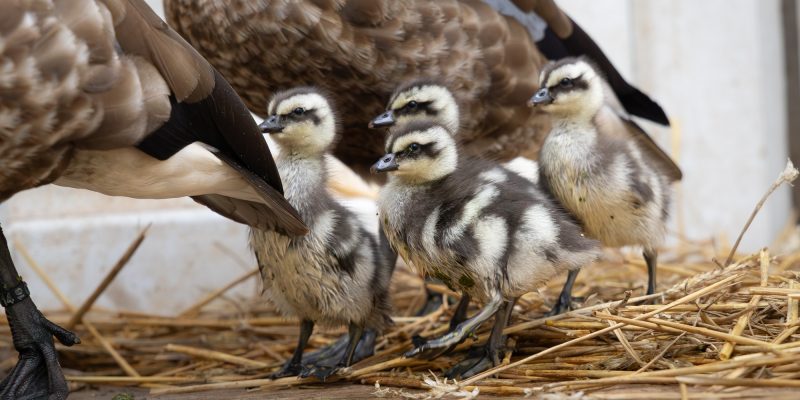
There are four blue-winged goslings in a box in the Tropical Wetlands pavilion at Safari Park Dvur Kralove, and the keepers are photographing them on a schedule. Not for the website. For Ethiopia.
The blue-winged goose lives nowhere in the wild except the Ethiopian highlands. Safari Park Dvur Kralove has a monitoring project running there, through its Research Institute for Gene Pool Protection, and the problem with monitoring a bird in the field is that you cannot tell how old the bird you are looking at is. A young goose photographed at short, known intervals from hatching gives you a reference series. Match a wild bird against it and you have an age.
We photograph them regularly at short intervals. Thanks to that we will be able to determine much more easily the age of birds monitored in the wild, and get a more accurate picture of the state of the population and its annual life cycle.
That is Michal Podhrazsky, a zoologist at Safari Park Dvur Kralove, in a statement translated from Czech. The original reads: “Pravidelne je fotografujeme v kratkem odstupu. Diky tomu pak budeme moci mnohem snaze urcit vek ptaku sledovanych v prirode a ziskat presnejsi prehled o stavu populace i jeho rocnim zivotnim cyklu.”
Why you cannot go and see them
The goslings are not on display, and the reason is the parents.
While the young are being reared it is essentially necessary to move the adult pair out of the aviary away from the other birds, because blue-winged geese are very aggressive and will attack practically anything that comes near the nest.
Podhrazsky again, translated from Czech. The pair reared young last season too, which is part of why this brood matters: a proven pair in a species that almost never breeds in collections.
How rare this is in zoos
Roughly fifty blue-winged geese are held across twelve institutions registered in ZIMS in Europe. Podhrazsky runs the European breeding program for the species under EAZA authorization, and he describes the primary goal in unglamorous terms: find new holders and assemble functioning breeding pairs. With fifty birds in twelve places, that is not easy.
Hatchings happen in a handful of collections. Four goslings is a meaningful fraction of a year’s European production.
The bird itself, and what the Red List says
The zoo’s announcement describes a species losing habitat under rising human pressure in its only range, and does not assign it a Red List category. For the record: the IUCN Red List, through BirdLife International, assessed the blue-winged goose as Near Threatened in 2022, with 3,000 to 7,000 mature individuals and a decreasing trend, across a breeding range of about 370,000 square kilometers. It is an Ethiopian breeding endemic and an altitudinal migrant.
Near Threatened is not the brink. That is worth stating plainly, because the interesting thing here is not a lifeboat argument. It is that a zoo with a research institute noticed a specific gap in field data, worked out that the fix was a camera and a calendar, and had the animals on hand to do it. That is a different and better claim than “we are saving the species,” and it is the one the zoo actually made.
What the announcement does not say
Dvur Kralove does not give a hatch date for the four goslings, does not say how many photographs the reference series will need or at what intervals, and does not say when the Ethiopian monitoring project began or who funds it. It does not say whether the goslings will stay at Dvur Kralove or move to other collections under the breeding program.
The park is a regular in this kind of work. It also runs the international studbook for other African species and, this summer, began keeping green mambas.
Source: Safari Park Dvur Kralove, August 6, 2026. Red List category, assessment year, population estimate and range from the BirdLife International species factsheet for Cyanochen cyanoptera.
Quick answers
- Why is Safari Park Dvur Kralove photographing its goslings?
To build an age reference series. Four blue-winged goslings are photographed at short, known intervals from hatching, so that a wild bird photographed in Ethiopia can be matched against them and aged. The park runs a monitoring project there through its Research Institute for Gene Pool Protection.
- Can visitors see the goslings?
No. The adult pair had to be moved out of the aviary away from other birds during rearing, because blue-winged geese are highly aggressive and will attack almost anything that approaches the nest.
- How rare is the blue-winged goose in zoos?
About fifty birds across twelve institutions registered in ZIMS in Europe. Safari Park Dvur Kralove's zoologist Michal Podhrazsky runs the European breeding program for the species under EAZA authorization.
- What is the blue-winged goose's conservation status?
The IUCN Red List, through BirdLife International, assessed it as Near Threatened in 2022, with 3,000 to 7,000 mature individuals and a decreasing trend. It breeds only in the Ethiopian highlands.