
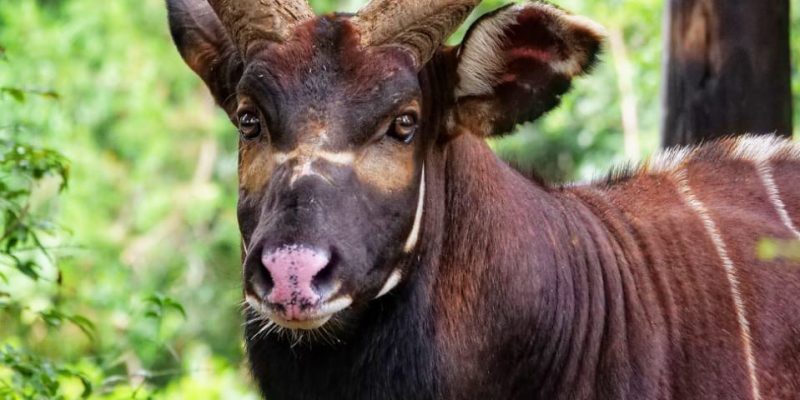
Kenya has a new plan to save its rarest large mammal, and the animals it will be built from are living in zoos. On September 23 at the Mount Kenya Wildlife Conservancy in Nanyuki, Cabinet Secretary for Tourism and Wildlife Hon. Rebecca Miano launched the second edition of the National Recovery and Action Plan for the Mountain Bongo, covering 2026 to 2030, and opened the IUCN Species Survival Commission Steering Committee meeting on the same day.
The Kenya Wildlife Service puts the wild population at fewer than 100 animals, down from roughly 500 in the 1970s. It also states the fact that makes this a zoo story: there are more mountain bongos in zoos around the world than there are in the Kenyan forests they came from.
What Kenya actually launched
The plan sets two numbers. The near one is a 50 percent increase in the national mountain bongo population by 2030. The far one is a self-sustaining wild population of 750 animals by 2075, a fifty-year commitment written by a government that will be several administrations removed from it long before the target date.
KWS Board Chair Hon. Joseph Lagat and Director General Prof. Erustus Kanga joined the launch, alongside researchers, conservation partners and community representatives. The service frames the bongo as a flagship for the highland forests of the Aberdares, Mount Kenya and the Mau Forest Complex, which are the catchments that feed Kenya’s rivers. Protect the antelope, the argument runs, and you protect the water towers.
Two recent developments sit underneath the plan. One is a previously unrecorded breeding population found in the Maasai Mau forest, carrying genetic lines KWS says are found nowhere else. The other is the steady return of captive-bred animals from abroad.
The breeding herd came home from zoos, twice
The Mount Kenya Wildlife Conservancy has run a mountain bongo breeding program since 2004. It started with 18 animals repatriated from North America under the American Zoo and Aquarium Association’s Bongo Species Survival Plan, coordinated with the Rare Species Conservatory Foundation. Fort Worth Zoo staff were central to that operation, handling the coordination, screening, transport and repatriation of the 18 bongos, and the animals were consolidated at White Oak Conservation in Florida before they flew.
Those 18 became a herd. The conservancy reported 101 bongos as of March 2026, and the recovery program has now recorded its 100th birth. The Mawingu Mountain Bongo Sanctuary, a 776-acre block of protected forest inside the species’ former range, works as the halfway house where captive-bred animals are prepared for life outside a fence.
A second American shipment followed in February 2025, when 17 bongos, 12 females and five males, arrived from the Rare Species Conservatory Foundation’s Florida facility and went to the Marania and Mucheene sanctuary in Meru County.
Four males, five European zoos, one coordinator
The most recent addition came from Europe. Under the EAZA Ex situ Program, which manages mountain bongos across 47 accredited European institutions, four young males were flown to Kenya at the turn of April and May 2026. They were received at Jomo Kenyatta International Airport by the Kenya Wildlife Service and taken to the Mount Kenya Wildlife Conservancy.
The animals came from Prague Zoo, National Zoo Bojnice in Slovakia, Zoo Frankfurt, Tierpark Berlin and Givskud Zoo in Denmark. Safari Park Dvůr Králové in Czechia organized the transport on EAZA’s behalf and quarantined the animals in its own approved export facility. In the park’s English-language account of the project, every male selected carries Dvůr Králové bloodlines, tracing back to bongos its former director Josef Vágner brought out of Kenya in the early 1970s; the park says 109 calves have been born there since 1974. It also funds the Kenyan conservancy directly, through a charity run and a dedicated wildlife account.
The selection itself was made by the program coordinator based at Chester Zoo in the United Kingdom, working with the EEP species committee on genetics, mean kinship, age and behavior.
“The mountain bongo is one of Africa’s rarest large mammals and, with fewer than 100 thought to remain in the wild, they are perilously close to extinction in the wild,” said Dr Nick Davis, the Mountain Bongo EEP Coordinator at Chester Zoo. “Collaborations like this are essential if we are to prevent this magnificent species disappearing altogether.”
Prague Zoo’s curator of ungulates, Barbora Dobiášová, describes the transfer as closing a circle between breeding animals in human care, conservation in the field, and what visitors learn from seeing the species at home in Prague. Her zoo has supported bongo habitat restoration, research and monitoring with the Kenyan conservancy for several years.
This is the same shape as the scimitar-horned oryx returned to Chad, a project that began with zoo-held animals and ended in a Red List downlisting, which we wrote about when the assessment changed. The bongo is roughly where the oryx was two decades ago.
A note on the numbers
The service’s own two accounts of the launch do not agree with each other. One says 66 to 100 animals remain in the wild; the other, published the same day, says fewer than 65. Chester Zoo says fewer than 100. We have used the “fewer than 100” framing because it is the figure all three sources can carry.
The IUCN Red List is a separate question. Its current global assessment treats the bongo as a single species, Tragelaphus eurycerus, and lists it as Near Threatened, with 15,000 to 25,000 mature individuals and a decreasing trend, assessed on July 7, 2016 by the IUCN SSC Antelope Specialist Group, with an errata version published in 2017. That figure is dominated by the far more numerous lowland bongo of Central and West Africa, and the Red List does not currently carry a separate global entry for the Kenyan subspecies, Tragelaphus eurycerus isaaci. So the Critically Endangered category everyone uses here is a statement about the mountain bongo in particular, not a reading off the global list. Both are true at once, and the global assessment is now ten years old.
Which zoos are actually paying for this
Nine accredited institutions are named above, and each of them either supplied an animal, held one in quarantine, ran the selection, moved the shipment or funds the Kenyan conservancy. That is unusually easy to trace. Most African conservation stories are not like this. The organization doing the work is a national agency or an NGO, and no zoological institution appears anywhere in the credit line.
The Association of Zoos and Aquariums reports that in 2025 its 235 accredited and certified facilities spent approximately $372.4 million on conservation across 139 countries. No published breakdown isolates how much of that reached Africa, so we are not going to estimate one. What can be said about the mountain bongo is narrower and firmer: without the herds built in North American and European zoos over the last fifty years, Kenya would not have the animals to write this plan around.
Quick answers
- What did Kenya launch on September 23, 2026?
The second edition of the National Recovery and Action Plan for the Mountain Bongo, covering 2026 to 2030. Cabinet Secretary for Tourism and Wildlife Hon. Rebecca Miano launched it at the Mount Kenya Wildlife Conservancy in Nanyuki, and opened the IUCN Species Survival Commission Steering Committee meeting the same day.
- How many mountain bongos are left in the wild?
Fewer than 100. The Kenya Wildlife Service published two accounts of the launch on the same day, one giving 66 to 100 animals and the other fewer than 65; Chester Zoo says fewer than 100. In the 1970s the population was around 500. There are more mountain bongos in zoos worldwide than in Kenya's forests.
- What does the plan commit to?
A 50 percent increase in the national population by 2030, and a self-sustaining wild population of 750 animals by 2075. It also covers protected forest, monitoring, breeding and reintroduction, and community involvement.
- Which zoos are behind the Kenyan breeding herd?
Nine accredited institutions are named in this story. Fort Worth Zoo staff coordinated, screened and transported the 18 bongos repatriated from North America in 2004, which were consolidated at White Oak Conservation. Prague Zoo, National Zoo Bojnice, Zoo Frankfurt, Tierpark Berlin and Givskud Zoo each supplied one of the four males sent in spring 2026, Safari Park Dvůr Králové organized and quarantined that transport, and Chester Zoo's EEP coordinator selected the animals.
- How big is the conservancy's herd now?
The Mount Kenya Wildlife Conservancy reported 101 mountain bongos as of March 2026, grown from the 18 animals it received in 2004, and the recovery program has recorded its 100th birth. The 776-acre Mawingu Mountain Bongo Sanctuary is where captive-bred animals are prepared for life in the wild.
- What does the IUCN Red List say?
Its current global assessment covers the bongo as one species, Tragelaphus eurycerus, and lists it as Near Threatened with 15,000 to 25,000 mature individuals and a decreasing trend, assessed July 7, 2016 with a 2017 errata version. That figure is dominated by the lowland bongo of Central and West Africa. The Red List carries no separate current global entry for the Kenyan subspecies, so the Critically Endangered category used here describes Tragelaphus eurycerus isaaci specifically.