
In December 2015, fourteen scimitar-horned oryx were coaxed into custom-made crates at Marwell Zoo in Hampshire and flown to the United Arab Emirates. Six of them had been born at Marwell. Two Marwell keepers went with them.
Ten years later the species is no longer Extinct in the Wild, and Marwell has published its own account of what it contributed and what it did not.
What Marwell actually did
The reintroduction of scimitar-horned oryx to Chad was a joint initiative of the Environment Agency of Abu Dhabi and the Government of Chad, implemented on the ground by Sahara Conservation. Marwell Wildlife was one of the supporting partners, and its job was upstream of the desert entirely.
The releases drew on a World Herd assembled at Deleika in the UAE under the direction of the Environment Agency of Abu Dhabi. A reintroduced population founded on too few bloodlines carries its founders’ genetic problems forever, so the herd had to be built deliberately. Dr Tania Gilbert, then the coordinator of the EAZA Ex Situ Programme for the species and now Marwell’s head of conservation science, selected fourteen oryx from European zoos whose genetic variation would strengthen it.
In the autumn of 2014, eight oryx from six European zoos arrived at Marwell to join six of Marwell’s own animals ahead of the onward journey. That doubled the size of the zoo’s herd. For a period Marwell held almost thirty oryx across several habitats.
The bachelor herd problem
The detail Marwell chose to tell on is the one a press release usually leaves out. Scimitar-horned oryx form mixed-sex herds in the wild and rarely gather in all-male groups. Where they do, competition for dominance can turn physical, and group dynamics can break down quickly and without warning. Marwell’s hoofstock keepers watched the bachelor group closely for the length of its stay.
The bonds held. That is the whole story of that year: nothing happened, on purpose, to animals that were only passing through.
What happened in Chad
By August 2016 the first group of oryx had been released into the Ouadi Rime-Ouadi Achim Faunal Reserve in Chad. The first wild birth was recorded a month later.
Marwell’s own animals were not in those first releases. Their offspring were. The genetic work done in Hampshire and Deleika reached the desert one generation later than the animals did, which is the ordinary shape of this kind of contribution and the reason it is easy to miss.
A note on the numbers
Marwell’s August 2026 article says the population “numbers around 600 animals” and that the species has been reassessed on the IUCN Red List to Endangered from Extinct in the Wild. Both statements are accurate. The framing places them in 2026, and they are older than that.
The downlisting happened in 2023. Sahara Conservation’s own announcement of it records more than 600 oryx in Chad at that point, and states that the Environment Agency of Abu Dhabi has translocated 285 oryx into the wild in Chad since 2016. So “around 600” is the figure that belongs to the assessment three years ago rather than a current count, and we have found no published 2026 census to replace it. Where a facility’s wording and the assessment differ, we use the assessment and say which year it comes from.
None of that diminishes the anniversary. A species that existed only in captivity is breeding in the Sahel, partly because somebody in Hampshire spent a winter keeping fourteen antelope calm. We covered the downlisting itself when Sahara Conservation announced it, and the American side of the same World Herd through the Smithsonian’s research herd.
Tunisia is the longer story
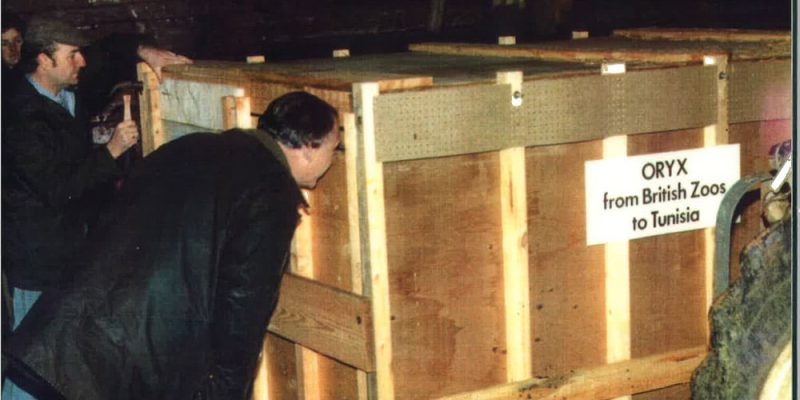
Chad is not where Marwell’s involvement with this animal starts. The zoo has managed scimitar-horned oryx herds since the early 1970s, sending animals to other collections worldwide, and has coordinated both the EAZA Ex Situ Programme and the International Studbook for the species. It ran oryx reintroductions in Tunisia in 1985, 1999 and 2007, and has worked there since with the Direction Generale des Forets, alongside other Tunisian and international partners, to restore habitat for oryx and the wider landscape.
Forty years of it, for one antelope.
What the article does not say
Marwell gives no cost for its part of the work, no current population figure of its own, no survival rate for the released animals or their descendants, and does not say how many of the fourteen oryx it sent to Deleika are still alive. It does not name the six European zoos that sent animals through Hampshire in 2014.
Source: Marwell Zoo, August 14, 2026. Downlisting year, Chad population and translocation total from Sahara Conservation.
Quick answers
- What did Marwell Zoo contribute to the Chad oryx reintroduction?
It hosted and sent fourteen scimitar-horned oryx to the World Herd at Deleika in the UAE in December 2015, six of them Marwell-born. Eight more arrived from six European zoos in autumn 2014 and were held at Marwell first. Marwell also coordinated the EAZA Ex Situ Programme and the International Studbook for the species.
- Is the scimitar-horned oryx still Extinct in the Wild?
No. The IUCN Red List downlisted it to Endangered in 2023 after the reintroduction to Chad. It had been listed as Extinct in the Wild since 2000.
- How many scimitar-horned oryx are in Chad now?
Sahara Conservation recorded more than 600 at the time of the 2023 downlisting and says the Environment Agency of Abu Dhabi has translocated 285 oryx into the wild in Chad since 2016. We have found no published 2026 census.
- Where were the oryx released?
The Ouadi Rime-Ouadi Achim Faunal Reserve in Chad, starting August 2016. The first wild birth was recorded a month later.