
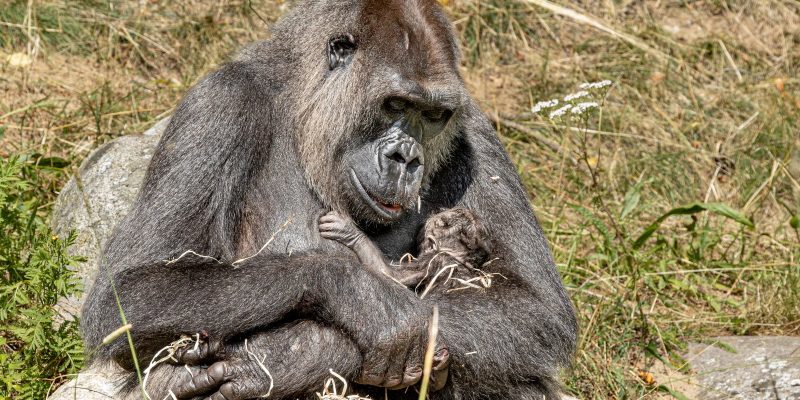
On July 29, 2026, a western lowland gorilla was born at Givskud Zoo – Zootopia in Denmark. It is the first infant in the park’s gorilla group in six years, and the first offspring for Baako, the group’s new silverback. Givskud is the only zoo in Denmark that keeps gorillas, which makes the birth a national event as well as a studbook one.
A new male, and his first infant
The mother is Minnie. The zoo says the infant spent its first days pressed close to her, which is why it had not been sexed when the announcement went out. It had not been named either.
Baako came to Givskud as the group’s breeding male and is a father for the first time. The zoo says he contributes genes that were thinly represented in the European population of western lowland gorillas, which is the reason a male gets moved between collections in the first place.
“Det er helt fantastisk, at vi har faaet en gorillaunge fra vores nye avlshan,” said Rasmus S. Nielsen, director of Givskud Zoo – Zootopia. “Det er resultatet af et dygtigt og engageret dyrepasserarbejde.” In English, in a statement translated from Danish: “It is absolutely fantastic that we have got a gorilla infant from our new breeding male. It is the result of skilled and committed keeper work.” Nielsen went on to call the infant an important link in the work European zoological institutions do to secure a healthy and sustainable population of critically endangered western lowland gorillas.
The rest of the group had to move first
A birth like this one is the last step in a sequence that starts with rearranging the animals. The group’s previous young, a male called Kijani and a female called Malkia, were born six years ago. When Baako was introduced, Kijani was taken out of the group, and Malkia joined her brother so he would not be alone. Givskud says Kijani travels on to another zoo later this year, after which Malkia goes back into the main group.
The zoo describes the two young animals living apart as a normal part of their development, and says it also gave the group the dynamic it needed, with Baako now setting the terms. That is the unglamorous half of a breeding recommendation, and it is usually the half that is left out of the announcement.
Where the species actually stands
The IUCN Red List assesses the western gorilla, Gorilla gorilla, as Critically Endangered globally, with a decreasing population. We read that entry directly rather than taking it from the release. The western lowland gorilla is the more numerous of the western gorilla’s two subspecies, and Givskud’s description of the animals in its care as critically endangered is accurate, which is worth saying plainly given how often a facility’s category and the assessment do not line up.
Givskud puts the number of western lowland gorillas left in the wild at several hundred thousand, and names poaching, disease including ebola, and habitat loss as the pressures on them. That population figure is the zoo’s; we did not open the full species assessment for a count, so we are not attaching it to the Red List.
The money behind the Cameroon end
Givskud Zoo Naturfond, the park’s own nature foundation, has supported gorilla protection in Cameroon since 2009 through the Limbe Wildlife Center, a rescue and rehabilitation center for wild animals. The foundation’s money there pays for teaching local representatives and for outreach work. The mechanism is a familiar one in Europe: 10 Danish kroner from every admission ticket sold at Givskud goes automatically to the foundation, which distributes it across conservation projects each year.
That is a smaller and more traceable chain than most. It is also the kind of link that is easy to miss from the outside, because the zoo’s name does not appear on the field project’s own materials. Compare the tangle of institutions behind the first wild birth to a rehabilitated Grauer’s gorilla in Virunga, where the funders of one translocation had to be separated from the funders of the organization as a whole.
What has and has not been said since
Six weeks have passed since the announcement. Givskud has published nothing further about the infant: the park’s news page carries items from August 9, August 13, August 18, August 24 and September 8, and none of them mentions the gorillas. We checked the Danish coverage from the day of the birth as well and found no later update. So the position as of this writing is the position in the release. The infant had not been sexed, it had not been named, and the zoo has not said otherwise since.
Source: Givskud Zoo – Zootopia, with the conservation category read from the IUCN Red List.
Quick answers
- When was the gorilla born at Givskud Zoo?
July 29, 2026. Givskud Zoo - Zootopia announced the birth the same day. It is the first infant in the park's gorilla group in six years, and the first offspring for Baako, the group's new silverback. The mother is Minnie.
- Is the infant male or female, and does it have a name?
Neither was stated. The zoo said the infant was still pressed close to its mother and had not been sexed when the announcement went out, and it was not named. Givskud has published nothing further about it since, and we found no later update in the Danish coverage.
- How threatened is the western lowland gorilla?
The IUCN Red List assesses the western gorilla, Gorilla gorilla, as Critically Endangered globally, with a decreasing population. The western lowland gorilla is the more numerous of its two subspecies. Givskud puts the wild population at several hundred thousand; that figure is the zoo's, not the Red List's.
- Does Givskud Zoo fund gorilla conservation in the wild?
Yes. Givskud Zoo Naturfond has supported gorilla protection in Cameroon since 2009 through the Limbe Wildlife Center, paying for teaching local representatives and for outreach. Ten Danish kroner from every admission ticket goes to the foundation automatically.