Seven satellite tags are now riding the dorsal fins of sharks off Alphonse Atoll, and the question they were fitted to answer is a simple one with awkward implications: when a shark leaves a marine protected area, where does it go, and who is fishing there?
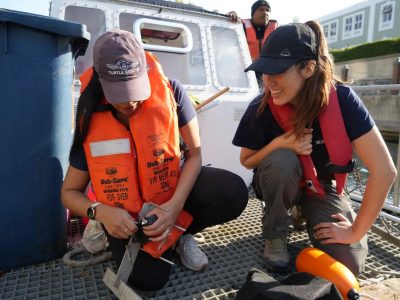
The Island Conservation Society announced the tagging project on November 4. It is working with Dr Nico Fassbender, a shark scientist affiliated with the University of Western Australia, and the plan is ten tags in total across several species in the waters around Alphonse, in the Seychelles outer islands.
Two kinds of tag, two kinds of answer
The project uses SPOT tags and SPLASH tags, and the difference between them is a trade the team has made deliberately. A SPOT tag records location and temperature and is expected to keep transmitting for around eighteen months. A SPLASH tag adds depth and diving behavior, so it shows how an animal uses the water column rather than just where it is on a map, but it runs about six months.
Both are bolted to the dorsal fin and transmit when the fin breaks the surface, with the data relayed by orbiting satellites. For an animal that can dive to considerable depths and cross hundreds or thousands of kilometers of the Indian Ocean, that surfacing moment is the entire data link.
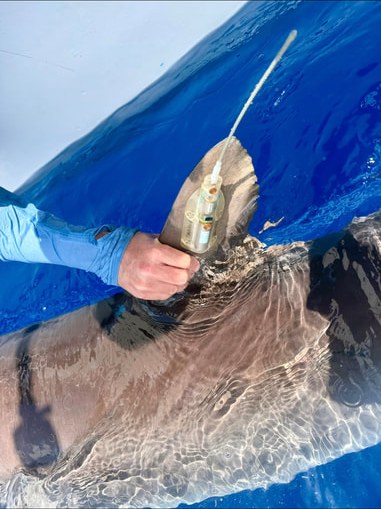
Despite difficult sea conditions the team has deployed seven of the ten, and says early results are already showing differences between individual animals.
Overlaying sharks on fishing fleets
The analysis is where this becomes a management question rather than a natural history one. By comparing the tracks against commercial fishing activity, the researchers intend to identify where these animals are most exposed to longline and purse-seine operations, whether as targets or as bycatch. They also want to measure how much time the sharks actually spend inside marine protected areas.
That second measurement is the one with teeth. An MPA drawn on a chart only protects an animal that stays inside it, and for wide-ranging pelagic predators nobody can assume that without the data. A protected area that an animal leaves for most of the year is protecting it for a fraction of the year.
Which sharks
The Island Conservation Society names bull sharks (Carcharhinus leucas), dusky sharks (Carcharhinus obscurus), silky sharks (Carcharhinus falciformis), tiger sharks (Galeocerdo cuvier) and makos.
On the mako we have to be careful. The announcement reads “Shortfin Makos (Isurus paucus)”, and those two names belong to different animals: Isurus paucus is the longfin mako, while the shortfin mako is Isurus oxyrinchus. From the announcement alone there is no way to tell which species was tagged, so we are not going to pick one. It makes no difference to the conservation picture, as it happens, because both makos carry the same category. This is almost certainly a typing slip in a release written by a small field team, and it is the kind of thing worth correcting quietly rather than scoring points over.
The categories, by species: bull shark Vulnerable, dusky shark Endangered, silky shark Vulnerable, tiger shark Near Threatened, and both mako species Endangered. We are giving the categories alone, without assessment years, criteria or population trends, because the IUCN Red List’s species pages returned an access error from both of the machines we check from on the day this was written. These are the categories republished by GBIF alongside their IUCN taxon identifiers, which makes them a second party publishing the same data rather than our account of documents we could not open.
Three Endangered or Vulnerable species in one tagging program is a reasonable summary of what has happened to the open-ocean sharks of the western Indian Ocean.
Which zoos pay for this?
None that we could verify. We checked the Island Conservation Society’s about and projects pages, and its partners and donors pages both return a 404. Nothing we could open names an accredited zoo or aquarium as a funder of this work or of ICS generally. The one named external collaborator on the shark project is a university scientist.
That is a finding rather than a gap. Accredited zoos and aquariums fund a great deal of field research, and the Association of Zoos and Aquariums reports that in 2025 its 235 accredited and certified facilities spent approximately $372.4 million on conservation across 139 countries. No published breakdown isolates an African or Indian Ocean share, and we are not going to estimate one. On the evidence available, the satellite tags off Alphonse were not paid for by a zoo.
We have covered this organization’s work on the same atoll before, when it moved 187 tortoises so that a rat eradication could go ahead.
Source: Island Conservation Society, November 4, 2026.
Quick answers
- What is the Alphonse shark tagging project?
A satellite-tracking study run by the Island Conservation Society with Dr Nico Fassbender, a shark scientist affiliated with the University of Western Australia, in the waters around Alphonse Atoll in the Seychelles. It was announced on November 4, 2026.
- How many sharks have been tagged?
Seven of a planned ten, deployed despite difficult sea conditions. Early results are already showing differences between individual animals.
- What is the difference between a SPOT tag and a SPLASH tag?
A SPOT tag records location and temperature and is expected to transmit for about eighteen months. A SPLASH tag adds depth and diving behaviour, showing how an animal uses the water column, but runs about six months. Both attach to the dorsal fin and transmit when the fin breaks the surface.
- What is the research question?
Where pelagic sharks go when they leave protected water, and who is fishing there. By comparing tracks against commercial longline and purse-seine activity, the team wants to find where the animals are most exposed, and to measure how much time they actually spend inside marine protected areas.
- Which species are being tagged?
Bull sharks, dusky sharks, silky sharks, tiger sharks and makos. The announcement gives the mako as "Shortfin Makos (Isurus paucus)", but Isurus paucus is the longfin mako and the shortfin mako is Isurus oxyrinchus, so which species was tagged cannot be determined from the release. Both are Endangered.
- What are the conservation statuses?
Bull shark Vulnerable, dusky shark Endangered, silky shark Vulnerable, tiger shark Near Threatened, and both mako species Endangered. We give the categories alone, without assessment years or criteria, because the IUCN Red List species pages returned an access error from both machines we check from. These are the categories GBIF republishes alongside their IUCN taxon identifiers.
- Do any zoos or aquariums fund this?
None that we could verify. The Island Conservation Society partners and donors pages both return a 404, and its about and projects pages name no accredited zoo or aquarium. The one named external collaborator is a university scientist.