
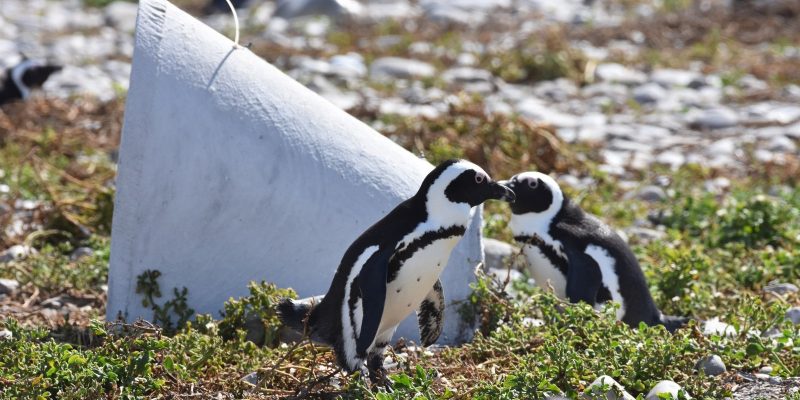
The artificial nests that African penguins are breeding in across South Africa and Namibia are designed by a curator at the Dallas Zoo and built by hand at a seabird hospital in Gansbaai. The Dyer Island Conservation Trust set out the history of the project in a piece published on November 25, and the chain it describes is the clearest example we have found this year of an accredited zoo funding, designing and sustaining field conservation on another continent.
It started as improvisation. Wilfred Chivell, who founded the Trust, began experimenting on Dyer Island with simple pipes and makeshift shelters, and noticed how quickly the penguins moved in.
Why do African penguins need a manufactured burrow?
Because the material they used to dig into is largely gone. African penguins historically built their nests in burrows dug in guano or sand, which gave them a cool, shaded, defensible chamber for an egg and a chick. Guano harvesting was carried out on the islands at significant scale before it was stopped, and birds without a burrow nest in the open, exposed to heat, rain and predators. An artificial nest is an attempt to put the ceiling back.
Getting that right is an engineering problem rather than a gesture. The current nests are built to ventilate and shed heat so the interior stays survivable for an adult, an egg and a chick through a South African summer. The Trust says the design has been through five generations, each revising materials, durability and ventilation.
The zoo in the middle of it
The Artificial Nest Project is run through the Association of Zoos and Aquariums’ Saving Animals From Extinction program, SAFE for short, and coordinated out of the Dallas Zoo. The nest itself was designed by Kevin Graham, an associate curator at the Dallas Zoo, who is also the project’s coordinator for AZA SAFE. On the South African side the nest project manager is Trudi Malan of the Dyer Island Conservation Trust and the African Penguin and Seabird Sanctuary. The third formal partner is the Pan-African Association of Zoos and Aquaria.
The project’s own account of how it arrived at the current design is a useful corrective to the idea that conservation hardware is obvious: fifteen designs were tested in the field before two were selected. Prototypes went into Bird and Dyer Islands in 2018, and larger numbers of the final design were delivered to nesting islands in 2019.
The sponsor list is longer than the partner list, and it is mostly accredited zoos and aquariums. The project names the Dallas Zoo, San Diego Zoo, Georgia Aquarium, Minnesota Zoo, Adventure Aquarium and Caldwell Zoo among its funders, alongside other institutions, several American Association of Zoo Keepers chapters, corporate donors and a school district. AZA’s own account of the program counts twelve AZA partners and five corporate sponsors, plus hundreds of individual donors. A Kickstarter campaign called Invest In The Nest raised $193,560 from more than 2,200 supporters in thirty days.
This is what a funder trace is supposed to look like when it works. Most conservation stories out of this region end with us reporting that we could not verify a zoo behind the work. This one has a zoo at the design table, a zoo coordinating the program, and a roll of zoos and aquariums paying for the materials.
Made in Gansbaai
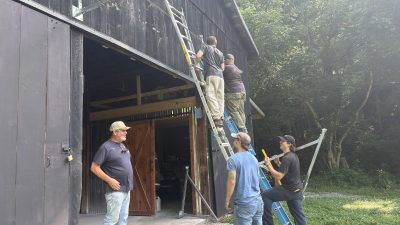
The manufacturing moved in mid-2024 from St Francis Bay to the African Penguin and Seabird Sanctuary at Gansbaai, where a construction team now makes the nests by hand before they are trucked to breeding colonies.
That matters more than a logistics note suggests. The sanctuary is the same building where the Trust’s rescue team brings in starving and injured birds, and we have written repeatedly this month about how hard it is keeping that hospital in fish. Nest production sits in the same budget and the same shed as the emergency work.
The nests go to Dyer Island, Stony Point, Bird Island, Boulders Beach, Robben Island and sites in Namibia. Set that list against the Red List assessment and it stops reading like a tour of nice places. Of 8,536 African penguin breeding pairs counted in South Africa in 2023, Dassen Island held 2,037, Bird Island in Algoa Bay 1,722, Stony Point 1,200, Robben Island 931, Dyer Island 903 and Simon’s Town, which is Boulders, 845. Those seven colonies hold almost 98 percent of the South African population. The nest project is supplying the places where the species still exists.
How many nests, and how well do they work?
On deployment the published numbers disagree, and neither page carries a date, so we will give both rather than pick one. AZA’s program account says 1,400 nests had been deployed with another 500 waiting and 400 to 500 more funded. The Dallas Zoo’s own species page says that since January 2018 the team has installed almost 1,700 nests across six colonies in South Africa. The Dallas Zoo figure is the larger and appears on the more recently updated page, so the true current total is probably at or above it, but nobody has published a figure with a date on it this year.
On performance, the AZA account reports a usage rate above 90 percent and chick success rates above 50 percent. Those are the project’s own figures and we have not seen an independent evaluation of them.
The number that frames all of this
The African penguin was uplisted to Critically Endangered on the IUCN Red List in 2024, under criteria A3bce+4bce. The 2023 estimate is 19,800 mature individuals, roughly 9,900 breeding pairs, and the trend is decreasing. For comparison, the historic estimate is 141,000 pairs in 1956 and 1957.
The Red List justification is explicit that the projected reduction exceeds 80 percent over three generations, driven principally by competition with commercial fisheries and climate-driven shifts in prey. The Trust’s own framing, that the African penguin is now Critically Endangered and every intervention matters, matches the assessment exactly, which is worth noting because facilities more often overstate a listing than get it right.
It is also the honest limit of this story. A nest does not produce a sardine. Nesting habitat is one of the pressures on this bird and it is the one that can be fixed with a mold and a team, which is precisely why the project exists and precisely why it cannot be the whole answer. Delegates at this year’s International Penguin Conference, which the Trust reported back from in September, came home with the line that not one penguin species is currently doing well.
If you want to pay for one
The Trust is selling nest sponsorships at R500 each, and visitors to the African Penguin and Seabird Sanctuary in Gansbaai can take part in the nest building. That is the Trust’s own appeal and we pass it on as one.
Quick answers
- Who designs the African penguin artificial nests?
Kevin Graham, an associate curator at the Dallas Zoo, who is also the nest project coordinator for the Association of Zoos and Aquariums’ Saving Animals From Extinction program. Fifteen designs were field tested before two were selected.
- Where are the nests made?
By hand at the African Penguin and Seabird Sanctuary in Gansbaai, South Africa, since production moved there from St Francis Bay in mid-2024. The Dyer Island Conservation Trust runs the sanctuary.
- Which colonies get them?
Dyer Island, Stony Point, Bird Island, Boulders Beach, Robben Island and sites in Namibia. Six of those hold a large majority of the South African breeding population.
- Do the nests work?
The project reports a usage rate above 90 percent and chick success rates above 50 percent. Those are its own figures and we have not seen an independent evaluation. Published deployment totals range from 1,400 to almost 1,700 nests and neither figure carries a date.
- How endangered is the African penguin?
The IUCN Red List uplisted it to Critically Endangered in 2024 under criteria A3bce+4bce. The 2023 estimate is 19,800 mature individuals, about 9,900 breeding pairs, against a historic estimate of 141,000 pairs in 1956 and 1957, and the trend is decreasing.