
The only emperor penguins in the Western Hemisphere no longer live in California. SeaWorld moved its emperor colony from San Diego to Orlando, and the birds went on view in the park’s Antarctica Realm on June 9, 2025.
For anyone who follows penguins in human care, this is not a routine animal transfer. It is the relocation of the most consequential emperor penguin program outside Antarctica, from the building where it was invented to a habitat rebuilt to receive it.
Why San Diego mattered
SeaWorld San Diego has been working with emperor penguins since the early 1980s, and it was the first zoological facility anywhere to breed the species successfully outside Antarctica. More than twenty emperor chicks have hatched there since 1980.
That record is harder than it sounds. Emperors breed on sea ice in the dark of the Antarctic winter, incubating a single egg on the male’s feet under a fold of skin for about two months, through the coldest conditions any bird breeds in. Reproducing anything like those cues in a building requires holding a room near freezing year-round and running an artificial light cycle that tracks the polar year rather than the local one.
The most recent chick was Pearl, who hatched on September 12, 2023 and was the first emperor hatched at the park since 2010. More than 29,000 people voted on her name.
What changed in Orlando
SeaWorld Orlando’s Antarctica Realm was upgraded before the birds arrived. The habitat is held at roughly 28 degrees Fahrenheit and runs light cycles that mimic Antarctic conditions rather than Florida ones, which is the specific requirement emperors bring with them and the reason they cannot simply be added to an existing penguin exhibit.
The area had already been through a rebuild. Antarctica reopened on May 25, 2024 after a renovation that included an updated penguin habitat, with the Penguin Trek coaster following on July 7. The emperor work came on top of that, a second pass at a building finished the year before.
What a building has to do to hold emperor penguins
Twenty-eight degrees is the easy part. Any refrigeration contractor can hold a room below freezing; the difficulty is holding it there, reliably, in central Florida, in a space that opens to the public all day and has to stay dry underfoot and clear of fog at the viewing glass. Cold air meeting Florida humidity is a condensation problem before it is an animal problem.
The light is harder. A penguin’s breeding physiology runs on photoperiod, so the habitat has to play the Antarctic year rather than the local one: months of near-continuous light, months of near-continuous dark, and the transitions in between, on a schedule offset from the sky outside the building. Get it wrong and the birds simply do not come into condition.
Then there is the water. Emperors are the deepest-diving birds in the world, recorded below 500 meters in the wild, and while no exhibit pool approaches that, the species still needs depth, chilled water and the filtration to keep it clean at temperatures where biological filtration works slowly.
None of this reads as spectacle from the walkway, which is rather the point. The visible part of an emperor penguin habitat is snow and birds. The rest is a plant room.
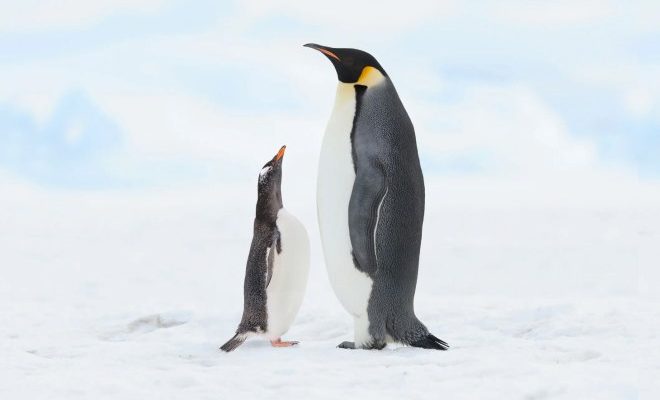
Six penguin species now live in the habitat. The emperors are the largest by a wide margin: an adult stands around four feet and can weigh 80 pounds, several times the weight of a gentoo.
“This is an incredibly rare and exciting opportunity for guests to encounter one of nature’s most extraordinary species,” said Jon Peterson, president of SeaWorld Orlando.
The birds came off public view in San Diego in May 2025 and debuted in Orlando the following month.
Orlando has been the landing place for other rare arrivals: the park took in Ukiaq, an orphaned Pacific walrus calf rehabilitated in Alaska, in September 2024.
Why emperor penguins are rare in zoos
Almost no facility outside Antarctica keeps them, and the reasons are practical rather than legal. The species needs sustained cold, a controlled photoperiod, and deep enough water to dive; emperors are the deepest-diving birds in the world, recorded below 500 meters in the wild. The husbandry knowledge behind all of that sits with a small number of people, most of whom learned it in one building in San Diego.
Consolidating the colony in one place puts the birds and that expertise together. It also means a visitor who wants to see an emperor penguin in this half of the world now has exactly one option.
What the move says about the species
The IUCN lists the emperor penguin as near threatened, and the pressure on it is not hunting or habitat destruction in the ordinary sense. It is ice.
Emperors breed on fast ice attached to the continent, and in parts of the range that ice is no longer reliably lasting as long as a breeding season needs. When it goes out early, chicks that have not yet grown waterproof plumage end up in the water.
Which is exactly why more than forty years of emperor penguin breeding at SeaWorld San Diego counts for something. That is a body of knowledge nobody else on this side of the world has, and it now sits in one place with the birds it was built around.
Go see them
Here is the thing worth saying plainly: you can walk into a building in Orlando, in Florida, and stand a few feet from an emperor penguin. There is nowhere else in this hemisphere you can do that.
They are enormous. Nearly four feet tall, up to 80 pounds, standing among five other penguin species that suddenly look like a different order of animal entirely. They have that upright, unhurried, faintly ceremonial way of moving that no photograph gets across.
The habitat is cold enough that you feel it on your face, the light is running an Antarctic clock, and the birds are doing what emperors do. Bring a jacket, and give it longer than you think you need.
Quick answers
- Where can you see emperor penguins in the United States?
Only at SeaWorld Orlando. The colony moved there from SeaWorld San Diego and went on view in the Antarctica Realm on June 9, 2025. It is the only group of emperor penguins on display anywhere in the Western Hemisphere.
- Why are emperor penguins so rare in zoos?
They need sustained cold near 28 degrees Fahrenheit, a light cycle that tracks the Antarctic year rather than the local one, and water deep enough to dive. The husbandry expertise involved sits with a small number of people, most of whom developed it at SeaWorld San Diego.
- Has SeaWorld bred emperor penguins?
Yes. SeaWorld San Diego was the first zoological facility anywhere to breed emperor penguins outside Antarctica, and more than twenty chicks have hatched there since 1980. The most recent, Pearl, hatched on September 12, 2023.
- Are emperor penguins endangered?
The IUCN lists them as near threatened. The main pressure is the loss of the fast ice they breed on: when the ice breaks up before chicks have grown waterproof plumage, entire colonies can fail.