
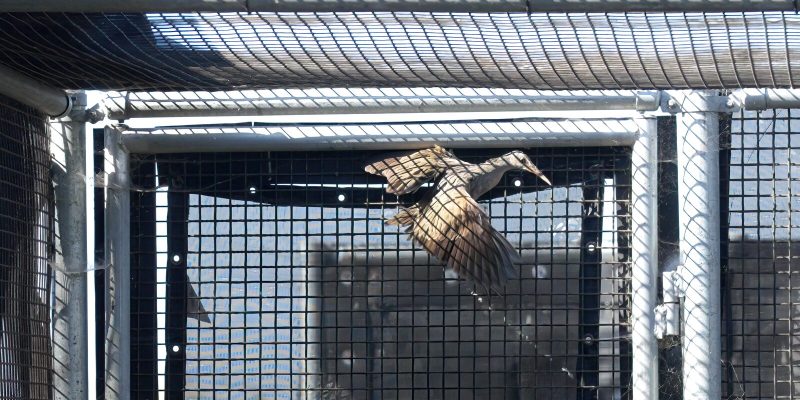
When SeaWorld San Diego moved two hand-raised Ridgway’s rails to a marsh near Chula Vista in August, the partnership behind the birds put its record at more than 400 released since 2000. The U.S. Geological Survey counts 655 released into southern California wetlands between 2001 and 2024.
Both numbers are right. The partnership is counting its own birds; the federal count covers every release into the program. Either way it is one of the longest-running bird augmentation programs in North America, and the most recent independent look at its genetics says something the press releases do not.
What the report found
USGS Open-File Report 2025-1011, by Amy Vandergast and colleagues, developed 54 microsatellite markers and used them to read the genetic structure of the light-footed Ridgway’s rail (Rallus obsoletus levipes) across its United States range. The headline result is encouraging. The birds sort into three regional genetic clusters, and gene flow between those clusters runs between 4.1 and 23.5 percent, a level the authors attribute in part to captive releases moving birds across marshes they could never have crossed on their own.
That is the case for the program, made with data rather than anecdote. A rail will not fly across a freeway. People carrying rails is the only connectivity this landscape has left.
And the part that stings
The report also compared today’s birds against DNA from 1989 samples held by the Smithsonian. Over that period genetic differentiation between populations has declined slightly, relatedness has increased, and allelic richness has decreased. The wild population is more numerous and less varied than it was.
More pointedly, the authors found that the birds recently used as captive breeders themselves had comparatively low diversity and high interrelatedness, and concluded that recent breeding birds added little or no genetic diversity benefit to the populations receiving their offspring.
Their recommendation is specific and fixable: source future breeding stock from the wetlands of north San Diego County, which hold the highest genetic diversity of any region sampled, rather than from Newport Bay, the program’s current source.
Why does this matter if the birds are surviving?
Because survival and recovery are different problems. A release program can hold a population up indefinitely and still be running down the variation that lets the species handle the next drought, the next disease, the next storm surge. Counting birds released measures effort. Counting alleles measures whether the effort is buying a future.
This is the same distinction the program’s own people already work with. Sandra Hamilton of the U.S. Fish and Wildlife Service, describing the August transfer, put it as incorporating new, genetically fit individuals to strengthen both the breeding population and the wild population. The USGS work is the measurement that tells them which individuals those are.
The zoos are in the data
The report credits the Living Coast Discovery Center for access to captive rails and SeaWorld for a blood sample the analysis needed. Team Clapper Rail, the partnership that runs the breeding program, is the U.S. Fish and Wildlife Service plus the Living Coast Discovery Center, the San Diego Zoo and SeaWorld San Diego, with pairings also held at the San Diego Zoo Safari Park.
Trace the funding and it does not lead to a foundation in another country. The birds are bred, housed, hand-raised and pre-released by accredited zoological facilities in San Diego County, and the Living Coast Discovery Center credits the Port of San Diego for the support that let it expand its share of the work.
The uncomfortable finding here is not an indictment of those institutions. It is the product of a program that let itself be measured, by an outside agency, with methods that could have embarrassed it. Most conservation programs never get audited this way, which is worth remembering the next time one reports only a release count.
What we do not know yet
The two rails moved in August were due for release into the wild about two weeks later. We have not found any published confirmation that the release took place, and no follow-up has been issued.
We covered the August transfer itself when it was announced. For a comparable case of a program measuring its own results rather than its own effort, The Wilds is funding isotope analysis to find out whether its released beetles are actually reproducing.
Sources: Vandergast, A.G., Smith, J.G., Mitelberg, A., Wood, D.A., Sawyer, K.A., and Conway, C.J., 2025, U.S. Geological Survey Open-File Report 2025-1011; U.S. Fish and Wildlife Service, San Diego Bay National Wildlife Refuge; Living Coast Discovery Center; SeaWorld San Diego.