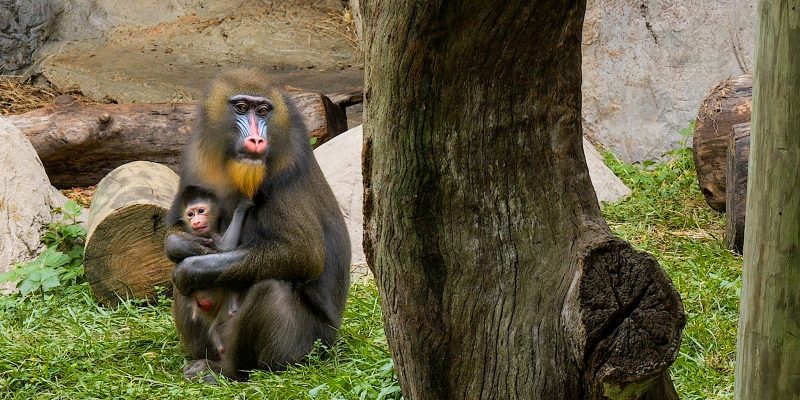
Audubon Zoo has a male mandrill, born October 30, 2026, to first-time parents Lucy and Obi. The zoo announced the birth on November 10 and says both mother and infant are doing well.
Lucy is 14. The care team’s report is the one they hope for with a first-time mother: the infant clung tightly from the start, nurses well, and is strong and healthy, and Lucy has been attentive and keeps him close all the time. Obi stays nearby and watches both of them. The rest of the troop has been respectful and curious rather than intrusive, which with a social primate is not a given and is worth saying out loud.
The infant has not been named yet.
Visitors may or may not catch a glimpse of him. Lucy chooses when to spend time in the outdoor habitat, and she and the baby keep access to their indoor space throughout, which means the viewing is on her terms rather than the schedule’s.
Where mandrills actually come from
This is the surprising part for most people. The mandrill is the most flamboyantly colored monkey on the planet, and the whole species lives in four countries: Cameroon, Gabon, Equatorial Guinea’s mainland, and Congo. That is the entire range, a block of rainforest in west-central Africa and nothing beyond it.
The IUCN Red List assesses the mandrill, Mandrillus sphinx, as Vulnerable, under a criterion that measures past population reduction. The assessment dates from November 2016 and was published in 2019, the trend is recorded as decreasing, and the Red List publishes no global population figure at all: the field for mature individuals is empty. That is worth knowing when a zoo announces a single birth. For a species nobody can count, every documented, parent-reared infant in an accredited collection is a known quantity in a population that otherwise is not one.
Audubon made no claim about the animal’s status in its announcement, so there is nothing here to correct. The assessment is simply the context the release left out.
The follow-up to a pumpkin
The pregnancy was announced in mid-October with a reveal staged around pumpkins, which we wrote up at the time. Eleven days after the birth, the follow-up is the part that was never guaranteed when the first story ran.
It is also a different outcome from the last mandrill birth we covered. Memphis Zoo’s first mandrill had to be hand-reared by keepers before she could be returned to her troop. Lucy’s infant has not needed any of that. He is with his mother, in his troop, being raised by a mandrill.
Quick answers
- When was the Audubon Zoo mandrill born?
October 30, 2026. The zoo announced the birth on November 10, 2026.
- Who are the parents?
Lucy, a 14-year-old female, and Obi. It is a first baby for both of them.
- Does the baby mandrill have a name?
Not as of the November 10, 2026 announcement.
- Can visitors see the baby mandrill?
Possibly. Lucy chooses when to spend time in the outdoor habitat, and she and the baby keep access to their indoor habitat as well, so the viewing is on her terms.
- Are mandrills endangered?
The IUCN Red List assesses the mandrill, Mandrillus sphinx, as Vulnerable. The assessment dates from November 2016 and was published in 2019, the population trend is recorded as decreasing, and no global population figure is published.
- Where do mandrills live in the wild?
In four countries: Cameroon, Gabon, the mainland of Equatorial Guinea, and Congo.