
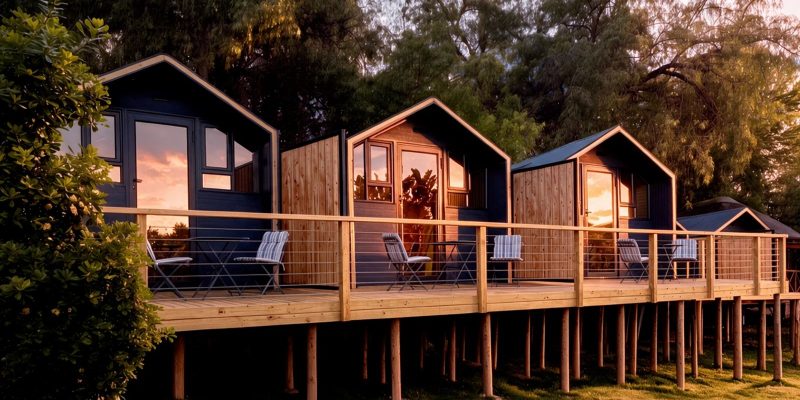
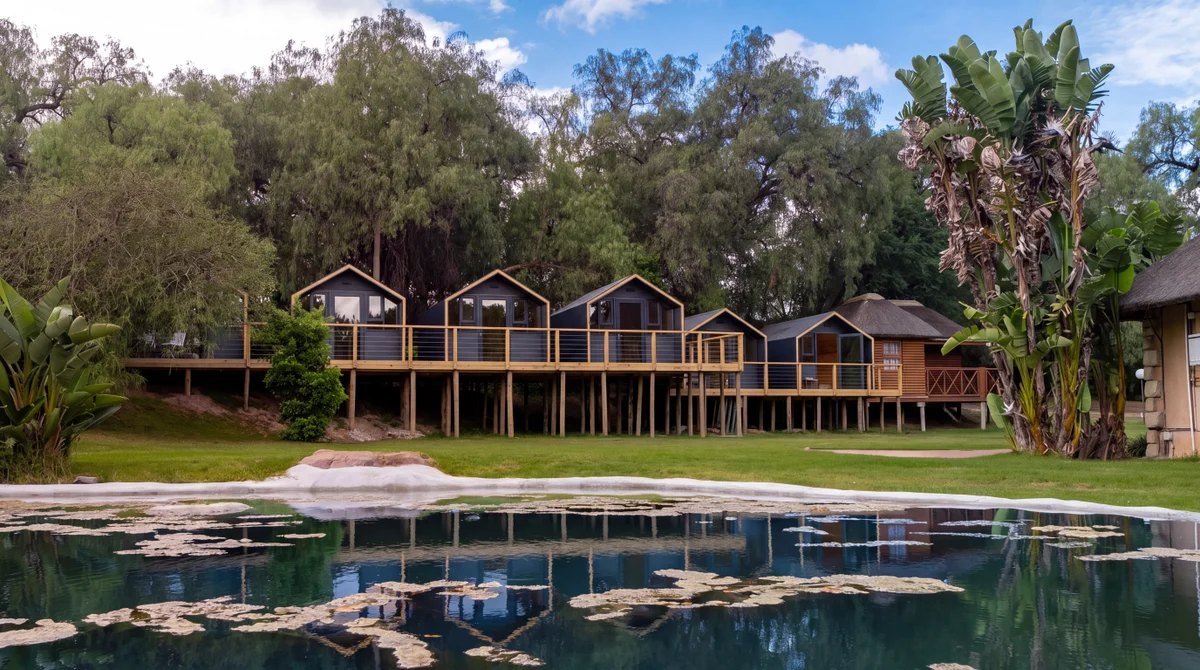
For forty years you could visit Cango Wildlife in Oudtshoorn and then drive away. As of October 2026 you can stay the night, in one of six new elevated pods built on a timber deck above the wetland at the edge of the property.
The facility calls them BOA Pods, and they are the more interesting half of a two-part launch. The other half is a piece of software, which sounds like the less interesting half and is not.
What was built
Six A-frame pods, raised on poles and linked by a shared timber walkway, each sleeping two. Every one has its own private deck, an en-suite bathroom and a skylight set into the pitch of the roof, which in the Klein Karoo is a reasonable thing to put over a bed. They sit among planted greenery, natural wetland and the birdlife that comes with standing water.
A stay includes breakfast at the BOA Cafe, full-day access to Cango Wildlife, a guided educational tour, and use of the pool and braai facilities. Room service, VIP tours and the facility’s Ambassador Animal Connections can be added. Rates start at R2,400 per pod per night for two people.
Where the booking money goes
This is the part worth pausing on. Every booking contributes to the BOA Foundation, Because of Animals, the non-profit arm Cango Wildlife runs to support animal care and conservation work inside the facility and beyond it.
That is a familiar argument in the zoological world and it is usually made as a slogan. Here it has a number attached to it. A couple who book a pod are funding the foundation at a stated rate, in a place where the alternative revenue model for conserving Klein Karoo wildlife is essentially nothing. Lodging is one of the few things a conservation facility can sell that does not require it to do anything to an animal.
And the software half
The second launch is Circle, a volunteer and intern hub that pulls what used to be an email conversation into one place. Prospective participants can read the program information, check dates and rates, ask questions and complete a booking without a back-and-forth.
It carries three pathways: the Cango Wildlife Volunteer Program, which is hands-on daily animal care and enrichment; the Conservation Internship, which rotates through the specialist animal care sections; and the Research Internship. Once booked, participants get a space to complete onboarding before they arrive. Alongside that sit the program FAQs, participant reviews, university partnership information, accommodation details and booking policies.
The design decision that makes Circle more than a booking form is that it does not close when the placement ends. Past volunteers and interns keep access, stay in contact with each other and keep following the facility. A conservation facility that trains a hundred young people a year and then loses track of all of them has thrown away its own alumni network, and most of them do exactly that.
Why does an overnight pod count as conservation news?
Because the physical place changed, and because the thing it changed into pays for the animals. Cango Wildlife is a working conservation facility rather than a hotel with a view, and it has spent 2026 marking forty years. That year also included two floods. The facility says a flood on 6 and 7 May left more than half its property under water, a second followed on 4 June, every animal and every member of staff was kept safe, and recovery took months of hard work. Building six revenue-generating structures on the far side of that is a statement about what the next forty are supposed to look like.
It is also not a small institution in regional terms. Cango Wildlife and Johannesburg City Parks and Zoo lead the hosting team that brings the World Association of Zoos and Aquariums annual conference to Cape Town in 2027, joined by the Two Oceans Aquarium and others.
We looked for an outside zoological funder behind the pods and the hub and did not find one. Both were built by the facility, for the facility, and the money they bring in goes to its own foundation. For a reader in the United States wondering what the overnight rate at a South African conservation park has to do with anything: it is the clearest version we have seen this year of the argument that people enjoying themselves at a wildlife facility is how the work gets paid for.
Quick answers
- What are the BOA Pods at Cango Wildlife?
Six elevated A-frame pods, each sleeping two, built on a raised timber deck above the wetland at the facility in Oudtshoorn, South Africa. Each has a private deck, an en-suite bathroom and a skylight.
- What does a stay include?
Breakfast at the BOA Cafe, full-day access to Cango Wildlife, a guided educational tour, and use of the pool and braai facilities. Room service, VIP tours and Ambassador Animal Connections can be added. Rates start at R2,400 per pod per night for two people.
- Where does the booking money go?
Every booking contributes to the BOA Foundation, Because of Animals, the non-profit arm Cango Wildlife runs to support animal care and conservation work inside the facility and beyond it.