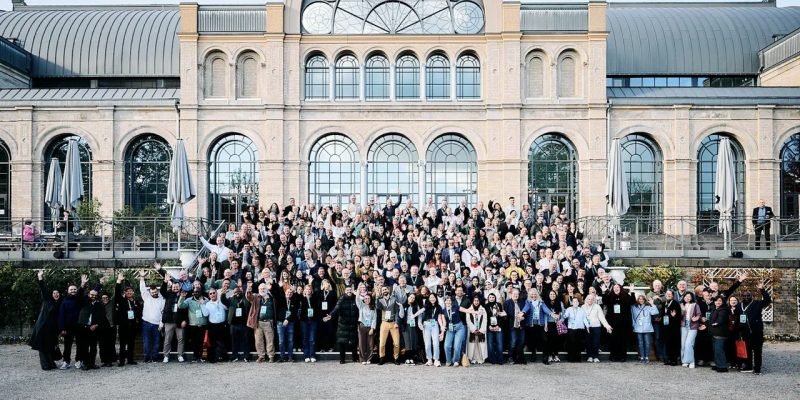
On 29 October 2026, in the last session of a conference held at Cologne Zoo, the World Association of Zoos and Aquariums approved its 2030 Conservation Goal. Two of the people who helped get it there work at an aquarium on the other side of the equator, and in 2027 the whole association is coming to their city.
Helen Lockhart and Judy Mann-Lang represented the Two Oceans Aquarium at the 81st WAZA Annual Conference, hosted by Cologne Zoo, the Kolner Zoo, from 25 to 29 October under the theme “Stewards of Tomorrow: Purpose. Direction. Global Responsibility”. It drew 319 participants from 58 countries and regions. WAZA itself is an alliance of close to 500 zoos, aquariums and associated organizations.
What the 2030 Conservation Goal actually requires
It is a reporting commitment, and that is less dull than it sounds.
The Goal builds on commitments made at the 79th WAZA conference in 2024, when members agreed to advance work supporting active contributions to halting extinctions, reversing population declines, restoring wildlife populations and securing a future for threatened species. The problem it addresses is not that zoos and aquariums do nothing. It is that what they do has never been documented or reported consistently, so nobody, including the sector itself, can say how much of it there is.
The Goal requires WAZA member regional associations to have two things in place by 2030. First, a conservation framework setting out how their members will contribute to the objectives. Second, a standardised reporting system that documents those activities the same way across the association. The framework recognises that conservation takes several forms: protecting species in their habitats, generating scientific knowledge, sharing expertise, building capacity, and creating positive social impact.
Anyone who has tried to answer the question “how much do zoos spend on conservation?” will recognize what is being fixed here. The Association of Zoos and Aquariums reports that in 2025 its 235 accredited and certified facilities spent approximately $372.4 million on conservation across 139 countries. That is a real figure because AZA collects it in a standard form. For most of the rest of the world, the equivalent number does not exist, because nobody agreed on how to count.
For the Two Oceans Aquarium the approval was personal. Both Lockhart and Mann-Lang were part of the initial team that advanced the work.
A hub so that nobody starts from scratch
Lockhart also introduced the new WAZA Sustainability Hub, built on the association’s existing sustainability strategy. It gathers practical tools and guidance for institutions at different stages of their own sustainability work, with plans to add case studies from across the global membership. The aim is plain: an aquarium beginning on plastics or sourcing should not have to invent an approach that a dozen other institutions have already worked out.
She joined a panel titled “From Commitment to Accountability: Scaling Sustainable Business Practices Across Zoos and Aquariums”, alongside representatives of the Aquarium Conservation Partnership, The Florida Aquarium, SSA Group and Verdis Group, on turning sustainability commitments into measurable action across plastics, climate and sourcing.
Why Cape Town in 2027 is a first
The 82nd WAZA Annual Conference runs from 17 to 21 October 2027 at the Cape Town International Convention Center, and it carries a distinction no previous conference has had. Every WAZA institutional member in the host country united behind a single national bid.
Cango Wildlife, in Oudtshoorn, and Johannesburg City Parks and Zoo, which runs the Johannesburg Zoo, lead the hosting team. They are joined by the Two Oceans Aquarium, uShaka Sea World and SAAMBR, and the National Zoological Garden of South Africa and SANBI. That is a national zoo, a municipal zoo, two aquariums, a marine research body and a privately run wildlife facility agreeing to put on one event together rather than competing to host it.
For a sector that spends a good deal of its time explaining that it collaborates, a joint bid is a more convincing demonstration than a statement about collaboration would be. It is also, for South Africa, a chance to put its own biodiversity and conservation work in front of several hundred colleagues who will mostly be seeing it for the first time.
The Two Oceans Aquarium thanked Cologne Zoo and its team for hosting the 2026 conference and for setting the precedent the Cape Town organisers now have to follow.
What this means for the people who visit
Very little will look different at any front gate in 2027, and that is worth being honest about. A reporting framework is infrastructure. What it changes is the answer a zoo can give when a visitor asks what their ticket paid for, because in a few years the institution will be able to point at a documented figure rather than a description.
The Two Oceans Aquarium has been a WAZA member since 2019 and is a founder member of the African Association for Wildlife in Human Care. Cape Town has had a busy year for this sort of thing: the aquarium also hosted the International Zoo Educators conference in 2026, bringing 187 educators from 35 countries to the same city that will host WAZA next October.
The 2030 Goal itself is published through WAZA, which coordinates the regional associations now responsible for building the frameworks.
Quick answers
- What is the WAZA 2030 Conservation Goal?
It is a commitment, approved on 29 October 2026, requiring WAZA member regional associations to have two things in place by 2030: a conservation framework setting out how members contribute, and a standardised reporting system to document what they actually do.
- Why does a reporting system matter?
Zoos and aquariums already contribute to conservation, but the work has not been documented or reported consistently, so the sector cannot show the size of its own contribution. The Goal is aimed at that gap.
- Where was the 2026 WAZA conference held?
At Cologne Zoo in Germany, from 25 to 29 October 2026. It drew 319 participants from 58 countries and regions.
- Who represented the Two Oceans Aquarium?
Helen Lockhart, its Conservation and Sustainability Manager, and Judy Mann-Lang. Both were part of the initial team that advanced work on the 2030 Goal.
- What is the WAZA Sustainability Hub?
A resource introduced by Lockhart at the conference, gathering practical tools and guidance so institutions starting sustainability work do not have to begin from scratch.
- Where is the 2027 WAZA conference?
The Cape Town International Convention Centre, from 17 to 21 October 2027. It is the first time every WAZA institutional member in a host country has united behind a single national bid.