
A wildlife facility in the Klein Karoo has started sending tissue samples into a national genetic reference library built to identify animals and animal products seized from the illegal wildlife trade. Cango Wildlife, in Oudtshoorn, set out on November 25 what research actually looks like at a zoological facility, and the newest entry on the list is the South African National Biodiversity Institute’s DNA barcoding project.
The piece is worth reading for a reason that has nothing to do with laboratories. Most of what Cango contributes to science is not an experiment. It is record keeping.
What counts as research at a zoo?
The largest single contribution the facility makes is the one its keepers make every day. Observations, weights, measurements and daily notes go into ZIMS, the Zoological Information Management System, a shared database run by the non-profit Species360 that holds animal records from member institutions around the world. Researchers can request that data. A keeper writing down what an animal ate on a Tuesday in Oudtshoorn is, eventually, a row in somebody’s analysis.
On top of that sit the specific projects. Every year, or sometimes every second year, the team takes gastric biopsy samples from its cheetahs. Gastritis is a persistent problem in cheetahs in human care, and the sampling lets researchers track how common it is and how it progresses, particularly when a facility changes a diet or a feeding method and wants to know whether the change helped.
Then there are the questionnaires. Diets, enrichment items, weights, measurements, usually for somebody’s bachelor’s or doctoral research. Cango answers them, and asks for a copy of the finished paper, which goes into a research folder the staff can look back through.
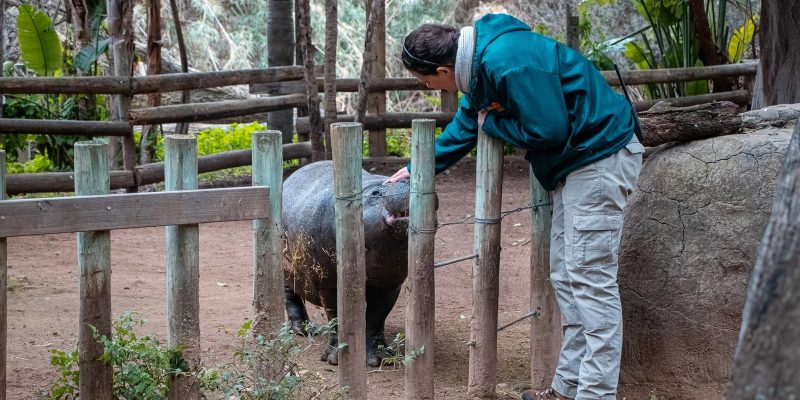
And then there are the odd requests. The facility has collected fecal samples for a study comparing otter species, and for training a detection dog to tell leopard scat from cheetah scat by smell. Its two pygmy hippos, Hilda and Herbert, have both been measured for a larger study of the species.
Why a facility can supply what a field team cannot
That pygmy hippo detail is the argument in miniature, and Cango makes it directly: a researcher who needs a reliable measurement or a clean sample can often get one faster from an animal in human care than from days of searching for the right species in the bush. The animal is known, the handling is routine, the identification is certain and the paperwork already exists.
This is the quiet half of what accredited zoological facilities are for, and it is the half that never makes a headline. It is also the half that an institution can offer without any budget at all, which matters for a facility of Cango’s size. The same organization is currently helping lead the South African bid to bring the world zoo and aquarium community to Cape Town in 2027.
What DNA barcoding actually does
A DNA barcode is a short, standardized stretch of genetic code that is consistent enough within a species and different enough between species to work as an identifier. For most animals the marker is a mitochondrial gene called cytochrome oxidase subunit I; for plants it is usually matK and rbcL, and for fungi the internal transcribed spacer region. Sequence that stretch from an unknown sample, compare it against a reference library, and you have a species name.
The reason that matters to a customs officer or a prosecutor is that illegal wildlife products rarely arrive looking like the animal. A bone, a scale, a piece of dried meat or a worked ornament gives an inspector very little to go on, and a species identification is frequently the difference between a seizure that becomes a case and one that does not. A reference library is only as useful as the species in it, which is why the gaps get filled one sample at a time. South Africa runs a national barcoding node, the South African Barcode of Life, as part of the International Barcode of Life Consortium, and the National Biodiversity Assessment records 124 barcoding projects funded between 2013 and 2022, worth more than 60 million rand.
Cango is in a good position to fill particular gaps, because it holds a rehabilitation permit and therefore receives injured indigenous wildlife from its own corner of the Western Cape. Those are animals a laboratory would otherwise have to go and find.
Two samples, and how they were handled
The facility has contributed two so far. One came from a polecat estimated at three to five days old. The other came from an adult Knysna dwarf chameleon. Both animals arrived at Cango in very poor condition and died shortly afterward, and the samples were taken then.
The procedure is not casual. Each sample is photographed and documented, and the tissue has to be collected by an authorized CapeNature official using a specified kit and following chain-of-custody rules, so that what arrives at the laboratory can be traced back to a particular animal at a particular place on a particular day. That is the same discipline an evidence exhibit gets, and for the same reason: a barcode that cannot be traced is not much use in court.
Two samples is a small number. It is also two species that were not in the library before, from a province whose wildlife is not evenly represented in it.
Who paid for this?
We trace the accredited zoos and aquariums behind conservation work in this region, because the funding is usually the only part of the chain that gets published. On this story the direction is reversed, which is worth saying plainly: the zoological facility is not the recipient of the funding, it is the supplier of the material. The institutions named around it are public rather than zoological. The South African National Biodiversity Institute is a government body. CapeNature is the Western Cape conservation authority. Species360, which runs ZIMS, is an international non-profit, not a zoo.
No outside zoo or aquarium funds this work, and none needs to. What Cango is spending is staff time, permit standing and access to animals, and those are the things a field laboratory cannot buy. For scale, the Association of Zoos and Aquariums reports that 235 accredited and certified facilities spent roughly $372.4 million on conservation across 139 countries in 2025. No published breakdown isolates what any one region receives, so we do not estimate one.
What this does not claim
No case has been built on a Cango sample, no paper has been published from one, and the facility does not say otherwise. A reference library pays off years after the sequencing, in a laboratory the donor never visits, on a sample nobody has collected yet. Confiscations are where that payoff becomes visible, as when a Florida zoo took in box turtles pulled out of the trafficking chain earlier this year.
What the Oudtshoorn piece is really arguing is something narrower and more useful: that research at a zoological facility mostly looks like paperwork, and that the paperwork counts. A keeper writing a daily note is not doing science by accident. Somebody, eventually, is going to need that note.
Quick answers
- What is Cango Wildlife contributing to?
The South African National Biodiversity Institute DNA barcoding project, which builds a genetic reference library used to identify animals and animal products taken from the illegal wildlife trade. Cango has supplied two tissue samples so far.
- What is DNA barcoding?
A DNA barcode is a short, standardized stretch of genetic code that is consistent within a species and different between species. For most animals the marker is the mitochondrial gene cytochrome oxidase subunit I. Sequencing that stretch and comparing it against a reference library returns a species name, which matters when a seized product no longer looks like the animal it came from.
- What else does the facility contribute to research?
Daily keeper observations, weights and measurements go into ZIMS, the Zoological Information Management System run by Species360, where researchers can request them. Cango also takes gastric biopsy samples from its cheetahs to track gastritis, answers student research questionnaires, and has supplied fecal samples for an otter study and for training a detection dog to tell leopard scat from cheetah scat.
- Does an accredited zoo or aquarium fund this work?
No, and on this story the direction is reversed. The zoological facility is the supplier of the material rather than the recipient of funding. The other bodies named are the South African National Biodiversity Institute, a government institute, CapeNature, the Western Cape conservation authority, and Species360, an international non-profit.