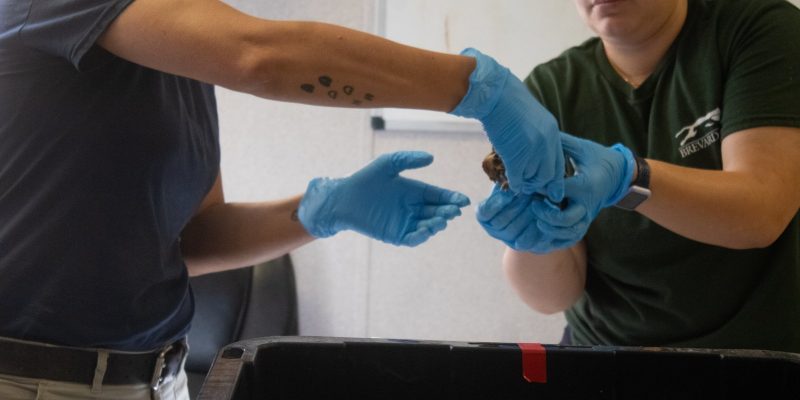
Dozens of box turtles seized by wildlife law enforcement are now living at Brevard Zoo, in two habitats along the Melbourne, Florida zoo’s Wild Florida loop. They are, by the zoo’s own account, a fraction of the native turtles taken out of the illegal trade in that state this year.
The word for how they got here is confiscation, and it carries more machinery than it sounds like. When officers seize live animals, somebody has to take them that day: feed them, house them, quarantine them, and work out one at a time whether each animal can ever go home. Brevard Zoo is a member of the Association of Zoos and Aquariums’ Wildlife Confiscations Network, which exists to answer that question quickly rather than leave seized animals sitting in an evidence room.
Will the turtles go back to the wild?
Some may. Some will not, and will stay in human care for the rest of their lives. The zoo says the outcome depends on a number of factors, health first among them, and is candid that it does not know much about the conditions these particular turtles were found in.
That uncertainty is itself part of the damage. Trafficked animals are routinely moved in conditions that cause disease, injury and death, so a turtle that survives the journey is not necessarily a turtle that can be released at the end of it. The decision gets made per animal, and it takes as long as it takes.
Why a box turtle is worth stealing
Because people buy them. High global demand for exotic pets drives the trade, and the animals taken to supply it are subtracted from wild populations that were not counted first. That is the part the zoo frames as the real conservation cost: not the individual animal, but the hole left in an ecosystem that has no way to recover what was removed.
On the IUCN Red List, the eastern box turtle, Terrapene carolina, carries the category Vulnerable. We are giving the category and nothing else here on purpose. The Red List’s species pages are currently returning errors to us, so we cannot open the assessment to read its date, its criteria or what it counts, and we do not print figures we have not read. The category itself is republished machine-readably by the Global Biodiversity Information Facility against IUCN taxon 21641, which is how we have it.
Not Brevard’s first confiscation, or anyone’s
Brevard has done this before, across a range of animals the zoo lists as running from Gulf Coast box turtles to infant black-handed spider monkeys. It is not alone. Last month we wrote about two spider monkeys confiscated at the border who now live at Utah’s Hogle Zoo, placed through the same network.
The network is the quiet infrastructure of this beat. It is also the reason a confiscation can end in a habitat rather than a holding pen, and accredited zoos are the ones carrying it.
What a visitor can do about it
Three things, in the zoo’s order. Think twice before buying an exotic pet, and read up first at NotAPet.Net. Report suspected wildlife crime to the U.S. Fish and Wildlife Service tips line, which also takes calls at 1-844-397-8477. And look at the federal legislation the zoo points to: the Wildlife Confiscations Network Act, which would fund the network’s expansion nationwide, and the Captive Primate Safety Act, which would bar private ownership, breeding and sale of monkeys, lemurs and apes as pets.
The turtles themselves are the easiest part. They are out on habitat in Wild Florida now, doing what box turtles do, which is very little and extremely slowly, and every one of them is a case that ended better than it started.
Source: Brevard Zoo, “Providing a Home to Wildlife Trafficking Victims”.
Quick answers
- Where did Brevard Zoo's box turtles come from?
They were confiscated by wildlife law enforcement from the illegal wildlife trade. The zoo describes them as a fraction of the native turtles seized in Florida this year.
- Where can visitors see them?
In two habitats along the Wild Florida loop at Brevard Zoo in Melbourne.
- Will the turtles be released back into the wild?
Some may be rehabilitated and returned to native habitat and some will stay in human care for life. The zoo says it depends on a number of factors, health first among them, and that it does not know much about the conditions these turtles were found in.
- What is the AZA Wildlife Confiscations Network?
A network of Association of Zoos and Aquariums members that takes in live animals seized by wildlife law enforcement, so that confiscated animals have somewhere to go on the day they are seized. Brevard Zoo is a member and has taken in animals ranging from Gulf Coast box turtles to infant black-handed spider monkeys.
- Is the eastern box turtle endangered?
The IUCN Red List category for Terrapene carolina is Vulnerable. We are giving the category only: the Red List's species pages are currently returning errors to us, so we have not been able to open the assessment itself to read its date, its criteria or its population figures, and we do not print figures we have not read. The category is republished against IUCN taxon 21641 by the Global Biodiversity Information Facility.
- How do I report suspected wildlife trafficking?
Through the U.S. Fish and Wildlife Service wildlife crime tips line at 1-844-397-8477, or its online tips form.