
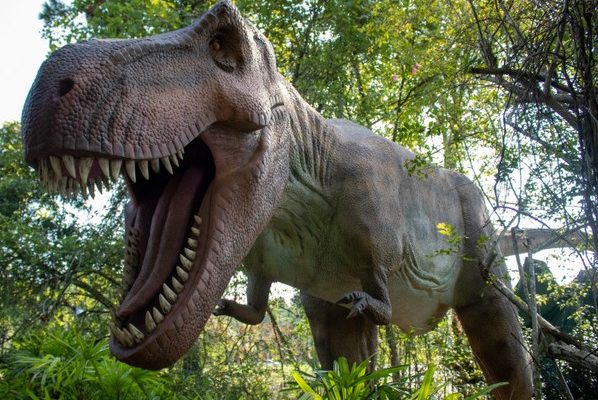
San Francisco Zoo and Gardens has 21 life-sized animatronic dinosaurs standing around its lower lake, and they come down on September 15, 2026. “Dinos Rule!” opened July 1 as an outdoor summer exhibition, which means anyone who wants to see it has about a week left.
The count is the thing to hold onto: 21 individual animals, not a themed corner. They are arranged along a pathway that runs around the outer lake, through dense planting, next to the 2.2-acre Australian WalkAbout and Koala Crossing habitats.
What is actually out there
The headline animals are the ones everybody knows, a Tyrannosaurus rex and a Brachiosaurus, the long-necked herbivore the zoo describes as the largest of its kind. The more interesting half of the roster is the part most visitors will not recognize. Gigantoraptor is a huge bird-like dinosaur. Pachycephalosaurus carried a thick domed skull ringed with spikes. Psittacosaurus had a beak like a parrot’s, which is where its name comes from.
Each is animatronic, meaning robotic rather than a static model: they blink, they breathe, and their tails swing. The zoo says all 21 are built on fossil evidence and grouped by era and geographic origin rather than lined up by size, with the animals staged in the middle of doing something, nesting, hunting or scavenging.
The theme running through the arrangement is evolution and extinction, which is a more pointed choice than it first sounds at a zoo that spends the rest of its year on species heading the same direction.
What is there for children to do
Four things, all physical: a five-foot photo-op dinosaur egg, a six-foot sauropod footprint and a four-foot Tyrannosaurus footprint to stand in, a 15-foot climbable dinosaur sculpture, and an eight-foot-square dig pit with fossils in it.
There is also a motion-based virtual reality experience at the zoo’s VR Zone, built with the immersive-entertainment company Immotion. “Dinosaur: Evolution” puts the viewer in the Cretaceous, in a motion seat, and draws its comparison to present-day climate.
Who built them
The dinosaurs come from Dino Don, Inc., whose animals are fabricated under paleontologist supervision. Its chief executive is Don Lessem, who advised Steven Spielberg on the original 1993 Jurassic Park on dinosaur anatomy and behavior, and who has a dinosaur named after him: Lessemsaurus, a large plant-eater found in Argentina.
“Dinosaurs continue to enthrall and evoke wonder for kids and adults alike,” said Cassandra Costello, the zoo’s CEO and executive director. “We felt that this was a great time to bring dinosaurs to the Zoo for the first time at this scale, something that would be exciting and new for our guests, and be a must-see for our community and beyond.”
The part that does not leave
The walk finishes at the Prehistoric Garden, across from the South American Tropical Rainforest and Aviary, and that garden is permanent. It is planted with lineages that were already old when the animatronics’ originals were alive: horsetails, whose jointed green stems date to the age of dinosaurs; ferns largely unchanged for millions of years; Gunnera, grown for leaves big enough that they get called dinosaur food; mosses, which go back roughly 450 million years; and magnolias and palms, at about 100 million and 80 to 90 million years respectively.
So the robots go and the garden stays, which is the more durable half of the project even if it is not the half on the poster.
Why put dinosaurs in a zoo at all
The zoo’s own answer is that the living collection is the point of comparison.
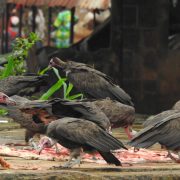
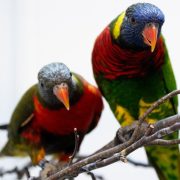
“By having dinosaurs at the Zoo, we can bring the unique perspective of having our guests see these giant, life-sized dinosaurs, and comparing them to living parallels, like our prehistoric-looking cassowaries, and other birds, that are descendants to dinosaurs,” said Paulo Vergara, executive vice president of marketing. “Even some of our giant tortoises, that came from ancient reptiles that co-existed with dinosaurs, make for a fascinating visit!”
That is a real thread rather than a marketing line. Birds are dinosaurs, and a zoo is one of the few places a visitor can walk from a robot Gigantoraptor to a living cassowary in a couple of minutes and see the family resemblance for themselves.
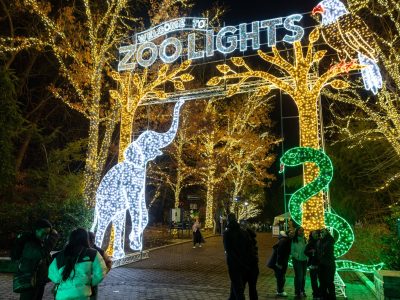
Limited-run installations have become a standard part of how zoos fill a season. Central Florida Zoo runs an Asian lantern festival on the same logic. San Francisco Zoo’s other current news is considerably slower moving: it rears the frogs behind Yosemite’s 10,000th California red-legged frog release.
Source: San Francisco Zoo and Gardens, July 1, 2026.
Quick answers
- When does Dinos Rule! close?
September 15, 2026. It opened July 1 as a limited-run outdoor summer exhibition at San Francisco Zoo and Gardens.
- How many dinosaurs are there?
Twenty-one life-sized animatronic dinosaurs, arranged around the zoo's lower lake and grouped by era and geographic origin. They blink, breathe and move their tails, and the zoo says all 21 are modeled on fossil evidence.
- What is there for children?
A five-foot dinosaur egg photo op, a six-foot sauropod footprint and a four-foot Tyrannosaurus footprint, a 15-foot climbable dinosaur sculpture, and an eight-foot-square dig pit with fossils. A motion-based virtual reality film, Dinosaur: Evolution, plays separately at the zoo's VR Zone.
- Does anything stay after September 15?
Yes. The Prehistoric Garden at the end of the route is permanent. It is planted with horsetails, ferns, Gunnera, mosses, magnolias and palms, lineages that date back to the age of dinosaurs and earlier.