
San Francisco Zoo and Gardens has capybaras again for the first time in nearly ten years. A four-month-old brother and sister arrived from the Sacramento Zoo on October 8, and the zoo expects to open their habitat to visitors on Tuesday, October 13.
Until then Puente al Sur stays closed while the pair settle in. They do not have names yet.
Where they are living, and who else lives there
Puente al Sur, or Bridge to the South, is a mixed-species habitat built as four separate areas rather than one enclosure. The capybaras share it with a giant anteater, a Baird’s tapir, a Southern pudu and a pair of Western Santa Cruz giant tortoises. A boardwalk runs above the large yard, which has an outdoor pond in it.
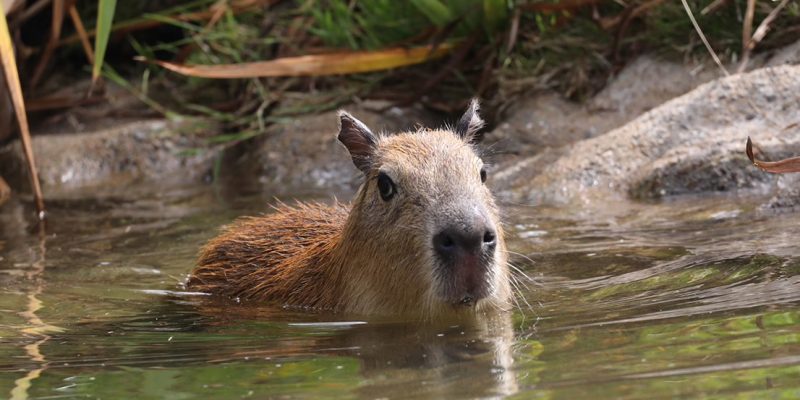
The pond did not go unnoticed. The female made straight for it the first time she was let out.
“Capybaras are excellent swimmers,” said Quinn Brown, the curator who oversees Puente al Sur. “It was great to see the two of them exploring their new home, taking laps in the pool, and checking things out. Over the next several days, we will allow them to acclimate privately without members of the public before opening the exhibit sometime next week. In addition, we will eventually introduce them to our male Baird’s tapir, Pacha, which will create a more dynamic exhibit.”
That last sentence is the part worth watching. Putting a tapir and two capybaras into the same yard takes a staged introduction between two large, water-loving South American mammals, and it runs on the animals’ timetable rather than the calendar’s.
A rodent the size of a large dog
The capybara (Hydrochoerus hydrochaeris) is the largest rodent in the world, in the order Rodentia alongside beavers and porcupines. A full-grown adult weighs 110 to 150 pounds or more, measures over four feet from snout to rump, and stands about two feet at the shoulder. The two that arrived are nowhere near that yet, at roughly 33 to 44 pounds, or 15 to 20 kilograms, each.
They are semi-aquatic, which is why they are found in lowland country close to water across Central and South America, and why the pond matters more than the yard does. They also turn up well outside that range as an introduced species, most famously in Japan, where capybaras sit in hot-spring baths called onsens. They have little body fat, so a warm soak in winter does real work for them.
Thirty years of capybaras in San Francisco
The internet discovered capybaras around 2020 and has not let go since. The zoo has had them a good deal longer than that: it has managed the species for more than 30 years. An earlier herd lived next to the Nile hippopotamuses before moving, in 1999, into the then-new Puente al Sur, which was built as a mixed-species habitat representing the biodiversity that runs from Mexico to the southern tip of Argentina.
The gap since the last capybaras is not a gap in interest. Animals move between accredited institutions on recommendations from the Association of Zoos and Aquariums Species Survival Plans, cooperative programs that manage each species across North America as a single population rather than as a collection of separate zoo populations.
“We have been in line to receive capybaras for several months, so we were excited to finally have an arrival timeframe, which was coordinated through the Association of Zoos & Aquariums’ Capybara SSP (Species Survival Plan),” said Cassandra Costello, CEO and executive director. “The excitement here is palpable. It has been several years since we last housed them here, and they are a favorite not only of our staff, but also of kids and adults alike on a global level!”
San Francisco has had a busy few weeks either side of this: in early October the zoo was recognized by the AZA for its work on Sierran amphibians. Capybara arrivals are a different kind of news, and a good one to be able to walk up to.
If you want to see them, Tuesday, October 13 is the day the zoo has given, and the pond is where to look first.
Source: San Francisco Zoo and Gardens, October 8, 2026.
Quick answers
- When can I see the capybaras at the San Francisco Zoo?
The zoo expects to open the habitat to visitors on Tuesday, October 13, 2026. Puente al Sur is closed until then while the pair acclimate privately.
- Where did they come from?
The Sacramento Zoo. They are a male and female sibling pair, about four months old, and they arrived on October 8, 2026 on a recommendation from the Association of Zoos and Aquariums Capybara Species Survival Plan.
- Where do they live at the zoo?
Puente al Sur, or Bridge to the South, a mixed-species habitat built as four separate areas. Their habitat-mates are a giant anteater, a Baird’s tapir, a Southern pudu and a pair of Western Santa Cruz giant tortoises. A boardwalk runs above the large yard, which has an outdoor pond.
- How big do capybaras get?
The capybara is the largest rodent in the world. A full-grown adult weighs 110 to 150 pounds or more, measures over four feet from snout to rump, and stands about two feet at the shoulder. The two new arrivals weigh roughly 33 to 44 pounds, or 15 to 20 kilograms, each.
- Do they have names?
Not yet. The zoo says the pair are not officially named.
- How long has the San Francisco Zoo kept capybaras?
More than 30 years, though this is the first pair in nearly a decade. An earlier herd lived next to the Nile hippopotamuses and moved into the then-new Puente al Sur in 1999.
- Will they be housed with the tapir?
Eventually. The curator who oversees Puente al Sur says the zoo plans to introduce them to Pacha, its male Baird’s tapir, to make a more dynamic habitat. That is a staged introduction and it runs on the animals’ timetable.