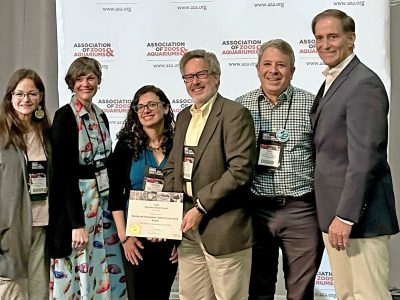


San Francisco Zoo & Gardens took top honors in the Association of Zoos and Aquariums’ North American Conservation Award category on September 30, 2026, for a decade of work on five Sierra Nevada frogs and toads. The clearest measure of why is not the number of animals the zoo has put back into the mountains. It is that some of those animals are now producing tadpoles of their own.
The award was announced at the AZA Honors and Awards Lunch during the association’s annual conference in Portland, Oregon. The zoo’s entry, titled “Saving Sierran Amphibians: A Decade of Conservation Action and Recovery,” was chosen from 96 applications across all of the award categories.
What head-starting actually means
The technique underneath the program is head-starting: young amphibians are reared in captivity through the stage at which almost all of them would otherwise be eaten or dried out, then returned to the wild once they are large enough to have a real chance. It matters here because a Sierra Nevada frog can lose an entire year class to a single bad season, and head-starting moves that bottleneck indoors where it can be managed.
San Francisco Zoo and Gardens has released more than 10,000 PIT-tagged juvenile frogs and toads across 46 lakes, streams and meadows in the Sierra Nevada. The tag is the reason the program can say anything at all about what happened next: a PIT tag is a rice-grain-sized transponder that gives each animal a permanent individual number, so a frog recaptured seasons later is a known individual rather than a guess. That is how the zoo can state that it helped establish one of the few documented self-sustaining populations of a federally listed frog in North America.
Five species sit inside the program: the mountain yellow-legged frog, the California red-legged frog, the Yosemite toad, the Sierra Nevada yellow-legged frog and the foothill yellow-legged frog. The zoo now operates the largest amphibian conservation rearing facility in California, and it is the sole recovery partner for Yosemite toads and California red-legged frogs in the Sierra Nevada.
Why finding tadpoles is the result that counts
“We are honored to have our work recognized by AZA,” said Cassandra Costello, CEO and Executive Director. “The real reward has always been seeing amphibians return to the wild and watching new populations begin to sustain themselves. When we find tadpoles produced by frogs that were once reared and released by our conservation team, it is a tangible sign that recovery efforts are working and that these species have a future.”
That distinction is the whole argument for this kind of program. Releasing animals is an input. A released animal that survives to breed, in the wild, without further help, is an output, and it is the only one that eventually lets a recovery program end.
The zoo also ran a first-of-its-kind rescue and recovery effort for mountain yellow-legged frogs during a chytrid fungal outbreak. Chytrid is a skin fungus that has driven amphibian declines worldwide by disrupting the way frogs move water and salts across their skin, which for an animal that breathes partly through that skin is fatal.
A note on the listings
The zoo describes all five species as imperiled, which is fair, but they do not sit at the same level and the gap is worth stating. The IUCN Red List assesses the mountain yellow-legged frog as Endangered, the Sierra Nevada yellow-legged frog and the Yosemite toad as Vulnerable, and the California red-legged frog and the foothill yellow-legged frog as Near Threatened. The United States Endangered Species Act is a separate list with separate vocabulary, and a species can carry different standing on each, so the federal listing a species holds is not the same statement as its Red List category. Where the two differ, ZooReviews defaults to the assessment.
None of which changes the result. A Near Threatened frog breeding again in a meadow it had been lost from is the same good day as an Endangered one, and the zoo is working on both.
Who else is in it
“This award acknowledges the hard work and dedication not only of our conservation and veterinary teams at the Zoo,” said Dr. Rochelle Stiles, Director of Field Conservation. “It also recognizes how important collaboration is between state and federal partners, universities and researchers, and our work with AZA’s Zoo-Park Partnership.”
“Congratulations to the team at San Francisco Zoo & Gardens for their hard work and dedication in achieving this remarkable recognition,” said Dan Ashe, president and CEO of the Association of Zoos and Aquariums. “This award recognizes the best of the best in the global aquarium and zoo community.”
Readers who followed the zoo’s 10,000th frog release in May have already met the arithmetic behind this award. What the award adds is the field’s acknowledgment that the arithmetic turned into populations.
The Association of Zoos and Aquariums says the category recognizes outstanding contributions by AZA-accredited facilities and conservation partners, judged on regional work such as habitat protection and species recovery. The 2025 top honors went to San Diego Zoo Wildlife Alliance’s Southwest Conservation Program.
Quick answers
- What did San Francisco Zoo & Gardens win?
Top honors in the Association of Zoos and Aquariums' North American Conservation Award category, announced on September 30, 2026 at the AZA Honors and Awards Lunch during the association's annual conference in Portland, Oregon. The entry, "Saving Sierran Amphibians: A Decade of Conservation Action and Recovery," was chosen from 96 applications across all award categories.
- Which species does the program cover?
Five Sierra Nevada amphibians: the mountain yellow-legged frog, the California red-legged frog, the Yosemite toad, the Sierra Nevada yellow-legged frog and the foothill yellow-legged frog.
- How many animals has the zoo released?
More than 10,000 PIT-tagged juvenile frogs and toads, across 46 lakes, streams and meadows in the Sierra Nevada.
- What is head-starting?
Rearing young amphibians in captivity through the stage at which almost all of them would otherwise be eaten or dried out, then returning them to the wild once they are large enough to have a real chance of surviving.
- What is a PIT tag?
A rice-grain-sized transponder that gives an animal a permanent individual number, so a frog recaptured seasons later is a known individual rather than a guess.
- How are the five species assessed on the IUCN Red List?
The IUCN Red List assesses the mountain yellow-legged frog as Endangered, the Sierra Nevada yellow-legged frog and the Yosemite toad as Vulnerable, and the California red-legged frog and the foothill yellow-legged frog as Near Threatened. A species can hold different standing under the United States Endangered Species Act, which is a separate list.