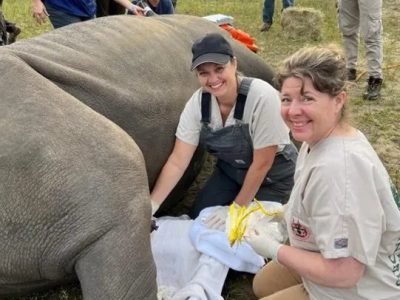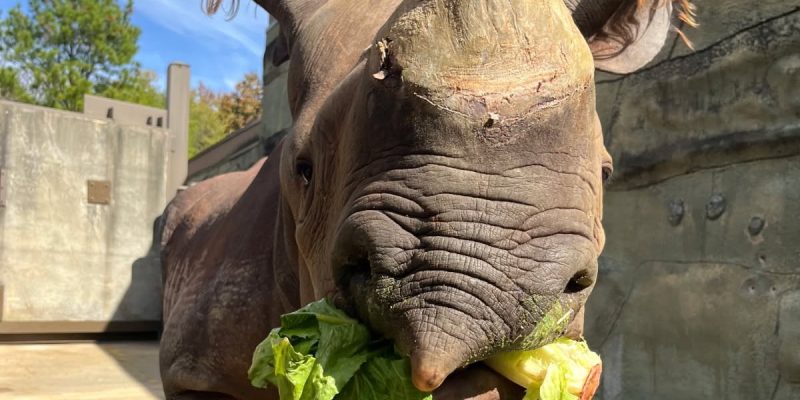
The Birmingham Zoo has a new Eastern black rhinoceros. Hatari, a five-year-old male, arrived from Zoo Miami, and Veterans Day, Wednesday, November 11, is the first day the public can see him.
He joins Kesi, a nine-year-old female Eastern black rhino already living at the zoo. Both are part of the Association of Zoos and Aquariums Species Survival Plan, the program that tracks the parentage of every animal of a species across accredited institutions and recommends which individuals should move and which should breed, so that the population in human care does not quietly collapse into a handful of family lines.
Hatari is Swahili for danger, hazard or risky. It is a good joke on an animal with that reputation and, as names go, a slightly unfair one.
Why is a black rhino not black?
It is not, and neither is a white rhino white. Both are gray. What separates them is the mouth, and the mouth is the whole animal.
A black rhino is a browser, meaning it feeds on the leaves, shoots and twigs of woody plants rather than on grass. To do that it has a pointed, prehensile upper lip, a lip it can curl and grip with, the way an elephant uses the tip of its trunk. It hooks a branch, strips the leaves and lets the stem go. A white rhino, by contrast, is a grazer with a wide, square lip built to mow grass close to the ground, and its name is most likely a mangling of a word for wide rather than a description of its color.
That difference decides where each animal can live, what a keeper puts in front of it, and what a habitat has to grow. It is also the easiest thing in the world to see once somebody points it out: watch a black rhino take a leaf and the lip does the work.
How many Eastern black rhinos are there?
Fewer than most people assume, and the number depends entirely on which animal you are counting.
The IUCN Red List assesses the Eastern black rhino, Diceros bicornis ssp. michaeli, as Critically Endangered, with 583 mature individuals across 20 locations at its most recent assessment, dated January 2020. The zoo’s description of the animal as critically endangered is exactly right. Its range today is Kenya and Tanzania, with reintroduced animals in Rwanda and a transplanted population in South Africa. It is gone from Eritrea, Ethiopia, Somalia, South Sudan, Sudan and Uganda.
The zoo’s release also says that fewer than 7,000 black rhinos remain in the wild. That figure belongs to the full species rather than to Hatari’s subspecies, and it counts a different thing. The Red List’s species-level assessment gives 3,142 mature individuals, also from January 2020; totals in the high thousands come from counts that include calves and subadults. Both numbers can be true at once, and the honest way to read them is that there are a few thousand black rhinos of all kinds, of which the eastern ones are a minority measured in hundreds.
Here is the part the release left out, and it is the better half. The Red List records the population trend for both the species and this subspecies as increasing. That is not a rounding error on a long decline; it is a direction of travel, earned by armed protection, careful translocation and the kind of studbook arithmetic that put Hatari on a truck in the first place.
What the Species Survival Plan is actually doing here
Moving a five-year-old male to a zoo that already has a nine-year-old female is not a coincidence, and it is not a decision Birmingham made alone. Black rhinos in North American collections are managed as one population, and animals are placed where the genetics and the ages line up. What that looks like from a visitor’s side is a new rhino in a yard. What it looks like on paper is a line in a plan written to keep a species’ options open for another century.
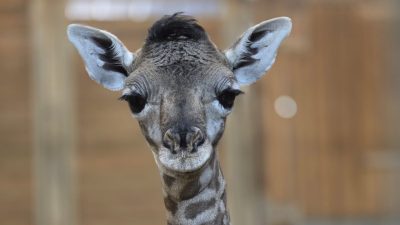
The zoo has had a steady year of these arrivals. In October it took in Onduli, a yearling giraffe from the Dallas Zoo, on the same kind of recommendation.
Going on Wednesday
Veterans Day is a sensible day to pick for a debut, because the Birmingham Zoo is also offering free admission to all active-duty and retired military personnel, plus up to five dependents per eligible member, on presentation of a military ID.
So the first crowd to meet Hatari will largely be service members and their families, which is a better opening day than most animals get. If you go, watch the lip.
Quick answers
- Who is Hatari?
A five-year-old male Eastern black rhinoceros who arrived at the Birmingham Zoo from Zoo Miami. His name is Swahili for danger, hazard or risky.
- When can the public first see Hatari?
Wednesday, November 11, 2026, Veterans Day, is the first day he is on public view at the Birmingham Zoo.
- Are there other rhinos at the Birmingham Zoo?
Yes. Hatari joins Kesi, a nine-year-old female Eastern black rhino already living at the zoo. Both are part of the Association of Zoos and Aquariums Species Survival Plan.
- What is the difference between a black rhino and a white rhino?
The mouth. A black rhino is a browser, with a pointed, prehensile upper lip it uses to grip leaves, shoots and twigs. A white rhino is a grazer, with a wide square lip built to crop grass. Both animals are gray.
- How endangered is the Eastern black rhino?
The IUCN Red List assesses Diceros bicornis ssp. michaeli as Critically Endangered, with 583 mature individuals across 20 locations at its January 2020 assessment. The population trend is recorded as increasing.
- Is admission free on Veterans Day?
The Birmingham Zoo is offering free admission to all active-duty and retired military personnel, plus up to five dependents per eligible member, on presentation of a military ID.
- What is a Species Survival Plan?
An Association of Zoos and Aquariums program that tracks the parentage of every animal of a species across accredited institutions and recommends which individuals should move and which should breed, so the population in human care stays genetically diverse.