
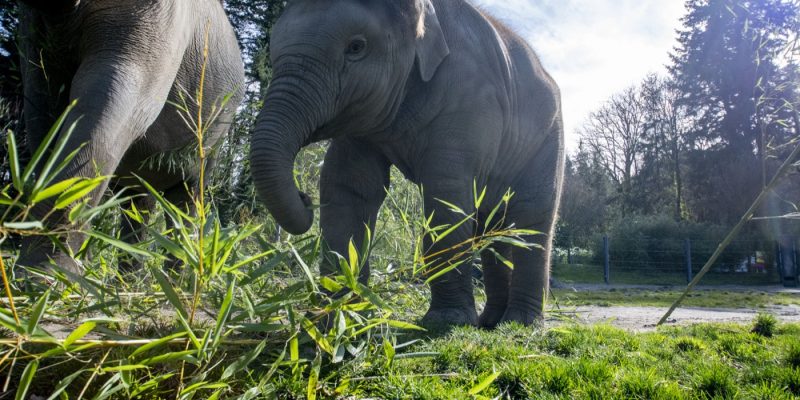
Tula-Tu, the young Asian elephant calf at the Oregon Zoo, has become the first elephant on the West Coast to be vaccinated against elephant endotheliotropic herpesvirus, a rapidly progressing and often fatal disease that hits elephant calves hardest. The zoo announced the milestone on August 31, 2026.
She received two doses of an mRNA vaccine this summer. A third is scheduled for the fall.
What is EEHV?
Elephant endotheliotropic herpesvirus, usually shortened to EEHV, moves fast once it takes hold, and calves are the group it takes hold in. The vaccine Tula-Tu received targets EEHV 1A, the most common strain of the virus.
The Oregon Zoo knows the cost of it directly. In 2018, Lily, another calf born to Tula-Tu’s mother Rose-Tu, died of EEHV shortly before her sixth birthday.
“Losing Lily to EEHV was devastating for our entire community, and it’s something we never want to happen again,” said Steve Lefave, who oversees the zoo’s elephant care program. “We’re so thankful to have a vaccine now to help protect against this virus.”
How a 1,300-pound calf gets a shot
Tula-Tu was born February 1, 2025, and now weighs more than 1,300 pounds. The care team began preparing her for this kind of medical work almost immediately.
“This is a huge milestone for us,” Lefave said. “Our team has been working with Tula-Tu since right after her birth, building the necessary trust and training for behaviors that allow her to participate in her own health care.”
Participation is the operative word. An elephant trained to offer an ear or a foot on cue can be examined, sampled and vaccinated as a cooperative act rather than a procedure done to her, and the difference shows up in how calm the animal is and how much monitoring her keepers can do without it becoming an ordeal.
Eighteen elephants, and counting
The vaccine was first given to adult elephants at the Houston Zoo in 2024 and has been rolled out on an experimental basis over the two years since. Tula-Tu is the 18th elephant to receive it.
No adverse side effects have been reported in any of those animals, and researchers at Baylor College of Medicine and the Houston Zoo have since reported that vaccinated elephants can withstand a natural infection without developing severe disease.
“Tula has been doing fantastic,” said Dr. Carlos Sanchez, the Oregon Zoo’s director of animal health. “She’s her usual playful self, and we have seen no negative side effects. Our hope is to provide her the protection she needs until she develops her own antibodies against this disease.”
Twenty-five years of blood samples
Sanchez chairs the research committee of the North American EEHV Advisory Group, and he is blunt about how long this took. The Oregon Zoo has spent close to 25 years contributing funding and elephant blood samples to the international effort to find a vaccine or a treatment. The vaccine now in Tula-Tu’s system is the product of 15 years of research led by Baylor College of Medicine, supported by zoos, conservation organizations and elephant specialists.
“When I started with the advisory group more than a dozen years ago, this vaccine was just a dream,” Sanchez said. “It is so gratifying now to see it become a reality.”
Detection has moved just as far. The zoo runs routine blood monitoring in house, with veterinary technicians trained to recognize elephant-specific blood cells, and it works with the Oregon Veterinary Diagnostic Laboratory at Oregon State University for advanced molecular testing.
“Early detection is critical,” Sanchez said. “We can collect blood samples in the morning and get results by the afternoon. That can be lifesaving.”
Tula-Tu’s blood is now feeding several studies of its own, including one run with Oregon State and Baylor to understand how elephants respond to the vaccine.
Why this matters for wild elephants
EEHV is not only a zoo problem. It affects wild elephants too, where it is much harder to identify and diagnose, and where it is overshadowed by poaching, habitat loss and human-elephant conflict. Scientists have confirmed roughly 200 EEHV deaths in Asian elephant range countries.
“The work we’re doing now could play a significant role in protecting future elephant calves from the disease, including those in range countries,” Sanchez said. “It’s very difficult to study the virus in wild elephants, but zoos can monitor the elephants in their care closely and obtain samples of blood and other fluids.”
That knowledge is already traveling. In 2023, Oregon Zoo veterinary staff worked with Malaysian wildlife officials to set up Sabah’s first hematology lab, a facility for analyzing blood, so that elephants there can be screened for EEHV whether they live in the forest or in human care. Zoo staff also run workshops on EEHV diagnostics and response for wildlife health practitioners across Southeast Asia.
The Oregon Zoo’s elephant program is more than 60 years old, and it has built a $1 million endowment for Asian elephants that supports the Association of Zoos and Aquariums SAFE program across all 13 countries where the species still lives. In Borneo, the zoo works with local partners on replanting forests, establishing protected corridors and helping elephants and farming communities share ground.
What you will see
A calf not yet two years old, over half a ton, and described by her own veterinarian as her usual playful self. She has had two of three doses. The third comes this fall, and if the early findings hold, Tula-Tu grows up with a defense that Lily never had.
The Oregon Zoo is publishing updates on Tula-Tu and the rest of its elephant family at oregonzoo.org. Elsewhere on the beat, we have followed a fourth elephant calf born at Sedgwick County Zoo and the Oregon Zoo’s northwestern pond turtle hatchlings.
Quick answers
- What is EEHV?
Elephant endotheliotropic herpesvirus, a rapidly progressing and often fatal disease that elephant calves are particularly susceptible to. The vaccine Tula-Tu received targets EEHV 1A, the most common strain.
- How many elephants have received the EEHV vaccine?
Tula-Tu is the 18th. The vaccine was first administered to adult elephants at the Houston Zoo in 2024 and has been rolled out on an experimental basis since.
- Does the EEHV vaccine work?
Early reports are positive. Researchers at Baylor College of Medicine and the Houston Zoo have reported that vaccinated elephants can withstand natural infection without developing severe disease, and no adverse side effects have been recorded so far.
- How does the Oregon Zoo detect EEHV early?
The zoo runs routine blood monitoring in house with veterinary technicians trained to recognize elephant-specific blood cells, and partners with the Oregon Veterinary Diagnostic Laboratory at Oregon State University for molecular testing that returns results the same day.