
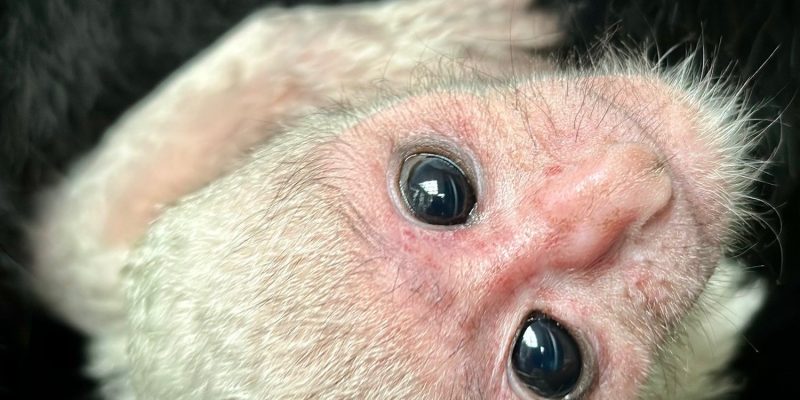
A black-and-white colobus monkey was born at Lincoln Park Zoo in the early hours of September 24, and for the next six weeks he will be the easiest animal to find in the Helen Brach Primate House. Colobus infants are born pure white, against parents who are almost entirely black.
The male infant is the first for seven-year-old Nola. The father is Oku, an eleven-year-old male who arrived in Chicago in 2024. The zoo says mother and newborn are both doing well and are being watched closely by care staff, and that all three are still with the family troop, which is paying the new arrival plenty of attention.
Why is the baby white?
Nobody has settled the question, but the effect is not subtle. An adult guereza is black with a white-framed face, a long white fringe of fur running from the shoulder down the sides and across the back in a U, and white fur at the tip of a tail that is longer than the body. A newborn carries none of that pattern. He is white all over, which makes him instantly identifiable inside a tight group of dark animals.
The zoo says the color change starts at about six weeks and the adult coat takes roughly six months to arrive. For visitors, that is a short and specific window.
A stomach built for leaves
Colobus monkeys are leaf-eaters from equatorial Africa, living high in rainforest canopy. Leaves are a poor meal, full of fiber and defensive compounds, and the animals solve that with a stomach divided into four chambers, one of which is a foregut. A foregut is a fermentation chamber that sits ahead of the true stomach, where bacteria break down plant material and neutralize some of its toxins before digestion proper begins. It is the same basic arrangement a cow uses, arrived at independently in a tree-dwelling primate.
The long white fringe may do mechanical work as well as visual. Some researchers think it acts like a parachute when the animals leap, letting them cover long horizontal distances between trees without dropping much height.
Four generations in one troop
The unnamed infant joins a group built around Kutaka, a 22-year-old female, and several of her offspring: Kean, three; Zinga, four; and Nola, seven, the baby’s mother. Guereza troops are small and tightly bound, usually one male with several females and their young, and may run to about 15 animals. Females give birth to a single infant roughly every 20 months after a gestation of four to six months. Males mature at about six years, females at about four.
What the Species Survival Plan was managing
The birth came from a recommendation by the Guereza Colobus Species Survival Plan, the Association of Zoos and Aquariums program that pairs animals across accredited institutions to keep the managed population genetically varied. That is worth stating precisely, because it is easy to read an SSP birth as a rescue of a vanishing species.
It is not, in this case. The IUCN Red List assesses the guereza as Least Concern, in an assessment by De Jong, Butynski and Oates published in 2025. The zoo’s own wording, that the species is at lower risk of extinction while facing deforestation, habitat loss and illegal hunting, matches that reading. The SSP here is doing population genetics on a common animal, which is the ordinary and unglamorous version of the work.
Where to see him
The troop lives in the Helen Brach Primate House. Lincoln Park Zoo says animal care staff may ask the group to spend time behind the scenes while they monitor Nola’s condition and feeding, so the troop will be visible intermittently rather than on a fixed schedule, including during Fall Fest. The zoo had another arrival the same month, when trumpeter swans returned to the Swan Pond, so a visit aimed at the new baby has a second stop built in.
Quick answers
- When was the colobus infant born?
In the early hours of September 24, 2026, at Lincoln Park Zoo in Chicago. The infant is male and had not been named when the zoo announced the birth.
- Who are the parents?
Nola, a seven-year-old female and a first-time mother, and Oku, an eleven-year-old male who arrived at the zoo in 2024. The zoo says mother and newborn are both doing well.
- Why is a baby colobus white when the adults are black?
Black-and-white colobus monkeys are born with a pure white coat, which makes an infant easy to pick out inside a troop of dark adults. The zoo says the color starts changing at about six weeks, and the adult coat takes around six months to come in.
- What do colobus monkeys eat?
Leaves. They live in rainforest canopy in equatorial Africa and have a four-chambered stomach including a foregut, a fermentation chamber ahead of the true stomach where bacteria break down plant material and neutralize some of its defensive compounds.
- Is the species endangered?
No. The IUCN Red List assesses the guereza, Colobus guereza, as Least Concern, in an assessment by De Jong, Butynski and Oates published in 2025. The zoo describes the species as at lower risk of extinction while facing deforestation, habitat loss and illegal hunting.
- Where can the troop be seen?
In the Helen Brach Primate House. The zoo says care staff may ask the group to spend time behind the scenes while they monitor Nola, so the troop will be visible intermittently rather than on a fixed schedule.