
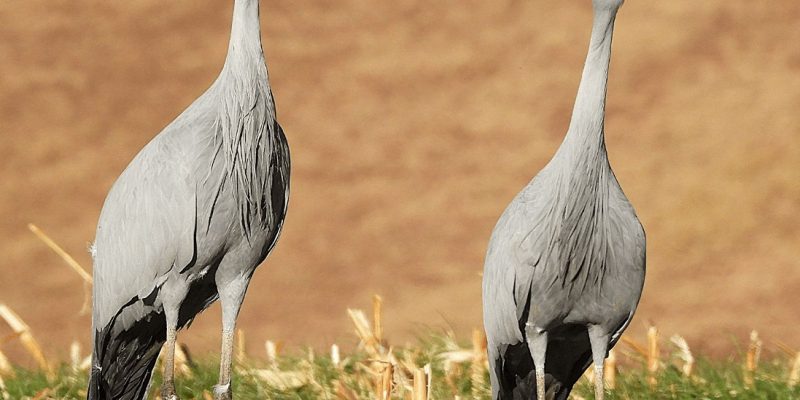
Over four days in July 2026, 547 people in South Africa went outside, looked at cranes, and sent in what they saw. The result is 18,888 Blue, Wattled and Grey Crowned Cranes logged on farmland, in wetlands, on open ground and in conservation areas, and the country’s first National Crane Census in 20 years.
It was run by the Endangered Wildlife Trust and the International Crane Foundation under the banner “Every Count Matters”, and the thing that made it possible is less romantic than the birds: people could submit a count and a location from a cellphone. Earlier censuses needed forms that were only available in certain places, or had to be posted. Lowering that barrier is most of why 547 people took part.
What the count actually found
970 sightings were submitted in all, about 300 of them before or after the four-day window of 24 to 27 July. 824 carried coordinates and could be mapped. Records missing a species or a usable location were removed.
In the final dataset, Blue Crane sightings numbered 13,172, Grey Crowned Cranes 4,944 and Wattled Cranes 384. A further 388 birds were counted without a species recorded and sit outside those three totals, which is how the national figure reaches 18,888.
The largest single flock was more than 500 Blue Cranes on a harvested pivot field near Groot Brak Rivier in the Western Cape. More than 150 Grey Crowned Cranes were recorded together at Himeville in KwaZulu-Natal. Twenty-two people saw all three South African crane species during the census, and 96 saw two.
Why a count of common birds is worth doing
Two findings answer that better than any argument about methodology.
Three color-ringed cranes were recorded, one each in Mpumalanga, KwaZulu-Natal and the Free State. The EWT has been ringing cranes for years, and resighting them is the hard part, because cranes move far enough that a ringed bird usually disappears from the record. Three sightings is three data points on how far and where.
The second is better. One participant found the hybrid Blue Crane and Wattled Crane juvenile, a bird raised by mixed-species parents, which the partnership had lost track of after it was color-ringed. It turned up 200 kilometers from where it was raised. Nobody was looking for it. Somebody with a phone happened to be standing in the right field.
The census also put Wattled Cranes in places the partnership did not know they used, which matters more for that species than for the other two, and which is the kind of result that redirects where conservation attention goes next year.
Which zoo is behind this?
The International Crane Foundation, and it is not a funder standing at a distance. It is an accredited zoo in its own right.
The Foundation, based in Baraboo, Wisconsin, was re-accredited by the Association of Zoos and Aquariums on 26 September 2024, at the AZA annual conference in Calgary. Accreditation involves a detailed application and a multi-day on-site inspection by independent zoological professionals covering animal care and wellbeing, veterinary care, staff training, safety, education, conservation, financial stability and governance. The Foundation keeps all 15 of the world’s crane species, including Whooping Cranes in its Crane City breeding facility.
And the census is not an EWT project that cites the Foundation. The two organizations run African crane work as a formal partnership that began in 1994, and the census carries both names. Dr Rich Beilfuss, the Foundation’s president and chief executive, has described more than fifty years of work on the birds. This is the connection the funding question is usually looking for, and here it is unusually direct: the institution paying attention to these cranes is itself a zoo.
Are these birds in trouble?
It depends which list you read, and the two lists disagree in both directions. This is worth going slowly over, because the source and the global assessment do not line up and both are right.
South Africa keeps its own Red Data Book of Birds, covering South Africa, Lesotho and Eswatini. The EWT reports that the Blue Crane, South Africa’s national bird, was uplisted there from Near Threatened to Vulnerable in 2025, that the Wattled Crane was downlisted from Critically Endangered to Endangered after sustained work in the Drakensberg, and that the Grey Crowned Crane is listed as Vulnerable.
The global IUCN Red List reads differently. The Blue Crane is Vulnerable, assessed on 16 June 2020 and published in 2021, with 17,000 to 30,000 mature individuals and a decreasing trend. The Wattled Crane is Vulnerable globally, assessed on 10 August 2018, with 6,000 to 6,300 mature individuals. And the Grey Crowned Crane is Endangered, assessed on 18 July 2024 by BirdLife International, with 20,100 to 24,600 mature individuals.
So the Wattled Crane is rarer in South Africa than it is globally, and the Grey Crowned Crane is the reverse: a national listing one step gentler than the global one. Neither is an error. A regional assessment measures how a species is doing inside one country’s borders, a global assessment measures the whole range, and a bird can be recovering in the Drakensberg while declining across the rest of the continent. We default to the IUCN assessment where the two are compared, and we name the list each time, because “Vulnerable” on its own tells a reader nothing about which question was asked.
The Wattled Crane case is the clearest. The International Crane Foundation and the EWT announced the regional downlisting in March 2025. The species had been regionally Critically Endangered since 2015, when the KwaZulu-Natal aerial survey, run for 32 years with Eskom and Ezemvelo KwaZulu-Natal Wildlife, found 267 birds. In 2024 that survey counted 304. The partnership was careful at the time to say that a regional downlisting means the South African population is no longer declining, not that it is secure, and that the global population is still going the wrong way. The census numbers above, with 384 Wattled Crane sightings against 13,172 Blue Crane sightings, are what that caution looks like in a dataset.
What the census changed
Since the last national count 20 years ago, the partnership’s localised aerial surveys have indicated that all three species are increasing in KwaZulu-Natal and declining elsewhere. A national census is how you test that, and how you find the birds the aerial transects fly over.
The practical value is that South Africa’s cranes live almost entirely on privately owned land. A map built from 824 located sightings tells conservation staff which farmers to talk to. The EWT’s own summary puts the softer outcome first: the census got South Africa talking about cranes. For birds that depend on landowners, that is not a throwaway line.
Cranes turn up on this beat from both ends. We have written about the West African crowned crane chick hatched at Brevard Zoo, a bird of the same family being raised in human care while its relatives are counted in a Free State field.
Quick answers
- How many cranes were counted in South Africa’s 2026 census?
Participants reported 18,888 Blue, Wattled and Grey Crowned Cranes. A further 388 birds were recorded without a species and were left out of the species totals.
- How many people took part?
547 people took part, submitting 970 sightings. 824 of those carried coordinates and could be mapped, and about 300 arrived outside the four-day window of 24 to 27 July 2026.
- Which three crane species live in South Africa?
The Blue Crane, the Wattled Crane and the Grey Crowned Crane. The Drakensberg range is a global hotspot for all three.
- Why did the census rely on cellphones?
Earlier censuses required paper forms that had to be collected or posted. Letting people submit a count and a location from a phone opened the census to anyone who could see a crane.
- What did the census find that aerial surveys could not?
It located Wattled Cranes in areas the partnership did not know they used, recorded three colour-ringed birds in three provinces, and relocated a Blue Crane and Wattled Crane hybrid 200 km from where it was raised.
- Which zoo is behind the National Crane Census?
The International Crane Foundation, which is accredited by the Association of Zoos and Aquariums and runs the census jointly with the Endangered Wildlife Trust as a formal partnership dating to 1994.
- Are South Africa’s cranes listed the same way worldwide?
No. The Grey Crowned Crane is Vulnerable in the South African Red Data Book and Endangered on the global IUCN Red List, while the Wattled Crane is Endangered regionally and Vulnerable globally.