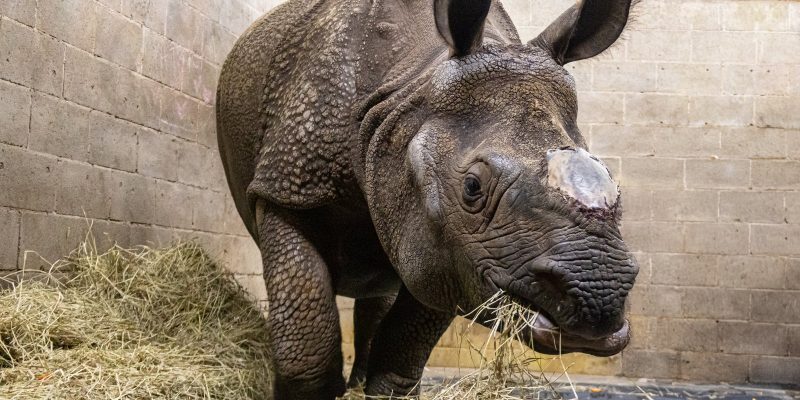
A five-year-old male greater one-horned rhinoceros named Patrick has arrived at the Buffalo Zoo from the Bronx Zoo, where he was born on June 20, 2021. He weighs more than 3,600 pounds. He is settling in behind the scenes and is not yet visible to guests.
The move was made on a breeding recommendation from the Association of Zoos and Aquariums Species Survival Plan, the program that decides which animals in accredited collections should be paired. The pairing in question is Patrick and Georgia, the Buffalo Zoo’s own five-year-old female greater one-horned rhino. Nothing has happened yet. What has happened is that the zoo now holds a breeding pair of a species it has kept for decades.
Getting two tons into a barn a truck cannot reach
The logistics are the part worth slowing down for, because they are the part that usually goes unsaid.
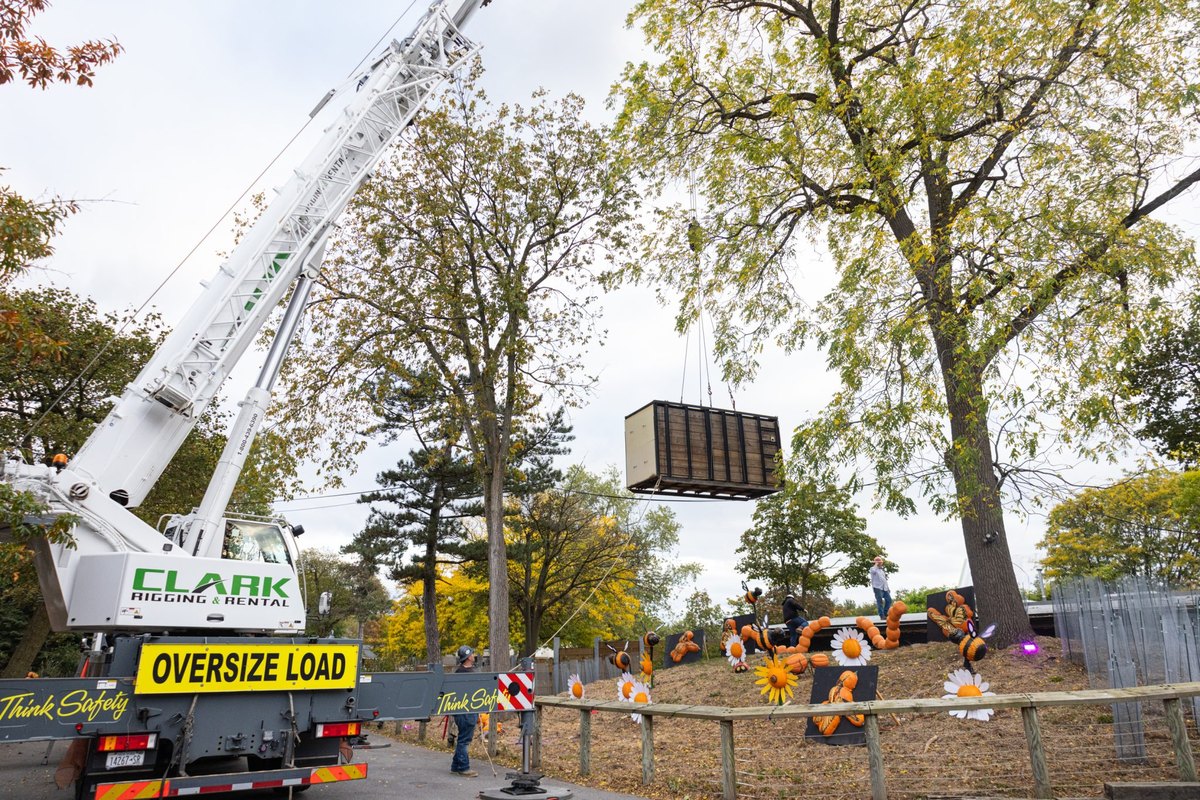
Moving a rhinoceros between accredited institutions means a purpose-built transport crate, a veterinary sign-off at both ends, and a crew who have rehearsed it. At the Buffalo end there was an additional problem: the zoo’s greater one-horned rhino barn cannot be reached by a standard transport truck. A berm, a hay shed and a stand of trees sit between the barn and the nearest spot a vehicle can park.
So the zoo brought in a heavy-duty crane and lifted Patrick’s crate over the obstacles, more than two stories up, and set it down on the far side. He walked out into the barn on his own, to a spread of his favorite food. The zoo credits its official partner, Reimer HomeServices, with underwriting the move.
“We are thrilled to welcome Patrick to the Buffalo Zoo,” said Lisa Smith, Buffalo Zoo President and CEO. “His arrival represents more than just a new addition to our rhino family. It is an important investment in the future of the Buffalo Zoo’s greater one-horned rhino program.”
What is a greater one-horned rhino, and why does the count matter?
Greater one-horned rhinos are the large Asian rhinoceros of the floodplain grasslands of India and Nepal, and they are the species whose hide folds into plates that look like armor. They are also the rhino conservation story that went right.
The IUCN Red List assessment of Rhinoceros unicornis, dated December 6, 2018 and published in 2019, lists the species as Vulnerable, with 2,100 to 2,200 mature individuals. The number that matters most in that entry is not the total. It is the population trend, which the assessment records as increasing. Very few rhinoceros assessments say that.
The same assessment records what it cost to get there. The species is extant in India and Nepal and extinct in Bangladesh and Bhutan, which is to say it holds on across a fraction of the range it once had. An increasing trend inside a shrunken range is a real result and a narrow one, and it is the reason a studbook keeps track of where a five-year-old bull in New York ought to live.
Where this sits in Buffalo’s year
Patrick is the second significant arrival the Buffalo Zoo has announced this autumn, after the pair of dwarf caimans that went on habitat in Rainforest Falls in early November, also on a Species Survival Plan recommendation. Both are the same kind of decision made at the same desk: a continental population managed as one, animal by animal.
The zoo has not set a date for Patrick’s public debut and is pointing guests at its social channels for the announcement. Until then he is in the barn, learning the building and the keepers, roughly two tons of a species that is slowly winning.
Quick answers
- Who is Patrick?
A five-year-old male greater one-horned rhinoceros who arrived at the Buffalo Zoo from the Bronx Zoo, where he was born on June 20, 2021. He weighs more than 3,600 pounds.
- Can visitors see Patrick?
Not yet. He is settling in behind the scenes and is not currently visible to guests. The Buffalo Zoo has not announced a debut date and is pointing guests at its social channels.
- Why was Patrick moved to Buffalo?
On a breeding recommendation from the Association of Zoos and Aquariums Species Survival Plan. The zoo hopes he will eventually breed with Georgia, its own five-year-old female greater one-horned rhino.
- Why did the zoo need a crane?
The Buffalo Zoo's greater one-horned rhino barn cannot be reached by a standard transport truck. A berm, a hay shed and trees sit in the way, so a heavy-duty crane lifted Patrick's crate more than two stories over them.
- How endangered is the greater one-horned rhino?
The IUCN Red List assessment dated December 6, 2018 lists Rhinoceros unicornis as Vulnerable, with 2,100 to 2,200 mature individuals and an increasing population trend.
- Where do greater one-horned rhinos live?
The IUCN assessment records the species as extant in India and Nepal, and extinct in Bangladesh and Bhutan.
- What is a Species Survival Plan?
An Association of Zoos and Aquariums program that manages a species across accredited institutions as a single population, deciding which animals should be paired and where they should live.
- Who paid for the move?
The zoo credits its official partner, Reimer HomeServices, with making the transfer possible.