
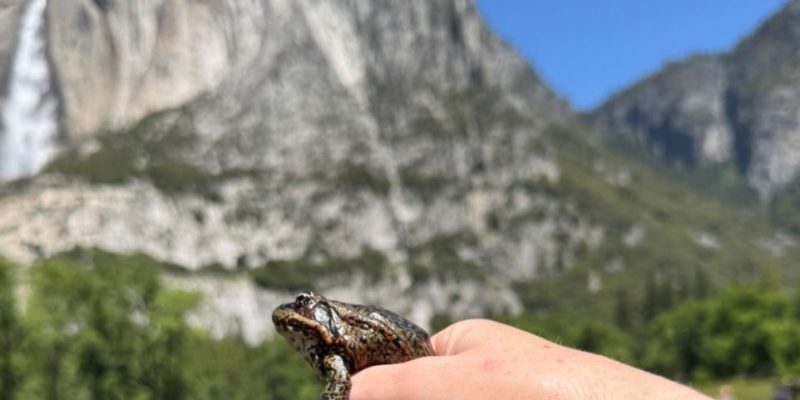
Ten years ago there were no California red-legged frogs in Yosemite Valley. On May 7, 2026, the partners who put them back released the program’s 10,000th frog there, a symbolic animal nicknamed Twain, at a ceremony near Yosemite Falls. San Francisco Zoo and Gardens rears the frogs that make the releases possible.
The recovery is led by the National Park Service, working with the U.S. Fish and Wildlife Service, the California Department of Fish and Wildlife, Yosemite Conservancy and the zoo. The California red-legged frog was listed as threatened under the federal Endangered Species Act in 1996, and it had been gone from this stretch of the park for decades.
What drove them out
Two things, and neither was subtle. American bullfrogs, introduced to the park, drove the decline and eliminated red-legged frogs from the area outright. Raccoon numbers were also elevated, fed by open refuse sites that stayed in use in the park until the 1970s.
Park staff spent decades removing bullfrogs. Habitat work tied to the Merced River Plan restored the wetlands, streambanks and river systems the frogs need. Only then was there anywhere worth releasing a frog into.
“This milestone reflects years of focused work to restore a species that plays an important role in the park’s ecosystem,” said Rob Grasso, aquatic ecologist at Yosemite National Park. “After invasive bullfrogs eliminated red-legged frogs from the area decades ago, we removed those threats and created conditions for recovery. Today, multiple generations of frogs are established in Yosemite Valley.”
Where does a zoo fit into a national park’s frog problem?
It supplies the frogs, and it supplies them at a size that survives.
In 2016 the National Park Service and the San Francisco Zoological Society built a dedicated rearing facility in San Francisco. Staff there collect eggs from the wild and raise the frogs in a controlled environment to one and two years old before they go to the park. That is head-starting, and the delay is the whole point: the animals enter the park well past the egg and tadpole stages, which are the stages an amphibian is least likely to survive.
The arrangement runs under the Zoo-Park Partnership Program, facilitated by the Wildlife Restoration Foundation, and is treated as a model for species recovery in California.
“When the program began in 2016, no California red-legged frogs remained in Yosemite Valley,” said Dr. Rochelle Stiles, director of field conservation at San Francisco Zoo and Gardens. “Today, every frog in the valley traces back to this effort. Despite drought, severe winters and flooding, the population has proven resilient.”
That last clause is the part that matters. Ten thousand animals released is an input. Multiple generations breeding on their own, through a decade that included drought and flooding, is an outcome.
The numbers this year
The zoo expects to release about 830 juvenile frogs into Yosemite this year and to raise roughly 600 eggs for future release. The program has not stopped at the milestone.
“Our partners have been essential to the recovery of the California red-legged frog,” said Kim Turner, acting field supervisor for the Sacramento Fish and Wildlife Office. “We appreciate the progress made over the past decade and remain committed to this collaborative effort.”
California’s share of the work was paid for in part by voters. “The California Department of Fish and Wildlife is proud to have assisted the recovery of California’s official state amphibian in Yosemite,” said Laura Patterson, amphibian and reptile conservation coordinator for the department. “Grants administered by the Department, using funds approved by the voters of California, facilitated the habitat restoration necessary for the success of this recovery effort.”
One more name belongs in this: Diane Buchholz, a private landowner in Garden Valley, California, let researchers collect frog eggs on her property. A reintroduction needs founder animals, and somebody has to say yes.
The frog itself
The California red-legged frog is the largest native frog in the western United States, two to five inches long, with the reddish underside that gives it its name and a soft, short call. It lives in ponds, streams and wet meadows.
It is also the frog in Mark Twain’s “The Celebrated Jumping Frog of Calaveras County,” which is where the 10,000th animal got its nickname. It is California’s official state amphibian, and it has been federally threatened since 1996, which is a strange pair of facts to hold at once.
Zoo-reared amphibian releases have become one of the more productive corners of the field. Santa Barbara Zoo runs its own California red-legged frog releases, and Vancouver Aquarium has been putting northern leopard frog tadpoles back into British Columbia. Amphibians breed in numbers, they are cheap to rear compared with a large mammal, and the habitat work that makes a release stick tends to benefit everything else in the wetland.
What a visitor sees
Not much, and that is the correct answer for a frog. There is no exhibit to walk past in Yosemite Valley, no viewing window. What is there is a valley with multiple generations of a native frog established in it, breeding without help, after decades of having none at all. Ten thousand frogs is the number. The frogs that hatched there on their own are the result.
Sources: San Francisco Zoo and Gardens, May 7, 2026, and the U.S. Fish and Wildlife Service species profile for Rana draytonii.
Quick answers
- How many frogs has the Yosemite program released?
Ten thousand. Partners marked the milestone on May 7, 2026, with the symbolic release of the 10,000th frog, nicknamed Twain, near Yosemite Falls.
- What is San Francisco Zoo's role in it?
It rears the frogs. A dedicated facility built in San Francisco in 2016 through a partnership between the National Park Service and the San Francisco Zoological Society raises frogs from wild-collected eggs to one and two years old before they go to the park.
- Why did red-legged frogs disappear from Yosemite Valley?
Introduced American bullfrogs eliminated them, and elevated raccoon numbers, fed by open refuse sites that stayed in use until the 1970s, contributed. When the program began in 2016 no California red-legged frogs remained in the valley.
- Is the California red-legged frog endangered?
It is listed as threatened under the federal Endangered Species Act, a listing made in 1996. It is also California's official state amphibian and the largest native frog in the western United States, two to five inches long.