
In British Columbia there is exactly one wild population of Northern Leopard Frogs left. One.
On Monday, June 16, 2025, the Vancouver Aquarium released 2,500 endangered Northern Leopard Frog tadpoles into natural habitat near Cranbrook. It was the aquarium’s second most successful year since the program began, and it came from the biggest egg mass it has ever produced.
“Northern Leopard Frogs are notoriously difficult to breed, and it is often dependent upon things outside our control, such as weather conditions before and during breeding season. We are delighted that it was such a successful year for this program.”
Andrew Cumming, biologist, Vancouver Aquarium
The work is done with the Wilder Institute, the Calgary Zoo, the Edmonton Valley Zoo and the Northern Leopard Frog Recovery Team.
Amphibians are in the worst trouble of any group of vertebrates
This is the part that does not make the evening news, so it is worth stating plainly.
Amphibians are the most threatened class of vertebrates on earth. Roughly two in five amphibian species are threatened with extinction, a worse rate than birds, mammals or reptiles. They are being hit from several directions at once: habitat loss, drainage of wetlands, pesticides, a warming and drying climate, and a chytrid fungus that has driven declines in hundreds of species and is implicated in extinctions on multiple continents.
A frog is a bad candidate for a fundraising poster. It is small, it is not cuddly, and it does not photograph like a tiger cub. That is precisely why this work has almost no other source of money.
Why humans need them
Amphibians sit in the middle of food webs, eating enormous quantities of insects and being eaten in turn. A single frog population removes an amount of mosquitoes, midges and agricultural pests that nobody has to pay for.
Their skin is permeable, which is why they are the first thing to go when water quality drops, and why biologists treat them as an early warning system. A wetland that has lost its frogs is telling you something about the water before it tells you anything else.
And amphibian skin has been a genuinely productive source for medicine. Compounds first identified in frog skin secretions have driven research into painkillers and antimicrobials. Every population that disappears takes an unread chemistry library with it.
Who is actually paying for this
Head-starting frogs is slow, technical and unrewarding work. You have to get adults to breed in human care, which as Cumming notes depends partly on weather you do not control. You have to raise egg masses to tadpoles. You have to move thousands of tadpoles to a site that will still be wet in August, and then you have to come back and count.
Almost nowhere else is funding this. Government recovery money for amphibians is thin, private philanthropy follows charismatic species, and there is no commercial return. Accredited zoos and aquariums are carrying this work, largely on admission revenue from people who came to see the otters.
“These animals are part of our shared natural heritage as Canadians, and it is a privilege to take action to preserve them for future generations. I hope others are inspired to act themselves.”
Andrew Cumming
That is the argument for a zoo in one sentence, made by someone standing in a creek with a bucket.
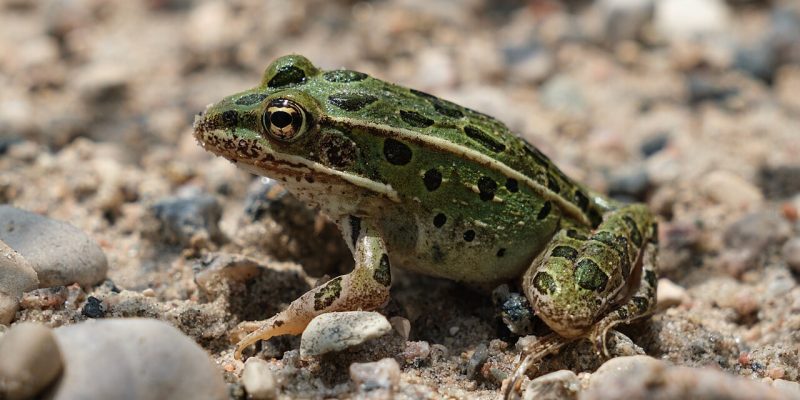
Source: Vancouver Aquarium. Photograph of a Northern Leopard Frog by Jasper Shide, released under CC0.