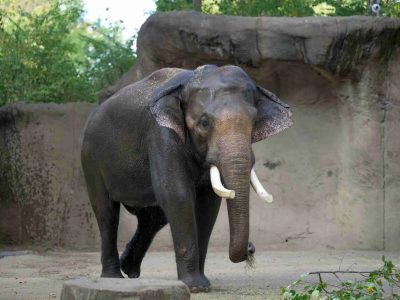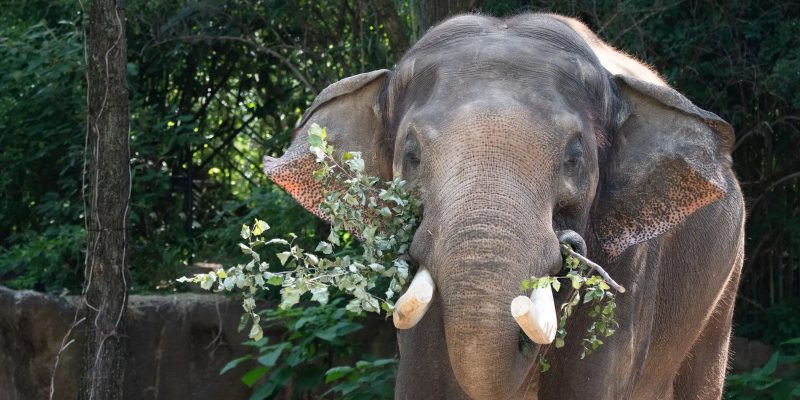
Raja, the 33-year-old Asian elephant bull who was the first elephant ever born at the Saint Louis Zoo, arrived at the Cincinnati Zoo & Botanical Garden on Thursday, October 29, 2026, and is settling into Elephant Trek. He weighs about 10,000 pounds. The reason he moved is genetic: he is related to every breeding-age female at the zoo he left, and to neither of the two females he is joining.
That is the whole mechanism of the transfer, and it is worth stating before anything else, because an elephant changing zoos reads like a logistics story and is actually a pedigree story.
Who is he joining?
Two females, Anak and Yasmin, known at the zoo as She-Ra. Cincinnati’s director of animal care, Christina Gorsuch, said both animals’ genetics are underrepresented in the managed North American population, and that the pairing is the point.
“Raja sired several calves during his years at the Saint Louis Zoo, and we’re hoping that he will hit it off with Anak and Yasmin (aka She-Ra), the females here,” Gorsuch said. “He is related to all of the females of breeding age at the Saint Louis Zoo, and breeding with the females in Cincinnati would add much-needed genetic diversity to the North American Asian elephant population.”
The two females have lived with Cincinnati’s bull Sabu for more than two years, and the zoo says he has shown almost no interest in breeding with them. That is the gap Raja is being asked to fill.
What is a Species Survival Plan actually deciding?
Where every animal lives. The Asian Elephant Species Survival Plan is the Association of Zoos and Aquariums program that treats every Asian elephant at every accredited North American institution as one population instead of as a set of separate collections. It is solving for two things at once: social groups that work, and enough genetic diversity for the population to sustain itself without taking animals from the wild.
Raja’s move is one of four the program has recommended in this round. Another bull is going to Saint Louis. Cincinnati’s own young bulls, Sanjay and Kabir, are leaving for another accredited zoo, expected sometime in December.
“Sanjay and Kabir are maturing and need to start their own journeys to become dads,” Gorsuch said.
That is the part of the arrangement people find hardest, and it is also the part that is least unusual. Bulls move. Adult male elephants leave the group they were born into, and a program that mimics that is doing what the species does. We wrote about Raja’s departure from St. Louis, and about what the zoo that raised him lost, here.
Why those two young bulls matter beyond Cincinnati
Sanjay and Kabir were vaccinated in 2024 against elephant endotheliotropic herpesvirus, the fast-moving disease that kills elephant calves, in what Cincinnati Zoo describes as the world’s first mRNA vaccination against EEHV. Both later tested positive for the virus, developed antibodies, subsequently tested negative, and the zoo says both are thriving. That sequence is the closest thing the field has to a demonstration that the vaccine does what it was built to do, and it is why other institutions have followed. The Saint Louis Zoo gave a calf named Jet his third dose at the end of September, which we covered here.
How many Asian elephants are left?
The U.S. Fish and Wildlife Service, citing the IUCN Red List, classifies the Asian elephant as endangered and puts the wild population at somewhere between 30,000 and 50,000, with habitat loss and fragmentation the primary driver of the decline, followed by conflict with people and poaching for ivory. The agency notes that in Sri Lanka alone, more than 100 elephants and 50 people are killed in conflict events each year.
Cincinnati Zoo’s announcement gives the figure as “fewer than 50,000,” which sits at the top of that range rather than contradicting it. We default to the assessment where the two differ, and here the difference is only that the range carries its lower bound with it. Either way the number is small enough that the parentage of a single bull is a national question, which is the thing the Species Survival Plan exists to manage. The agency’s species profile is here.
Can you go and see him?
Yes, with a caveat the zoo states up front: introductions between elephants take time, and there will be stretches when Raja or other members of the herd are not on view. Elephant Trek is the zoo’s largest habitat, a 3.8-acre outdoor yard with a 15,000-square-foot Elephant Center and a set of off-habitat care yards behind it, and it won Top Honors in the AZA Exhibit Award in September, which we wrote about here. The zoo is open 10 a.m. to 5 p.m. daily. Sanjay and Kabir are expected to leave in December, so the window to see the pair who went first is short.
Quick answers
- When did Raja arrive at the Cincinnati Zoo?
Thursday, October 29, 2026. He is settling into Elephant Trek, the zoo’s largest habitat.
- Why did Raja leave the Saint Louis Zoo?
On a recommendation from the Association of Zoos and Aquariums Asian Elephant Species Survival Plan. He is related to every breeding-age female at the Saint Louis Zoo and to neither of the two females at Cincinnati, so breeding in Cincinnati adds genetic diversity that breeding in St. Louis could not.
- How old and how large is Raja?
Thirty-three years old and about 10,000 pounds. He was the first elephant ever born at the Saint Louis Zoo.
- Which elephants is he joining?
Two females, Anak and Yasmin, who is known at the zoo as She-Ra. Both have lived with Cincinnati’s bull Sabu for more than two years, and the zoo says Sabu has shown almost no interest in breeding with them.
- What happens to Sanjay and Kabir?
The two young Cincinnati bulls are moving to another accredited zoo, expected sometime in December. They were vaccinated against EEHV in 2024, later tested positive, developed antibodies, then tested negative, and the zoo says both are thriving.
- How many Asian elephants are left in the wild?
The U.S. Fish and Wildlife Service, citing the IUCN Red List, classifies the species as endangered and puts the wild population between 30,000 and 50,000. Habitat loss and fragmentation are the primary driver of the decline, followed by conflict with people and poaching for ivory.