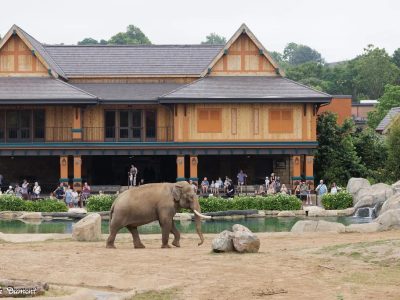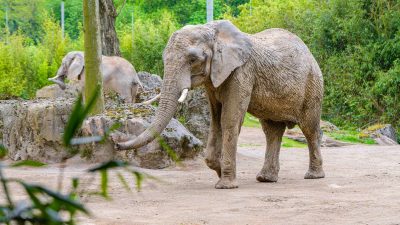

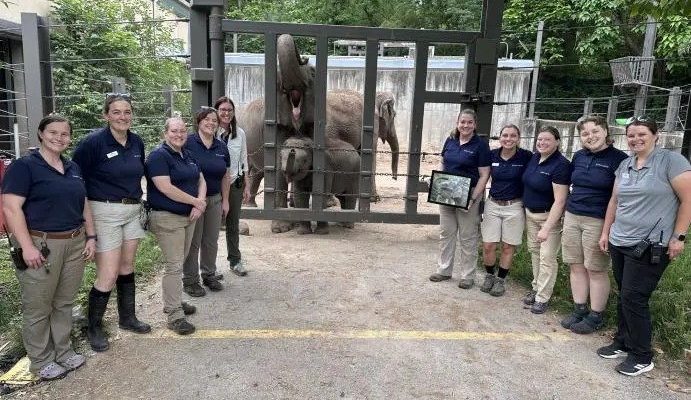
An Asian elephant calf at the Saint Louis Zoo has been vaccinated against the virus that kills more young elephants than anything else. Jet received his third dose of an experimental mRNA vaccine for elephant endotheliotropic herpesvirus, or EEHV, on Wednesday, September 30. He is the first elephant at the Saint Louis Zoo to receive it.
He is also among the first Asian elephant calves anywhere to get the vaccine, which was developed by virologists at Baylor College of Medicine. The zoo reports he is doing well.
Why a calf is the one who needs it
EEHV was identified in 1995, and it behaves unlike almost anything else elephants face. Adults carry it quietly. Calves do not. In young elephants a sudden active infection carries a mortality rate of 60 to 80 percent, and it can move from the first sign of illness to death in a matter of days. It is present in wild herds and in managed ones alike, which means no amount of care in a barn makes it somebody else’s problem.
What protects a calf in his first months is not his own immune system but his mother’s. Maternal antibodies cross to the calf and circulate in his blood, borrowed immunity that works well and then runs out. Jet has those antibodies now. Over the next year or two they will steadily fall away, and until he meets the virus himself and mounts his own response, he is exposed.
That gap is the whole point of the vaccine. It is not a replacement for natural immunity. It is a bridge across the window where the borrowed kind has faded and the earned kind has not arrived.
What “third dose” actually means
The EEHV vaccine is given in multiple rounds rather than as a single shot, which is why the September 30 appointment matters more than the first one did. Jet’s first came on May 27, 2026. Each round is followed by blood work, and the Saint Louis Zoo’s animal care and veterinary teams will keep testing his antibody levels to see what the vaccine is actually buying him.
“This vaccination is a critical step forward in the decades-long effort to protect Asian elephants from EEHV,” said Dr. Kari Musgrave, the zoo’s Director of Animal Health. “After years of collaboration with researchers, veterinarians and elephant care experts, we’re thrilled to have Jet vaccinated against this devastating disease.”
The work behind it is genuinely decades long. Researchers at Baylor and veterinarians at the Houston Zoo began developing an mRNA vaccine for EEHV in 2009. Adult elephants at Houston received the first doses in 2024, and accredited zoos across North America have been adopting it experimentally since. Houston has widened its own program to African elephants, and the Oregon Zoo’s Tula-Tu was the first elephant on the West Coast to receive it.
Early results have shown strong immune responses. Researchers recently reported the first evidence of clinical protection, when two vaccinated juveniles picked up a natural EEHV 1A infection and recovered on their own, without medical intervention. That is the outcome everyone has been working toward: not an elephant who never meets the virus, but an elephant who meets it and walks away.
Why this zoo, and why this calf
The Saint Louis Zoo has reason to take EEHV personally. Kenzi, a six-year-old Asian elephant, died of the disease in 2018. She remains the only elephant the zoo has lost to it.
“Our team understands just how devastating EEHV can be,” said Katie Pilgram-Kloppe, Curator of Ungulates and River’s Edge. “I can’t describe how it feels to know that Jet has an extra layer of protection against the virus that has threatened his species for decades.”
Since then the zoo has built itself into one of the places other institutions lean on. In 2021 it stood up its own polymerase chain reaction laboratory, which lets staff test an elephant’s blood for viral DNA within hours of drawing it rather than shipping samples out and waiting. With a disease that can kill in days, hours are the entire margin. The zoo’s animal health team also keeps a plasma bank that other zoological institutions can draw on to treat active EEHV cases, and contributes to blood cross-matching and antiviral treatment research.
Who Jet is
Jet was born on November 23, 2024, the first Asian elephant at the Saint Louis Zoo conceived through artificial insemination. His mother is Jade, a zoo resident; his father is Jake, at the Denver Zoo Conservation Alliance. The pairing came on a recommendation from the Association of Zoos and Aquariums’ Asian Elephant Species Survival Plan, the cooperative program that decides which animals in accredited North American collections should be bred together to keep as much genetic variation in the population as possible.
Artificial insemination is what made that particular match workable. Jade could contribute her genes to the population without leaving the family group she lives in, which for a species that holds multi-generational social bonds is not a small consideration. Jet is the newest member of an eight-animal, four-generation herd at the zoo that also includes Ellie, Maliha, Pearl, Priya, Sri and Raja.
The IUCN Red List assesses the Asian elephant as Endangered. The zoo also funds field work for the species through its WildCare Institute Center for Asian Elephant Conservation, which supports programs in Laos, Sumatra and elsewhere across the range, and it takes part in the AZA’s Saving Animals From Extinction program for the species.
What this changes
Nothing a visitor can see, which is rather the point. Jet is a not-quite-two-year-old elephant in a four-generation family group, and he will go on being exactly that. What changed on September 30 is a number in his blood work and the odds on a year of his life that nobody can schedule. Every accredited zoo holding a young elephant has spent three decades watching for the first sign that something is wrong, knowing how little time that sign leaves. A vaccine that turns that vigil into a routine appointment and a blood draw is the kind of quiet result the field has been working toward since 1995.
Source: Saint Louis Zoo, October 8, 2026.
Quick answers
- What is EEHV?
Elephant endotheliotropic herpesvirus, a viral infection of both wild elephants and elephants in human care, identified in 1995. Adult elephants generally carry it without becoming ill. In young calves an active infection carries a mortality rate of 60 to 80 percent and can kill within days.
- What did the Saint Louis Zoo do?
On Wednesday, September 30, 2026 the zoo gave Asian elephant calf Jet his third dose of an experimental mRNA vaccine against EEHV. He is the first elephant at the Saint Louis Zoo to receive it and among the first Asian elephant calves anywhere to do so. His first dose was on May 27, 2026.
- Who developed the vaccine?
Virologists at Baylor College of Medicine, working with veterinarians from the Houston Zoo, who began the work in 2009. Adult elephants at the Houston Zoo received the first doses in 2024, and accredited zoos across North America have been using it on an experimental basis since.
- Does it work?
Early studies have shown strong immune responses in vaccinated elephants, and researchers recently reported the first evidence of clinical protection, when two vaccinated juveniles contracted a natural EEHV 1A infection and recovered without medical intervention.
- Why does a calf need it when his mother is immune?
A calf is protected at first by maternal antibodies that cross from his mother and circulate in his own blood. Those decline over the first year or two of life. The vaccine is meant to cover the window between the moment that borrowed protection runs out and the moment the calf meets the virus and mounts his own response.
- Who is Jet?
An Asian elephant born at the Saint Louis Zoo on November 23, 2024, the first there conceived through artificial insemination. His mother is Jade and his father is Jake, at the Denver Zoo Conservation Alliance, paired on a recommendation from the AZA Asian Elephant Species Survival Plan. He is part of an eight-animal, four-generation herd at the zoo.
- Is the Asian elephant endangered?
The IUCN Red List assesses the Asian elephant as Endangered.