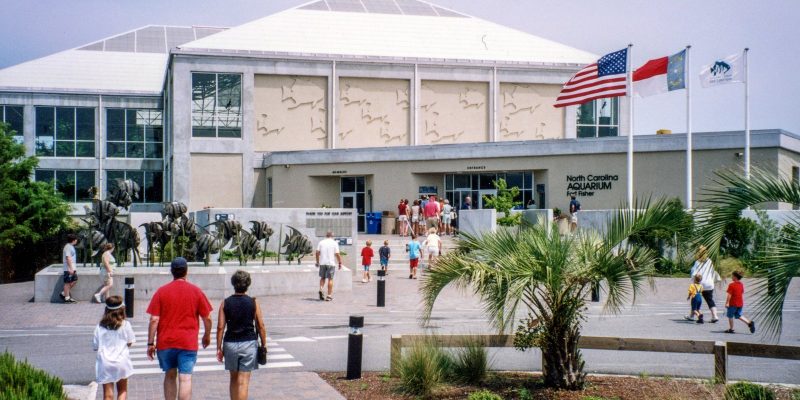
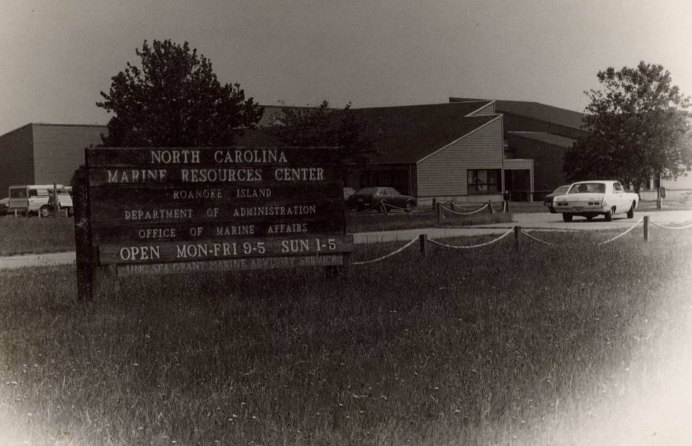
The North Carolina Aquariums are fifty years old this year. The system opened on September 9, 1976, when the state put three new buildings on its coast at the same time: one on Roanoke Island, one at Pine Knoll Shores and one at Fort Fisher. They were not called aquariums. They were Marine Resources Centers, built as hubs for research and education that happened to let the public in.
Half a century later those three sites draw more than a million visitors a year between them, and the system has grown by one. Jennette’s Pier at Nags Head joined in 2011, which gave the Aquariums something none of the original buildings had: a working fishing pier running out over the Atlantic, where the exhibit is the ocean itself.
What does a state aquarium system actually do?
The North Carolina Aquariums are a division of the state’s Department of Natural and Cultural Resources, which is an unusual arrangement worth understanding. Most American aquariums are private nonprofits. These are a public agency, funded and governed as part of state government, with a separate nonprofit partner, the North Carolina Aquarium Society, raising private money alongside the state’s appropriation.
That structure shapes what gets built. The Society’s stated job is to fund new habitats, the care of the animals and the education and conservation research programs, which means the ambitious projects tend to be paid for twice over, once by the taxpayer and once by donors and members.
“For 50 years, the North Carolina Aquariums have played a vital role in inspiring visitors, strengthening coastal communities, and protecting the natural resources that make our state so special,” said Pamela B. Cashwell, secretary of the Department of Natural and Cultural Resources. “This anniversary reflects decades of visionary leadership, sustained community support and dedicated staff who have ensured the Aquariums remain places of learning, wonder, and conservation for generations of North Carolinians.”
What has changed in fifty years?
The mission did. A 1976 Marine Resources Center was principally a place to do coastal science with a public gallery attached. What the three sites grew into are conservation operations: sea turtle rescue and rehabilitation, species research, and education programs that reach schools across the state. The rescue work in particular is the sort of thing the original buildings were never designed for and now define them.
“As we celebrate this milestone, we’re honoring a legacy that’s as deep and vibrant as the waters that connect us,” said Hap Fatzinger, the North Carolina Aquariums director. “It’s both a moment to chart the course we’ve traveled and the one ahead, continuing to inspire wonder and responsibility for our waters and aquatic life.”
The Aquariums and the Aquarium Society are marking the year with events and programs across all four sites, and the system has put its own history online at a dedicated fiftieth anniversary site with a decade-by-decade timeline. If you want a sense of what the work looks like now rather than in 1976, the Roanoke Island site recently contributed a Kemp’s ridley sea turtle named Finn to research on how to age the species.
Three buildings, a pier, fifty years and a million people a year. Not a bad return on a 1976 decision to let the public into the laboratory.
Quick answers
- When did the North Carolina Aquariums open?
On September 9, 1976, when the state opened three Marine Resources Centers at once, on Roanoke Island, at Pine Knoll Shores and at Fort Fisher. Jennette's Pier at Nags Head joined the system in 2011.
- Who runs the North Carolina Aquariums?
They are a division of the North Carolina Department of Natural and Cultural Resources, which makes them a state agency rather than a private nonprofit. The North Carolina Aquarium Society is the separate nonprofit partner that raises private funds alongside the state's.
- How many people visit the North Carolina Aquariums?
More than a million a year across the three aquariums and Jennette's Pier.