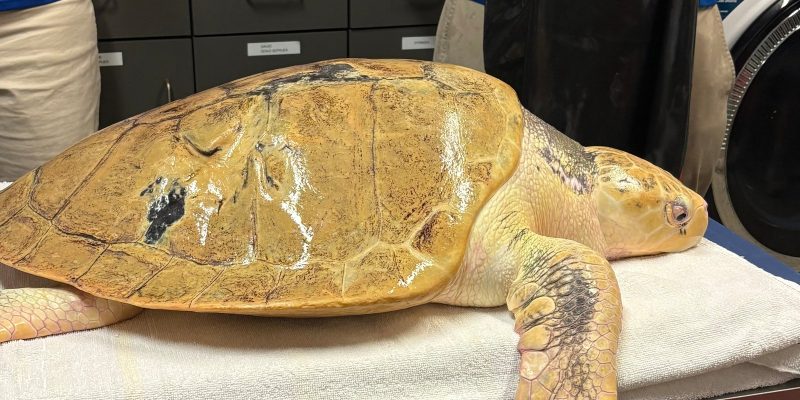
Telling how old a sea turtle is has always meant waiting until it was dead. A doctoral researcher working with the North Carolina Aquariums, at the aquarium on Roanoke Island, is building two ways around that, and one of her reference animals is a Kemp’s ridley sea turtle named Finn who has lived at the aquarium for more than a decade.
Why is age the hard number?
The established method is skeletochronology. A bone is sectioned and the growth marks inside it are counted, the same principle as reading tree rings: each year of growth leaves a line, and the lines add up to an age. It works, and it has one disqualifying limitation. You need the bone, which historically has meant the turtle had to be dead, so the age data behind sea turtle management has come almost entirely from stranded animals.
That skews everything downstream. Growth rate, age at maturity, how long a population takes to replace itself, how a recovery plan should be timed: all of it rests on ages drawn from the animals that washed up, rather than from the ones swimming.
The two tools being built
Jamie Clark, a doctoral candidate at the University of North Carolina Wilmington, is leading a study to develop more accurate aging tools for sea turtles, and Kemp’s ridleys in particular. She is working on two at once.
The first is near-infrared spectroscopy, a light-based technique. A sample is lit with infrared light just past the range the human eye can see, and the pattern of wavelengths it absorbs and reflects acts as a chemical fingerprint of the tissue. Those fingerprints change in regular ways as tissue ages, which is what makes the method a candidate for estimating age without cutting bone.
The second is genomic: a DNA biomarker approach, reading molecular signals carried in the genome that track with an animal’s age.
Neither is useful until it is calibrated, which is what skeletochronology is for here. The old method supplies the known ages the new methods are tuned against. Clark is not replacing ring counting; she is using it as the ruler.
Where Finn comes in
Finn arrived at the aquarium 12 years ago with a severe boat-strike injury to her carapace, the upper shell, along with wounds to her fins and neck. The injuries and the surgeries they required left her unreleasable, so she has lived at the aquarium since, on a target-feeding routine in which an animal is taught to go to a specific marker to be fed, which lets staff control who eats what and watch each animal closely while it does.
In the weeks before the aquarium’s August visit, Clark and an undergraduate researcher collected samples from living Kemp’s ridleys, Finn among them. That is the advance. An aquarium animal with a known history, available for repeat sampling, is exactly the reference point a calibration needs, and it is a job an unreleasable turtle can do that a wild one cannot.
All of the sea turtle work is conducted under permits: ESP-25ST41, issued by the N.C. Wildlife Resources Commission to Dr. Mathew Ramirez, and a 2026 research permit issued to Clark by N.C. State Parks.
What it is worth, and to which turtle
The Kemp’s ridley (Lepidochelys kempii) is listed as Critically Endangered on the IUCN Red List, the highest category of extinction risk the list assigns to a species still in the wild. For a population that small, every demographic number is load-bearing, and age is the one that has been hardest to get.
Once the new tools are calibrated, researchers will be able to estimate the age of a living sea turtle with more accuracy than they can now. Sea turtles are long-lived animals that function as indicators of ocean health, so knowing the real age structure of a population, rather than the age structure of its casualties, changes what conservation decisions can be based on.
It also changes what a resident animal is for. Finn cannot go back to the water. She can, it turns out, help settle how old the turtles still out there are.
Sources: the North Carolina Aquarium on Roanoke Island’s account of the visit, 12 August 2026, and the IUCN Red List assessment for Lepidochelys kempii. The New England Aquarium’s hyperbaric oxygen treatment of a Kemp’s ridley is the clinical end of the same species’ story.
Quick answers
- How do scientists tell how old a sea turtle is?
The established method is skeletochronology, which sections a bone and counts the growth marks inside it the way you would count tree rings. It historically required a dead animal, so most sea turtle age data comes from stranded turtles.
- What are the new methods being tested?
Two. Near-infrared spectroscopy reads the pattern of infrared light a tissue sample absorbs and reflects, which changes as tissue ages. The second uses DNA biomarkers, molecular signals in the genome that track with age. Both are being calibrated against skeletochronology.
- Why is Finn part of the research?
Finn is a Kemp’s ridley sea turtle who arrived at the NC Aquarium on Roanoke Island 12 years ago with a severe boat-strike injury to her carapace and wounds to her fins and neck. She was deemed unreleasable, so she is an animal of known history available for repeat sampling, which is what a calibration needs.
- How is the Kemp’s ridley listed?
The IUCN Red List lists the Kemp’s ridley, Lepidochelys kempii, as Critically Endangered.