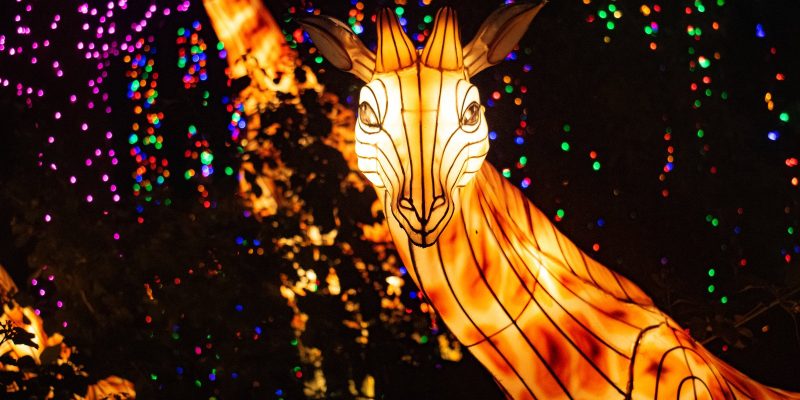
The Houston Zoo is running its holiday light event on a premise that is slightly odd and entirely deliberate: on six Fridays it will spend the evening telling you about animals you will not be able to see.
Fridays for Wildlife is part of TXU Energy presents Zoo Lights, and each of the six Fridays belongs to one animal at the zoo and the field project that zoo money supports for its wild relatives. The first 2,000 guests each night get a limited-edition ornament and a conservation activity built around that night’s animal. Admission to Zoo Lights is the only ticket involved.
The animals themselves are mostly asleep or off exhibit after dark. The zoo says so plainly, which is the right call, and it changes what the evening is for: this is where the gate revenue goes, told one species at a time.
November 20: Hasani, and lions in Mozambique and Kenya
Hasani is the zoo’s male African lion. His name is Swahili for handsome, he weighs more than 500 pounds, and on hot Houston days he can be found lying on his back in front of a personal air conditioning unit.
Lions are the only truly social cat, living in prides run by the females. Houston Zoo funds the Niassa Carnivore Project in Mozambique and Ewaso Lions in Kenya, both of which work on the specific problem that gets lions killed: livestock. The work is identifying the situations where people and cattle and lions collide, and changing them, so that protecting a livelihood does not require shooting a predator.
November 27: Chuck, and elephant corridors in Borneo
Chuck is the zoo’s newest Asian elephant. The IUCN Red List assessed the species in 2019 as Endangered, with a decreasing population.
In Borneo the zoo works with Seratu Aatai and with local oil palm plantations, studying how wild elephants move through a landscape that has been cut up by agriculture and finding places where corridors can be put back. A corridor is exactly what it sounds like: a connected strip of habitat that lets an elephant get from one patch of forest to the next without crossing a plantation, which is where elephants and people get hurt.
December 4: Kamia, and plastic in the Galapagos
Kamia is the largest female in the zoo’s California sea lion colony, dark brown, athletic, and the dominant animal in the group.
She stands in for her close relatives in the Galapagos Islands, where Houston Zoo’s partnership with the ECOS Foundation works on reducing threats to the marine environment, plastic pollution among them. The zoo’s ask of visitors here is the smallest one of the six: skip the single-use straws, bags and bottles.
December 11: Tino, and wire traps in Kenya
Tino is the youngest Masai giraffe at the zoo.
Through the Somali Giraffe Project the zoo funds wildlife rangers who find and remove illegal wire snares, and when a giraffe is caught in one, veterinary intervention comes through the Lenya Wildlife Service mobile veterinary unit. This is the least glamorous item on the list and possibly the most concrete: somebody walks the landscape, finds the wire, and takes it out.
December 18: flamingos, and the lithium in your phone
The zoo’s Chilean flamingos live in the Birds of the World aviary. Their wild relatives live on shallow highland lakes in the South American Andes, and those lakes sit on top of lithium, the metal in the batteries in phones, laptops and electric cars.
Houston Zoo has run an electronics recycling program since 2013 for this reason. Recycled lithium is lithium nobody has to mine, and the flamingo is the animal standing in the water above the deposit.
December 25: Chaka, and gorillas in the forest
Chaka is the zoo’s oldest male gorilla, a silverback who watches the bachelor group from a distance these days.
The zoo supports the Dian Fossey Gorilla Fund, whose daily forest patrols, research and habitat protection are the long unglamorous spine of gorilla conservation, and Gorilla Doctors, the veterinarians who give wild gorillas health checks and treat them for injuries and illness in the field.
What is Fridays for Wildlife?
Six Friday evenings during Zoo Lights, each one dedicated to a single animal at the Houston Zoo and the conservation partner working on that species in the wild, with a limited-edition ornament for the first 2,000 guests and an activity tied to the animal of the night. It runs November 20, November 27, December 4, December 11, December 18 and December 25, and everything is included with Zoo Lights admission.
The zoo publishes what it funds in more detail in its annual conservation reporting, and it has backed that spending up before: its elephant team’s work on the EEHV vaccine trial with Baylor College of Medicine is the same money doing the same job, in a laboratory instead of a landscape.
Source: Houston Zoo, November 13, 2026.
Quick answers
- What is Fridays for Wildlife at Houston Zoo Lights?
Six Friday evenings during Zoo Lights, each dedicated to one animal at the Houston Zoo and the conservation partner working on that species in the wild. The first 2,000 guests each night receive a limited-edition ornament and a conservation activity tied to that night's animal.
- What are the dates?
November 20 (African lion), November 27 (Asian elephant), December 4 (California sea lion), December 11 (Masai giraffe), December 18 (Chilean flamingo) and December 25 (western lowland gorilla).
- Does it cost extra?
No. Fridays for Wildlife is included with Zoo Lights admission.
- Will I see the animals?
Mostly not. The zoo says these animals may not be visible during Zoo Lights. The evenings are about what the zoo funds for their wild counterparts rather than about seeing the animals themselves.