
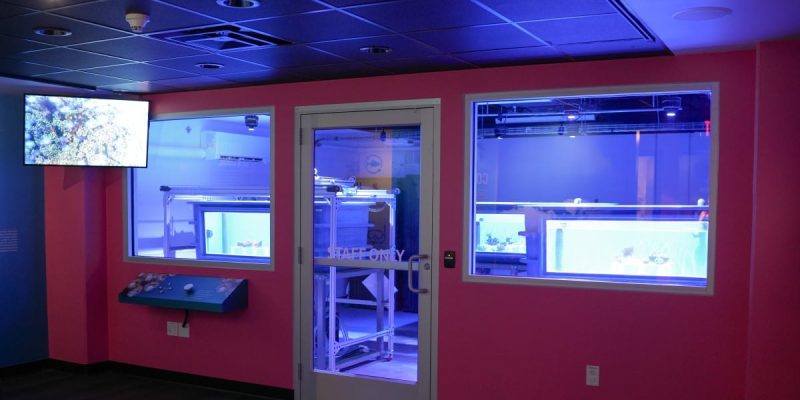
Mystic Aquarium opened the Kishfy Coral Lab on May 18, 2026, an exhibit built around a working coral laboratory that visitors can watch through a glass wall and an interactive camera.
It is a hybrid of two things aquariums usually keep apart: a display of live corals, and the room where the science happens. Scientists work on coral spawning and fragmentation on the other side of the glass while guests watch.
What the lab adds
The space increases the aquarium’s capacity to hold coral species and gives it room to collaborate with other institutions, which is how coral work is done. No single facility holds enough genetic diversity of any reef species to matter on its own.
The two techniques named are the ones that define the field. Fragmentation takes advantage of the fact that a coral colony is a clone: cut a piece off, mount it, and it grows into a new colony, which is how restoration groups produce planting stock at volume. Spawning is the harder one and the more valuable, because it produces genetically new individuals rather than copies, and most reef-building corals spawn only a few nights a year, cued to the moon.
Getting a coral to spawn on schedule inside a building means reproducing the moonlight, the temperature curve and the season it is reading. Facilities that can do it reliably are still rare.
Privately funded
The lab was paid for entirely by private donations, with a leadership gift from Nick and Kate Kishfy that covered the design and construction and expanded the aquarium’s coral spawning, growth and restoration work.
“In addition to being an engaging and educational exhibit, the Kishfy Coral Lab allows us to expand our efforts to conserve coral species across the world,” said Dr. Allison Tuttle, chief zoological officer at Mystic Aquarium. “The work being done here at Mystic Aquarium in this new lab space will help visitors understand the vital role these fragile ecosystems play in our daily lives.”
Nick Kishfy traced his own interest to a ten-gallon tank in his bedroom.
“Coral reefs cover barely one percent of the seafloor yet support twenty-five percent of marine species and a billion human lives,” he said. “I hope this lab inspires children and adults alike to learn more about these extraordinary ecosystems.”
Why coral labs are multiplying
Aquariums have been building this kind of space because the reef emergency outran the field’s capacity to respond to it. Bleaching events that were once a generational shock have become frequent, and restoration now depends on land-based facilities holding, propagating and eventually replanting corals that cannot be left where they are.
San Antonio Zoo opened its own ocean conservation lab in August, on the same reasoning.
Putting that work behind a window rather than behind a door is the second decision, and it is a deliberate one. A visitor who watches someone fragment a coral under a lamp has seen conservation as work rather than as a poster.