
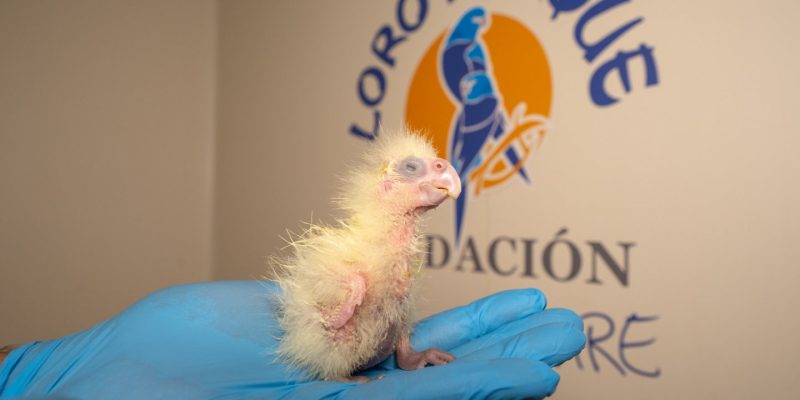
After years of failed attempts, Loro Parque Fundación has bred a red-tailed black cockatoo. It is the first time the species has been bred anywhere in Europe.
The chick, announced on December 1, 2025, needed help getting out of the egg.
The bird
Calyptorhynchus banksii naso is the forest red-tailed black cockatoo of southwestern Australia, a large black parrot with scarlet tail panels. It is listed as endangered.
Its problems are specific: the eucalypt forest it depends on is being cleared, feral honeybees take over the tree hollows it needs to nest in, and it is still poached illegally.
The hollow problem is the one that resists a simple fix. A eucalypt takes well over a century to develop a cavity big enough for a cockatoo this size. Every hollow lost to logging or occupied by bees is a nest site that cannot be replaced within a human lifetime.
Years of trying
“Tras anos de intentos, hemos conseguido criar por primera vez esta rara ave en Loro Parque”
After years of attempts, we have bred this rare bird for the first time at Loro Parque
Marcia Weinzettl, biologist and bird conservator, Loro Parque Fundación, in a statement translated from Spanish
That sentence contains the whole difficulty. Black cockatoos are slow, selective and difficult to breed. They pair for life, produce very few eggs, and are unforgiving of anything they dislike about the setup.
“Este logro no solo representa una reproduccion exitosa, sino la confirmacion de que nuestras metodologias son capaces de responder incluso a las necesidades de las especies mas complejas”
This achievement represents not only a successful reproduction but confirmation that our methodologies are capable of meeting the needs of even the most complex species
Rafael Zamora, scientific director, Loro Parque Fundación, in a statement translated from Spanish
Why a first matters more than a number
One chick does not secure a species. What a first successful breeding produces is a method: what the pair needed, what the enclosure had to be, what the incubation required, and in this case that the chick had to be assisted out of the shell.
That is transferable. The next institution to try does not start from zero.
Method transfer is what makes small-species work compound: the technique behind the Desertas snail releases on Bugio came out of exactly this kind of first attempt.
Loro Parque Fundación’s breeding center holds more than 350 parrot species and subspecies across more than 30,000 square meters, which the foundation describes as the largest genetic reserve of parrots in the world.
Mike Jordan, the park’s zoological director, called the chick an important step in the conservation of the species.
Source: Loro Parque Fundación. Quotations translated from the Spanish.