
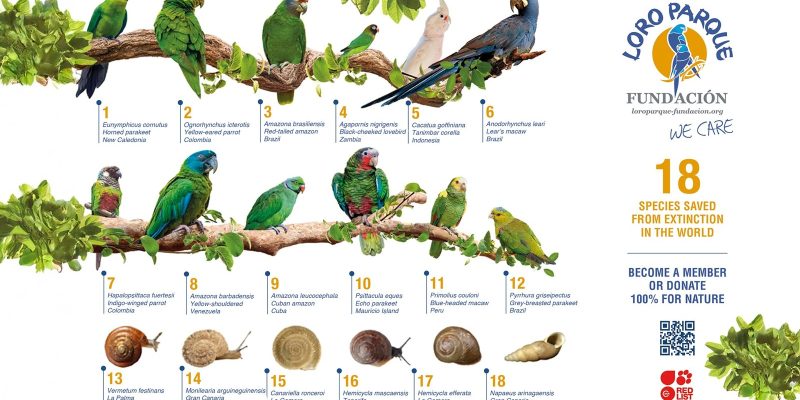
Eighteen species are alive today that would probably not be, and the money came from a bird park on Tenerife.
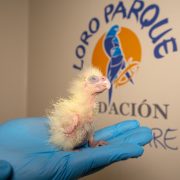
Loro Parque Fundación was founded in 1994 by Wolfgang Kiessling. It has since invested more than 30 million dollars in over 300 conservation and research projects across more than 50 countries, and it claims 18 species saved from extinction.
What “eighteen species” actually means
This is worth spelling out, because the headline number is easy to misread. The foundation’s own list is twelve parrots and six snails.
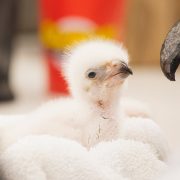
The parrots: Lear’s macaw, Cuban amazon, black-cheeked lovebird, Tanimbar corella, Mauritius parakeet, Fuertes’s parrot, yellow-shouldered amazon, yellow-eared parrot, blue-headed macaw, red-tailed amazon, grey-breasted parakeet and horned parakeet.
The other six are endemic land snails of the Canary Islands, worked on through the foundation’s CanBIO program. Nobody builds a fundraising campaign around a Canarian snail, which is exactly why it needed a foundation attached to a zoo to do it.
That is the same logic behind the work other European institutions are now doing on species with no public profile at all, from Durrell’s lesser night geckos on Mauritius onward.
The numbers, and how fast they move
The foundation publishes its running totals, and they climb visibly:
- 2018: more than $18 million, 9 species saved
- 2023: more than $26 million, over 220 projects, 12 species
- 2024: around $28 million, 276 projects, 12 species
- 2025: more than $29 million, over 300 projects, 18 species
- 2026: more than $30 million, 300+ projects, 18 species
The jump from twelve to eighteen happened between September 2024 and October 2025, when the Canarian snails were added.
One caution for anyone quoting these figures: the foundation’s own pages say 53 countries in one place and 54 in another, and its wild population estimate for Lear’s macaw appears as 1,100, 1,200 and 1,300 depending on which page you read. Those are its numbers, not ours, and we have used the most recent in each case.
The breeding center
La Vera, the foundation’s breeding center, covers more than 30,000 square meters devoted entirely to parrots and holds more than 350 parrot species and subspecies.
“En las instalaciones de Loro Parque Fundacion contamos con la mayor reserva genetica de loros del mundo. Un tesoro de biodiversidad que nos permite tener el mejor conocimiento de estos animales.”
At Loro Parque Fundacion’s facilities we have the world’s largest genetic reserve of parrots. A treasure of biodiversity that gives us the best knowledge of these animals.
Christoph Kiessling, president of Loro Parque Fundacion, in a statement translated from Spanish
The foundation also publishes around 20 scientific papers a year and states that 100 percent of donations go to conservation projects, with the parent company covering administration.
Why the model is unusual
Most zoo conservation funding is a line item: a share of admissions, a donation box, a partnership with a field NGO. What Tenerife built instead is a separate foundation with its own breeding facility, its own scientific council and its own publication record, funded by a commercial theme park.
That structure is why the snails got done. A species with no public profile and no tourism value has to be paid for by something, and here the something is a parrot park with two million visitors a year.
Sources: Loro Parque Fundacion. Figures as published by the foundation; quotation translated from the Spanish.