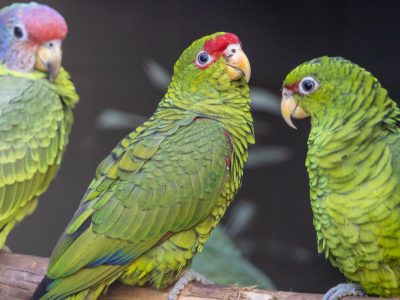

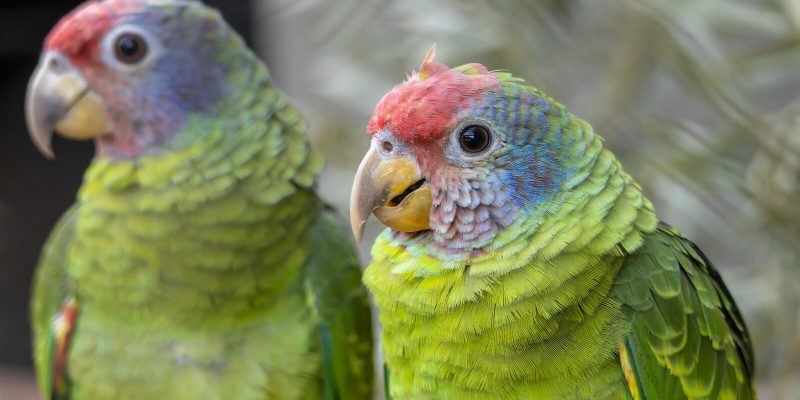
Nine parrots hatched from eggs smuggled through a Rio de Janeiro airport are now living at São Paulo Zoo. Six of them are Red-tailed Amazons, and there are Red-tailed Amazons left to smuggle at all because people have been buying tickets to a zoo in the Canary Islands for thirty years.
This is the part of a trafficking story that usually goes untold. The rescue is visible. The reason there was still a wild population for the traffickers to rob is not.
The nest boxes came from Tenerife
The Red-tailed Amazon (Amazona brasiliensis) lives in a thin strip of Atlantic Forest along the coast of São Paulo and Paraná states. The field program that has monitored and protected it since 1995 is run by SPVS, the Brazilian conservation organization Sociedade de Pesquisa em Vida Selvagem e Educação Ambiental.
SPVS does the work on the ground. Loro Parque Fundación has underwritten it since 1995, and publishes the figure: $772,162 committed to the project. The foundation’s money comes overwhelmingly from the zoo next door and the people who walk through its gate.
What that bought is unusually concrete for a conservation grant. The project has registered 219 natural nesting cavities and monitored 127 nests, and where the forest no longer offers enough cavities, it has installed artificial PVC nest boxes. Red-tailed Amazons nest in tree hollows, and old coastal forest with hollows in it is exactly what the region has least of.
The number that changed
In the 1980s the total wild population of Red-tailed Amazons was probably somewhere around 2,500 birds. The 2015 estimate is 9,000 to 10,000.
The foundation’s own page describes the result as a downlisting from Endangered to Vulnerable. The species has in fact moved one step further since: the current IUCN Red List category, from the BirdLife International assessment, is Near Threatened. It is a small correction in the foundation’s favor, and worth making because the direction of travel is the point.
A species goes from roughly 2,500 birds to roughly 9,500 over thirty years and drops two Red List categories. That does not happen by itself, and it does not happen on a three-year grant cycle. It happens because somebody funded the same unglamorous nest survey every single year for three decades, and that somebody was a zoo full of visitors who came to look at parrots.
The other three birds
The three Red-spectacled Amazons (Amazona pretrei) at São Paulo come from a species with a different profile. It is listed as Vulnerable, and it stayed Vulnerable after a 2022 review considered moving it to Near Threatened and decided against.
The numbers alone would have supported the downlisting. A 2021 census counted 22,332 birds, with a population viability analysis putting mature individuals at 15,618, well above the 12,500 figure the earlier assessment worked from. What kept the species where it was is the shape of its risk rather than its headcount.
Red-spectacled Amazons depend heavily on Araucaria angustifolia, the Paraná pine, which is itself on the Red List. And the entire population concentrates into one small wintering area, which means a disease outbreak or a badly sited wind development there is not a regional problem but a species-level one.
Is a confiscated bird actually worth anything to conservation?
It depends entirely on where it lands. A confiscated parrot that lives out its life in a holding facility is a rescue and nothing more. A confiscated parrot entered into a managed breeding program that sits inside a national recovery plan is a genetic contribution to the population it was stolen from.
Both of these species sit inside Brazil’s National Action Plan for Atlantic Forest Birds, coordinated federally through ICMBio, and both are covered by managed-breeding programs run through AZAB, the Brazilian association of zoos and aquariums. Parque das Aves in Foz do Iguaçu, an accredited institution, is among the facilities that participate in those national action plans.
So the chain runs: a smuggler’s eggs, seized by a federal environmental agency, hatched into intensive care, transferred to an accredited zoo, entered into a managed program under a national plan, for a species whose wild population was rebuilt by another accredited zoo four thousand miles away.
That is not three separate good deeds that happened to line up. It is one system, and every load-bearing part of it is a zoo. Which means every load-bearing part of it is also a family who decided, on some ordinary weekend, to go and look at animals.
What we still do not know
São Paulo Zoo says its technical team is now working toward breeding pairs, with the possibility of offspring going to other conservation programs. Whether any of these nine birds or their young ever reach the coastal forest their parents’ eggs were taken from is a question for a decade from now, not this year.
We covered the arrival of the nine parrots at the Conservation Grove when the zoo announced it. Loro Parque Fundación’s parrot work has come up here before, in its Lear’s macaw recovery program and its claim to have kept eighteen species from going extinct.
Sources: Loro Parque Fundación; BirdLife International Data Zone; BirdLife International Globally Threatened Bird Forums; São Paulo Zoo.