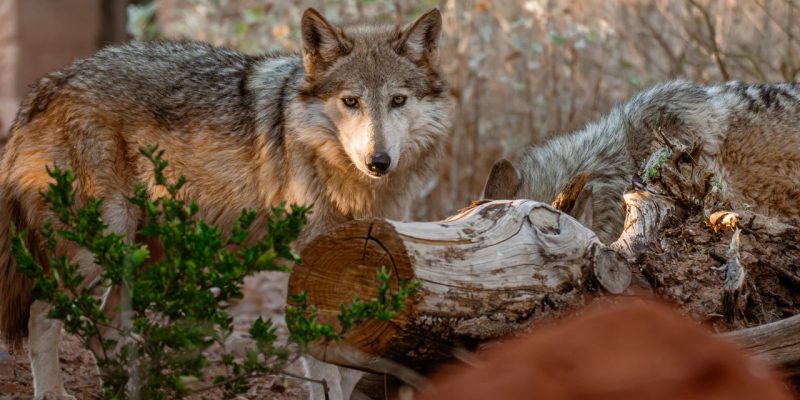
Every Mexican wolf alive today, in zoos across two countries and in the mountains of Arizona and New Mexico, descends from seven animals. Not seven packs. Seven individual wolves, five of them pulled out of Mexico by a single trapper between 1977 and 1980, and two pairs added fifteen years later only after a genetics lab settled an argument about whether they were really wolves at all.
The Phoenix Zoo has laid out that history in its own account of the subspecies, which it counts among the Arizona natives whose conservation it takes part in, alongside the black-footed ferret and the Mount Graham red squirrel. Both of those were once so scarce they were thought to be gone, and were later rediscovered. The Mexican wolf is the one that came closest to having no second act.
How a wolf runs out of country
Mexican wolves are a subspecies of gray wolf, and the rarest one in North America. They are called Mexican because most of their range sat in the higher elevations of Mexico, though it reached up into southern Arizona, southern New Mexico and western Texas. They have been on this continent for several thousand years, and a few centuries ago they numbered in the thousands.
What happened to them in the early 1900s was arithmetic. Unregulated hunting stripped the Southwest of elk and deer, which are what gray wolves eat. Cattle filled the gap, and there were a great many: Arizona and New Mexico each carried more than 700,000 head. Wolves switched to the animals that were in front of them. Federal and local government agencies then joined the effort to get rid of the wolves, and it worked completely. By the 1970s there were none left in the wild in the United States.
The decade that finished them also produced the law that saved them. The Endangered Species Act was signed in 1973, and by the Phoenix Zoo’s account the Mexican wolf was added to its endangered list in 1976, which made the federal government responsible for recovering an animal it had spent fifty years removing.
Five wolves, one female
Recovery needed wolves, and there were none to be had in the United States. So the government sent Roy McBride, an expert wolf hunter and trapper, into Mexico to catch them alive. Mexican wolves were legally protected there too by then, but the eradication campaign had crossed the border ahead of him. In four years of looking, McBride found five.
Those five went to the Arizona-Sonora Desert Museum in Tucson, and the numbers around them were not encouraging. In 1980 McBride estimated there were “less than 50” lobos left in Mexico. In 1981 Jose Treviño, Mexico’s director general of wildlife, put it at “perhaps 30.” Nobody tried to catch any more, and most experts now believe the Mexican wolf went extinct in the wild not long after.
Only one of the five was female. Her name was Nina, and the single piece of luck in this entire story is that she was pregnant when she was caught. She gave birth weeks later to five pups: four males and one female. The female died four days in, which left Nina, again, as the only female in the program.
Of the captured males, one was too young to breed and two never did. That left Maximillian, the last male McBride brought back, as the only possible match. Both wolves were moved to the Wild Canid Survival and Research Center in Missouri, known today as the Endangered Wolf Center, which had more room and more quiet. In 1981 Nina whelped four pups, three of them female, and the subspecies had a future.
That line, the McBride lineage, rests on three founders: Nina, Maximillian, and the wild male who fathered Nina’s first litter and was never caught.
The two lineages nobody would use
Three founders is not much genetic material to build a population on, and more were needed. Two other captive groups had existed since the 1960s. The Ghost Ranch lineage was kept by the Arizona-Sonora Desert Museum, and the Aragón lineage by the San Juan de Aragón Zoo in Mexico City.
Neither had been allowed into the breeding program, because of a suspicion that the animals in them were wolf-dog hybrids. It was a reasonable worry and an expensive one, because it kept two separate reservoirs of Mexican wolf ancestry sitting unused while the program ran on three founders.
The question was finally answered in a lab. In 1995, Arizona State University professor Philip Hedrick and colleagues ran the genetics and concluded that the Ghost Ranch and Aragón wolves were full-blooded Mexican wolves. One male and one female were taken from each group, which added four founders to the three already there. Seven is the number the whole subspecies has been working with ever since.
Why seven still matters
This is where the Phoenix Zoo’s account stops and the federal record picks it up, and the second half is what turns the first half from an origin story into a live constraint. Wolves from the captive program went back into the wild in 1998, into an area the government calls the Mexican Wolf Experimental Population Area: the parts of Arizona and New Mexico lying south of Interstate 40, down to the border.
In its 2022 revision of the rules governing that population, the U.S. Fish and Wildlife Service set two targets rather than one. The first is a headcount: an average of at least 320 wolves across the two states, sustained over eight years, with the number above 320 in each of the last three years and the growth rate flat or rising. Reach that, the Service estimates, and the population has a 90 percent chance of still being there in a hundred years.
The second target is the one the seven founders wrote. It is genetic, and it is counted in individual animals: at least 22 wolves released from captivity have to survive to breeding age in the wild. The reasoning sits in the same document, and it is blunt about the constraint. Gene diversity in the captive population declines slowly and continuously “because no new founders are available to add diversity.” There is nowhere left to find an eighth founder. What exists is what there is.
The numbers are moving the right way. Between 2018 and 2021, gene diversity in the wild population rose from 74.54 to 76.23, and mean kinship, which measures how closely related the animals are to one another, fell from 0.2546 to 0.2377. As of August 2021 both figures were the best they had been since 2010. That is what a released wolf is actually for: not another body in the count, but a different set of genes walking into a population that badly needs some.
We have written before about the same arithmetic in a different animal, when the Saint Louis Zoo’s red wolf pups were fostered into wild dens in North Carolina, and about the Smithsonian’s work cloning black-footed ferrets to reach genetic material no living animal carried anymore.
The Phoenix Zoo’s telling does not spell out the zoo’s own role in the wolf program, and we are not going to invent one. What its account does do is put the number in front of you. Seven wolves, one of them a pregnant female caught at what turned out to be exactly the right moment, and who would otherwise have been the end of it.
Quick answers
- How many wolves is the entire Mexican wolf population descended from?
Seven. Three from the McBride lineage (Nina, Maximillian, and the wild male who fathered Nina’s first captive-born litter), and four added in the 1990s, a male and a female from each of the Ghost Ranch and Aragón lineages.
- Why were there only five wolves to start with?
Because that is all the trapper Roy McBride could find. The United States sent him into Mexico to capture Mexican wolves alive, and between 1977 and 1980 he retrieved five. In 1980 he estimated fewer than 50 remained in Mexico; in 1981 Mexico’s director general of wildlife, Jose Treviño, said perhaps 30. No further captures were attempted.
- Who was Nina?
The only female among the five wolves McBride captured, and the animal the program depended on. She was pregnant when caught and gave birth to four males and one female, and the female pup died four days later. In 1981, paired with Maximillian at what is now the Endangered Wolf Center in Missouri, she whelped four pups, three of them female.
- Why were the Ghost Ranch and Aragón wolves excluded at first?
They were suspected of being wolf-dog hybrids. Genetic research by Arizona State University professor Philip Hedrick and colleagues in 1995 concluded they were full-blooded Mexican wolves, and one male and one female were taken from each group as founders.
- What happened to Mexican wolves in the wild?
Unregulated hunting cut elk and deer numbers across the Southwest in the early 1900s while cattle numbers were high, Arizona and New Mexico each carrying more than 700,000 head. Wolves preyed on cattle, eradication efforts followed with federal and local government assistance, and by the 1970s no Mexican wolves were left in the wild in the United States.
- How many Mexican wolves is the recovery program aiming for?
The U.S. Fish and Wildlife Service’s 2022 rule for the Mexican Wolf Experimental Population Area sets an average of at least 320 wolves across Arizona and New Mexico, sustained over eight years, above 320 in each of the last three years, with a flat or rising growth rate. At that point the Service estimates a 90 percent chance the population persists for 100 years.
- What is the genetic objective?
At least 22 wolves released from captivity surviving to breeding age in the wild. It exists because gene diversity in the captive population declines continuously, in the Service’s words, "because no new founders are available to add diversity." Between 2018 and 2021 gene diversity rose from 74.54 to 76.23 and mean kinship fell from 0.2546 to 0.2377, the best figures since 2010.
- Where were Mexican wolves released?
Into the Mexican Wolf Experimental Population Area, the parts of Arizona and New Mexico south of Interstate 40 down to the international border. Reintroduction began in 1998 under section 10(j) of the Endangered Species Act.