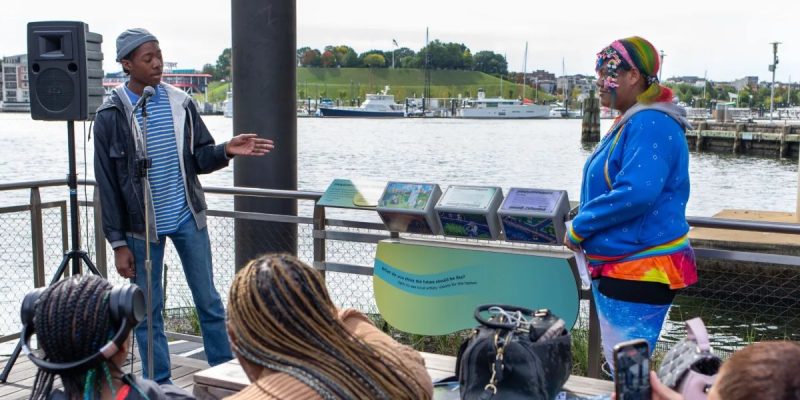
There is a new thing to spin at the National Aquarium’s Harbor Wetland, and what comes up when you spin it is Baltimore’s Inner Harbor a hundred years from now, as imagined by 31 people between the ages of 14 and 21.
The aquarium and Baltimore Youth Arts unveiled the installation this week: twelve original artworks mounted across three interactive tumblers, which visitors turn to travel forward in time. The first panel shows the harbor in 25 years, the next in 50, the last in 100. The whole thing sits on Harbor Wetland, the floating salt marsh along the aquarium’s waterfront, which is free and open to the public without an aquarium ticket.
The brief was a question
Through the spring and summer of 2026, 31 Baltimore Youth Arts apprentices worked with aquarium conservationists and educators, studying the science and the history of harbor restoration. Then they were asked one thing: what should the future of the Inner Harbor be?
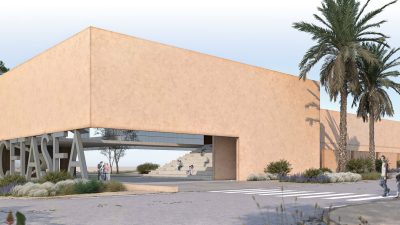
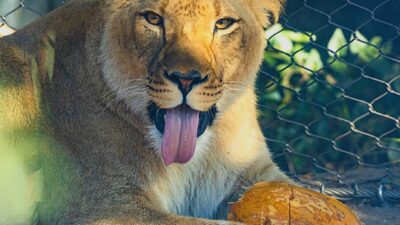
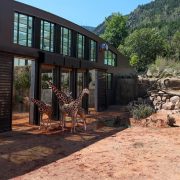
What came back is not a mood board. The collaborative works describe a fully restored, self-sustaining ecosystem, with both human and wildlife residents, and they are built on what the apprentices had just spent two seasons learning about how a harbor actually recovers.
“Harbor Wetland invites visitors to imagine the many possibilities that our harbor holds, and art plays an important role in sparking that imagination,” said Jenny Hamilton, director of community partnership strategy at the National Aquarium. “Through our collaboration with Baltimore Youth Arts, we aim to not only inspire our guests, but amplify the next generation of Baltimore creatives as they think about the future of our city, and our planet.”
A display built to be replaced
This is the second installment of Future Harbor, and the format is the point. The three tumblers are designed to carry new work by local artists every two or three years, which makes the display a standing commission rather than a one-time decoration. Come back in 2029 and the harbor’s future will have been imagined by somebody else.
Baltimore Youth Arts is in its twelfth year. It runs creative entrepreneurship and workforce development programs for young people aged 14 to 25 across the city, with a focus on those who have been affected by the juvenile justice system, and it has spent a decade putting artistic and leadership opportunities in front of them.
“31 unique voices are represented across the project, and the final result is a powerful example of how creative entrepreneurship and mentorship can shape both individual artists and the way our community collectively envisions its future,” said Gianna Rodriguez, founder and executive director of Baltimore Youth Arts.
Madison Murphy, one of the apprentices, put the appeal of the thing more plainly. She liked that the project was collaborative, she said, “and that people who live in Baltimore and visit Baltimore can see it.” Her hope for visitors is that they “talk about the ideas people actually want to see change in the future, and try to make that change real.”
Why it is on the wetland and not inside
Placement is doing work here. Harbor Wetland is the aquarium’s living argument that the Inner Harbor can hold a functioning salt marsh, and the panels are a set of pictures of what happens if that argument keeps winning. You read the future standing on the prototype.
It is also free, which matters for a piece of public art made by Baltimore teenagers about Baltimore’s water. Anyone can walk onto the wetland, spin the tumblers and leave without paying anything.
The aquarium has been working this seam for a while. Its Read to Reef book club with the Enoch Pratt Free Library runs on the same idea, that the institution is most useful to the city when the city can get into it. Details of the installation are in the aquarium’s announcement.
Quick answers
- What is the installation?
Twelve original artworks mounted across three interactive tumblers on the National Aquarium’s Harbor Wetland exhibit. Visitors spin each tumbler to move forward in time, seeing Baltimore’s Inner Harbor imagined in 25, 50 and 100 years.
- Who made it?
Thirty-one Baltimore Youth Arts apprentices aged 14 to 21, working with National Aquarium conservationists and educators through the spring and summer of 2026.
- Does it cost anything to see?
No. Harbor Wetland is free and open to the public, and does not require an aquarium ticket.
- What is Future Harbor?
The display the installation belongs to. Its three tumblers are designed to carry new work by local artists every two to three years, so the artwork is replaced rather than permanent. This is the second installment.
- What is Baltimore Youth Arts?
A Baltimore creative entrepreneurship and workforce development program for young people aged 14 to 25, now in its twelfth year, with a focus on those affected by the juvenile justice system.
- What do the artworks show?
A fully restored, self-sustaining Inner Harbor ecosystem with both human and wildlife residents, built on what the apprentices learned about the science and history of harbor restoration.