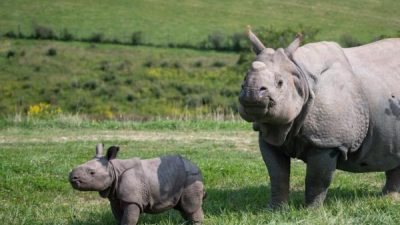

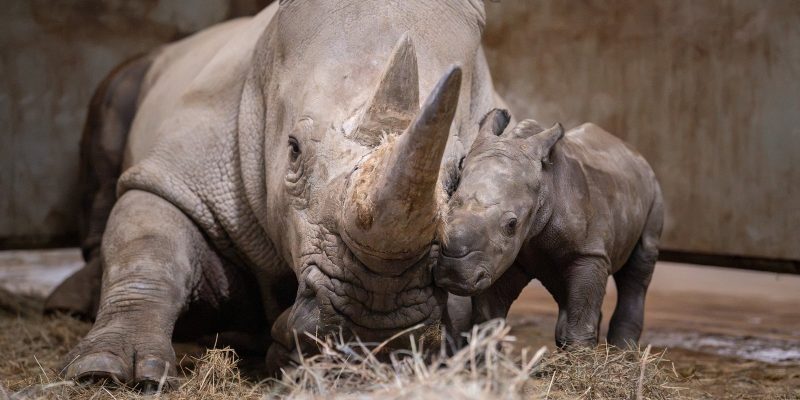
The Wilds has two new southern white rhino calves, and one of them is the first sixth-generation calf of the species born anywhere outside Africa. Both arrived in the space of three days this month at the conservation center in Cumberland, Ohio.
The male calf was born early on Thursday, Nov. 12, 2026, to a female named Scout, and was up and moving around well soon after birth. The Animal Management team is monitoring the pair closely through the first days. A female calf followed on Nov. 14, born to a rhino named Anan, and the team reported that she was already standing when staff arrived that morning.
What does sixth generation actually mean?
It is a pedigree count, and it is counted backward to the last animals that came out of the wild. Scout’s calf is a sixth-generation rhino because you can trace his family tree through five generations born in human care before you reach a wild-born ancestor. In his case, one of Scout’s great-great-great-grandmothers and one of her great-great-great-grandfathers were born in South Africa and came to the United States in 1975.
That is the number worth paying attention to, because every generation in the chain is a separate problem solved. A female rhino has to reach breeding age, conceive, carry and deliver a calf, and raise it, and then her daughter has to do all of it again. The Wilds remains the only facility outside Africa where fourth-generation and now fifth-generation females are breeding at all.
Scout is one of them. She was born in a pasture at The Wilds on Oct. 23, 2019, the conservation center’s third fifth-generation southern white rhino, which makes this calf the first she has raised herself.
“Scout has grown up here, so welcoming her first calf is especially special for our team,” said Cody Cseplo, Animal Management Specialist at The Wilds. “We’ve cared for her through each stage of her life, and now we’re supporting her as a first-time mother. Our focus is on giving Scout and her calf the care they need as they begin this next stage together.”
Anan’s history runs along the same line, one generation earlier. She was The Wilds’ first fourth-generation southern white rhino, born in 2009, and she went on to become the mother of Letterman, the center’s first fifth-generation calf, born on Nov. 12, 2014.
Who the father is, and why that was decided elsewhere
Bernard sired both newborns. He came to The Wilds in 2022 as a breeding male recommended through the Southern White Rhinoceros Species Survival Plan, the program the Association of Zoos and Aquariums runs to keep a managed population genetically diverse across every participating institution rather than inside any one of them. Pairings are recommended centrally, which is why a rhino’s parents are so often born hundreds of miles apart: Scout’s mother, Agnes, was born at The Wilds, and her father, Kengele, was born at San Diego Zoo Safari Park.
Scout’s calf was Bernard’s 18th offspring and Anan’s was his 19th. Four of his calves have now been born at The Wilds.
“We have watched generations of rhinos grow up here and become parents themselves,” said Dan Beetem, Director of Animal Management at The Wilds. “Sustaining that population requires planning well beyond any individual birth. The care and pairing decisions we make today help shape the generations that follow.”
Where the species stands
The white rhinoceros is listed as Near Threatened on the IUCN Red List, which is also how the Columbus Zoo and Aquarium described the species in announcing the births. The current assessment is Emslie 2020, published in January of that year, and it puts the species at 10,080 mature individuals with the trend decreasing. Hunting and trapping, invasive species and disease, and shifting habitat are the threats it names.
The Wilds also contributed to the American Institute of Rhinoceros Science, a research partnership supported by a National Leadership Grant from the Institute of Museum and Library Services, which studied rhino well-being and reproductive health. We covered that program while it was running. Data collection is complete and the program has ended, but the research team is still working through the results, and the findings are shared across the participating facilities.
Can you see the calves?
Yes. The Wilds welcomed its first rhino calf in 2004 and now keeps one of North America’s largest southern white rhino herds. Guests can see the herd, the new calves among them alongside their mothers, on a Winter Wildside Tour or a Rhino Barn Tour. Both are built to put you close enough to watch the animals and to hear from the people who look after them, which on a property this size in rural Ohio is the difference between seeing a rhino and understanding one.
Quick answers
- What does a sixth-generation rhino mean?
It is a pedigree count run backward to the last wild-born ancestor. Scout's calf is sixth generation because his family tree passes through five generations born in human care before reaching a rhino born in the wild.
- Why is this birth a first?
It is the first sixth-generation southern white rhino born anywhere outside Africa. The Wilds remains the only facility outside Africa where fourth-generation and now fifth-generation females are breeding.
- How many southern white rhinos are left?
The IUCN Red List assessment published in 2020 puts the white rhinoceros at 10,080 mature individuals and lists the species as Near Threatened, with the population trend decreasing.
- Can visitors see the new calves?
Yes. The calves are out with their mothers in the herd, and guests can see them on a Winter Wildside Tour or a Rhino Barn Tour at The Wilds in Cumberland, Ohio.