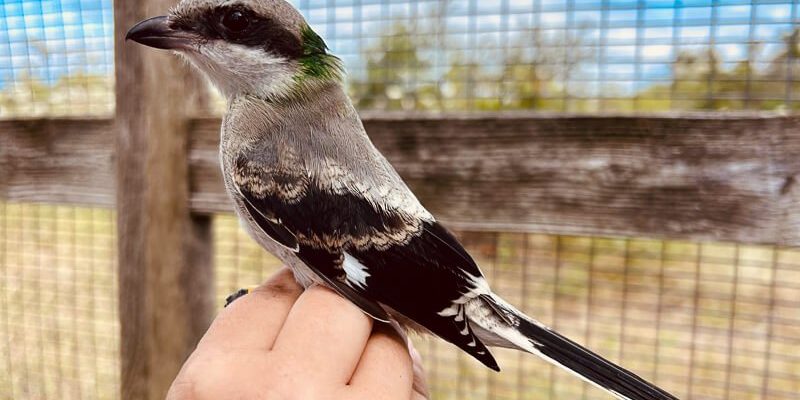
Two bird keepers from Nashville Zoo at Grassmere left Tennessee at seven in the evening and reached the Canadian border near Niagara at seven the next morning, driving through the night with nine loggerhead shrikes in carriers behind them. Eight of those birds are now flying free in Ontario, in a province where the eastern shrike had very nearly stopped existing.
The zoo described the trip on October 12. It is the kind of conservation work that almost never produces a photograph of a zoo, because the whole point is that the animals end up somewhere else.
What a loggerhead shrike actually is
A shrike is a songbird that hunts like a raptor without a raptor’s feet. Lacking the talons to hold prey while it feeds, the loggerhead shrike impales what it catches on thorns and barbed wire and eats from the spike, which is why the bird has carried the nickname butcherbird for well over a century. The habit is also a map: shrikes turn up in open pasture and grassland with elevated perches and, pointedly, with fence lines.
The species ranges across the United States and much of Canada east of the Rockies, including Middle Tennessee, where Nashville Zoo’s own avian team works on native birds. The Ontario birds migrate south for the winter and come back to breed.
The Ontario population, and what it is actually listed as
Nashville Zoo describes the Ontario birds as a critically endangered population, and the stakes behind that wording are real: the eastern shrike had nearly been extirpated from the province. The precise listings are worth stating, because they sit on three different lists that use the same words to mean different things.
Globally, the IUCN Red List assesses the loggerhead shrike, Lanius ludovicianus, as Near Threatened, in an assessment published in 2020 that counts about 7 million mature individuals and a decreasing trend. The Red List carries no separate assessment of the eastern subspecies at all. The Ontario bird is listed as Endangered under Canada’s Species at Risk Act, added to Schedule 1 in June 2003 as the loggerhead shrike eastern subspecies, and as Endangered under Ontario’s own Endangered Species Act.
So the zoo’s phrasing overshoots the category by a notch while being right about the substance: a bird that is merely declining across its whole range can be on the edge of disappearing from one province, and that is exactly the situation this program exists for. We default to the assessment, and the assessment agrees that the Ontario end of this species is in trouble.

Twenty-three years of releases, counted
Wildlife Preservation Canada was asked to lead a reintroduction in 2003, and built a breeding population spread across several Ontario facilities. Most of what those birds produce goes out to the wild each summer; a small number stays back to keep genetic diversity in the breeding flock.
The program’s running totals, as the zoo gives them: 1,595 young shrikes released, 499 nests monitored, 1,213 young documented fledging in the wild, and 7,200 hectares of shrike habitat restored or improved. That last figure is roughly 17,800 acres, and it is the half of the work that does not photograph well either.
Nashville Zoo is the second facility in the United States to join the breeding side of that program.
How the birds got there
Sending nine small birds across an international border is mostly paperwork. The zoo’s curator of animal data and logistics, Jayne Hardwick, worked the permits through the U.S. Fish and Wildlife Service and its Canadian counterparts, and the veterinary team had to satisfy Canadian health protocols before the birds would be accepted.
Lead bird keeper Megan Fox and avian conservation keeper Rachael Payton did the driving. At the border they met Wildlife Preservation Canada staff at the U.S. Fish and Wildlife animal inspection facility; once the birds cleared to leave the United States, the Canadian crew took them across for inspection by the Canadian Food Inspection Agency. One shrike went to African Lion Safari in Hamilton to join the breeding population there. The other eight went on to a release site, and Fox and Payton flew home from Buffalo after about twenty-four hours on the move.
At the release site the eight went into large pens, where field staff fed and watched them while they got used to the place. After a couple of weeks the pen doors were opened and the birds left on their own schedule, with food still on offer for several days until they dispersed. The habitat is alvar: flat limestone grassland with thin soil, scattered shrubs and small trees, and it is part of the shrike’s historical Ontario range.
What happens after they leave
This is the open question in the whole effort. First-year birds die at high rates on migration, and tracking a 50-gram songbird from Ontario to the southern United States has never been straightforward. The zoo points to Motus, the automated radio-telemetry network whose receiving stations log tagged animals as they pass, as the technology beginning to answer where the released birds actually go.
Until that picture fills in, the measurable output is the one above: birds produced, birds released, nests found, fledglings counted. Nashville’s contribution this year is nine birds and a night’s drive, which is a small number until you consider that the entire Ontario population was recently a rounding error.
Nashville Zoo’s avian team runs native bird work at home as well; our earlier report on its native bird banding station covers the Tennessee end of the same department’s work.
Source: Nashville Zoo, October 12, 2026.
Quick answers
- How many shrikes did Nashville Zoo send to Canada?
Nine. One stayed at African Lion Safari in Hamilton, Ontario, to join the breeding population there, and the other eight went to a release site.
- Why is the loggerhead shrike called a butcherbird?
It hunts like a raptor but lacks the talons to hold prey while it feeds, so it impales what it catches on thorns and barbed wire and eats from the spike.
- How is the loggerhead shrike listed?
Globally the IUCN Red List assesses Lanius ludovicianus as Near Threatened, in an assessment published in 2020. The eastern subspecies in Ontario is listed as Endangered under Canada’s Species at Risk Act and under Ontario’s Endangered Species Act.
- How many shrikes has the Ontario program released?
Wildlife Preservation Canada and its partners have released 1,595 young shrikes, monitored 499 nests and documented 1,213 young fledging since the program began in 2003.
- What is an alvar?
A flat limestone grassland with thin soil and scattered shrubs and small trees. It is part of the loggerhead shrike’s historical range in Ontario.
- How are released shrikes tracked?
Through Motus, an automated radio-telemetry network whose receiving stations log tagged animals as they pass, which is beginning to show where the released birds go on migration.