
Eight people from the Sabaot community around Mount Elgon, in western Kenya, have between them spent more than two centuries watching the same elephants. One of them has been doing it for 78 years. A study published in Scientific Reports on September 24 asked them a question that field biologists on short visits are badly placed to answer: when an elephant here is unwell, does it go and eat something specific?
Their answers fill a list of 39 natural resources. Thirty-five are plants, from 23 families. Four are soils, minerals or clays. Every plant named in the interviews was collected and identified against herbarium voucher specimens, so the list is a botanical record rather than a set of common names.
What the eight experts described
The participants were four wildlife community scouts, two guides, a retired agricultural officer and a retired Kenya Wildlife Service ranger. Each had spent more than twenty years in the study area. The researchers used semi-structured questionnaires and asked about unusual feeding: a plant eaten rarely, a plant eaten in a strange way, a plant an elephant walked a long way to reach, a plant eaten by an animal that looked sick.
Of the 39 resources, informants said 34, or 87 percent, are also used as medicine by people in the area. Of those 34, they identified 25 that they believe are medicines for elephants. For 19 of the 39 the interviewees could supply a specific anecdote rather than a general impression.
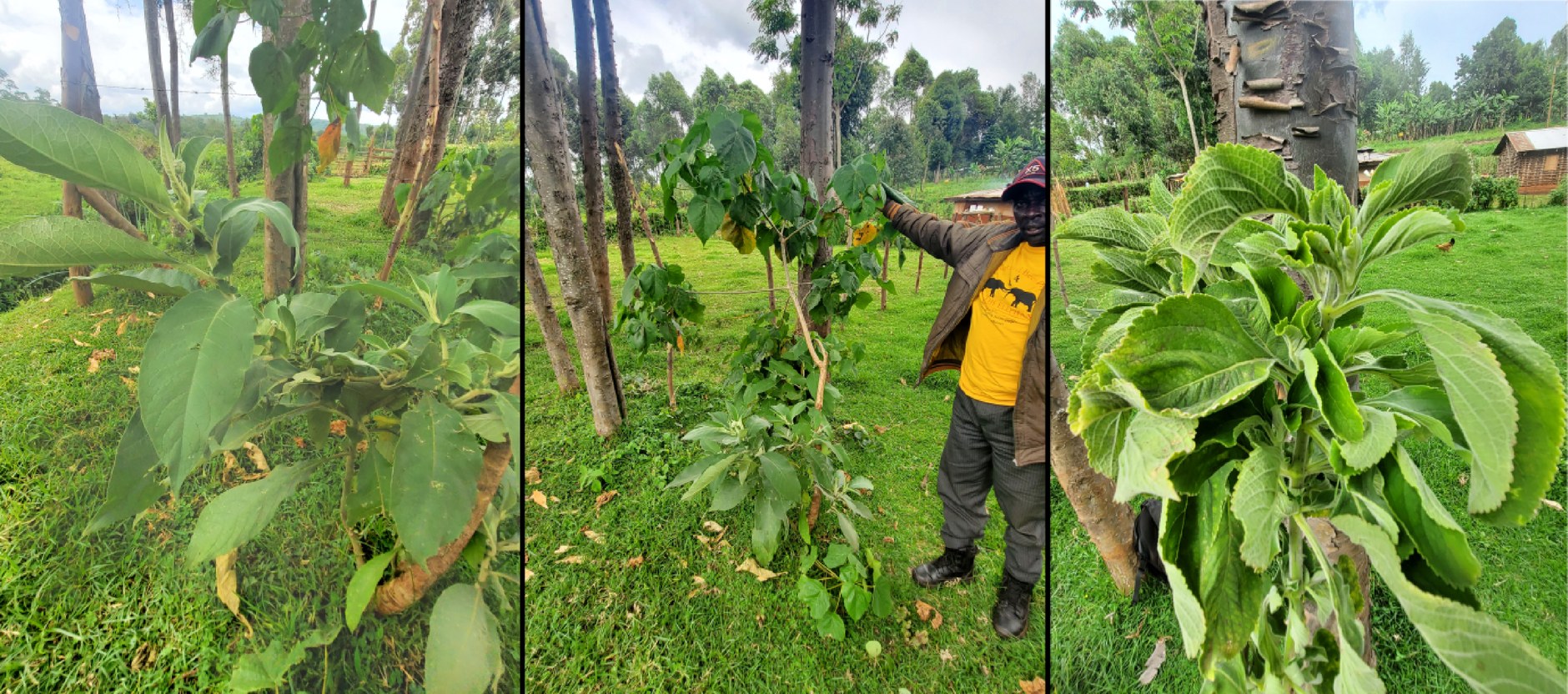
The authors then sorted the claims rather than accepting them whole. Ten plants came out as Mode 3: somebody called them an elephant medicine, but nothing was recorded about the animal’s health at the time. Seven more were put in a tentative Mode 4(!) category, named as medicine taken by a sick elephant with no illness specified. Eight reached Mode 4, the strongest class in the scheme, meaning they were named as medicines sought by a visibly sick elephant for a stated purpose, or given to a calf for its benefit. Those eight are Aloe arborescens, Bersama abyssinica, Coleus barbatus, Dombeya burgessiae, Dombeya rotundifolia, Dombeya torrida subsp. torrida, Ficus natalensis and Kuloa usambarensis.
Mode 4 is not a finding that those eight plants work. It is a label for how good the reported evidence is. The study did not measure a single elephant’s physiology before or after it ate anything.
The part everyone is going to quote
The interviews include accounts of mother elephants combining plant material with their own milk before giving it to their calves. Ficus natalensis is named, along with Coleus barbatus and Bersama abyssinica. The informants’ own description of what this is for, quoted in the paper, is “a kind of immunization.”
That phrase is doing a lot of work and the authors are careful with it. It is the observers’ interpretation, offered by people whose expertise in human medicinal plants is precisely why they were interviewed. Nobody has shown that these plants stimulate a calf’s immune system, and the paper does not set out a step-by-step account of how a mother collects the plants, mixes them with milk and gets the mixture into the calf. It is an unusually interesting hypothesis, and it is a hypothesis.
A second line will travel just as far and deserves the same care. One participant explained that an elephant after a particular resource may head straight for it without stopping to feed, saying that if the resource is 20 kilometers away “they go straight there without eating anything to get there quickly.” The paper states plainly that this was a general remark and was not attached to any specific plant or any specific medicinal event. It describes how deliberate these observers think elephants can be. It is not a record of an elephant walking 20 kilometers for medicine.
The caves are a separate question
Mount Elgon’s elephants are famous for walking into caves and digging out mineral-rich earth with their tusks. It would have been easy for a study about elephant medicine to fold that behavior in.
The informants did not. They attributed the soil eating mainly to minerals such as salt and iron rather than to treatment. That restraint is worth noticing, because it shows the method did not simply classify every odd thing an elephant swallows as medicine.
Which zoo paid for this
None, and in this case the answer is unusually clean.
The funding statement names two grants from the Volkswagen Foundation and one internal grant from Neubrandenburg University of Applied Sciences, with open access paid through Projekt DEAL. No zoo, aquarium or zoological society appears anywhere in it. The research group sits at the Bernhard Nocht Institute for Tropical Medicine in Hamburg.
The study reached a conservation audience through the Tsavo Trust, whose October 2 explainer is careful in the same places the paper is, and which is the reason we went and read it. We checked the trust’s own supporters page as well. It names Tusk, Re:wild, Maliasili, the Addax and Oryx Foundation, BIOPAMA, Helping Rhinos and Africa Geographic among others, alongside a number of logos it does not caption. No zoo, aquarium or zoological society is among the ones it names there.
One qualification, because it would be sharp practice to leave it out. The Tsavo Trust does have a zoological partner: the Zoological Society of London appears on the partner list for its Tsavo West black rhino program, a separate piece of work that the trust says takes at least $350,000 a year. That is different work in a different part of Tsavo, several hundred kilometers away. It has nothing to do with Mount Elgon, nothing to do with this study, and ZSL is not among the authors or the funders of it. We mention it so that the negative above is read as what it is, a statement about this research rather than about the organization.
For scale elsewhere, the Association of Zoos and Aquariums reports that in 2025 its 235 accredited and certified facilities spent approximately $372.4 million on conservation across 139 countries. No published breakdown isolates the African share of that, and we are not going to invent one. Zoos do fund elephant fieldwork in Kenya, and we wrote about one such study earlier this year. This is not one of them.
On the listing
The paper says the African elephant is classified as endangered by the IUCN. One gentle note: since 2021 there is no single African elephant on the Red List. The assessors split the genus, and the announcement of March 25, 2021 placed the African forest elephant, Loxodonta cyclotis, in Critically Endangered after a decline of more than 86 percent over 31 years, and the African savanna elephant, Loxodonta africana, in Endangered after a decline of at least 60 percent over 50 years. Dr. Kathleen Gobush led the assessments. Mount Elgon’s elephants are savanna elephants, so Endangered is the category that applies here, and the paper is right about the animals in front of it.
What the study offers is a list of candidate plants with a reason attached to each one, which is the thing a laboratory or a long-term monitoring program can now go and test. The researchers say as much. Several of the plants already have documented pharmacological activity in the literature, which makes them interesting and does not make them medicine.
The paper is dedicated to the memory of Dr. Jane Goodall, who died a year ago and who the authors say mentored their research group, and to Dr. Christina Janson.
Source: Schultz, Clark, Powles, Freymann, Kinyanjui, Ndiema, Sila, Baez, Colson and Garbe, “African elephants putatively self-medicate with medicinal plants in the Mount Elgon region, Kenya”, Scientific Reports 16, article 28904, published September 24, 2026, open access under CC BY 4.0; and the Tsavo Trust’s explainer of October 2, 2026.
Quick answers
- What did the study actually find?
That eight Sabaot experts around Mount Elgon in western Kenya can name 39 natural resources they believe local elephants use medicinally: 35 plant species from 23 families, plus four soils, minerals or clays. Every plant was collected and identified against herbarium voucher specimens. The study documents and classifies what those observers report. It does not demonstrate that any plant treats anything.
- Who were the informants?
Four wildlife community scouts, two guides, a retired agricultural officer and a retired Kenya Wildlife Service ranger, all from the Sabaot community. Every one had spent more than twenty years in the study area and one had 78 years of experience there. The method is built on that length of observation, which a researcher on a short field season cannot match.
- What do the Modes mean?
They grade how good the reported evidence is, using criteria from the existing zoopharmacognosy literature. Ten plants came out as Mode 3, named as an elephant medicine with nothing recorded about the animal's health. Seven were put in a tentative Mode 4(!), named as medicine taken by a sick elephant with no illness specified. Eight reached Mode 4, named as medicine sought by a visibly sick elephant for a stated purpose or given to a calf. Mode 4 is a grade of evidence, not a finding that the plant works.
- Did elephant mothers really give medicine to their calves?
That is what the informants described, and it is the study's most striking report rather than a demonstrated fact. They said mothers combine Ficus natalensis, Coleus barbatus and Bersama abyssinica with their milk before giving it to calves, and called it, in their words, a kind of immunization. The paper does not describe the mechanics of the behavior and nobody has tested whether the plants affect a calf's immune system.
- Is it true an elephant walked 20 kilometers for medicine?
No, and the paper is explicit about it. One participant made a general remark that an elephant after a particular resource might travel straight to it, saying that if it is 20 kilometers away they go without stopping to feed. The paper states the quote was generalized and not attached to any specific plant or medicinal event.
- Which zoo funded the research?
None. The funding statement names two grants from the Volkswagen Foundation and one internal grant from Neubrandenburg University of Applied Sciences, with open access paid through Projekt DEAL. We also read the supporters page of the Tsavo Trust, which brought the study to a conservation audience, and found no zoo, aquarium or zoological society among the organizations it names.