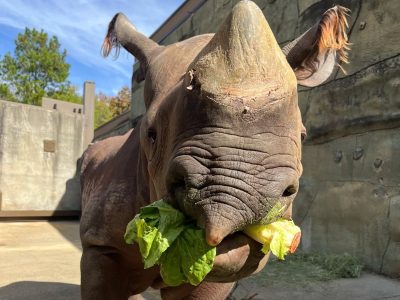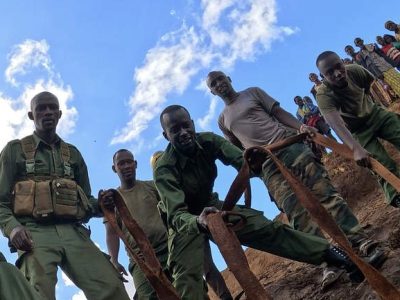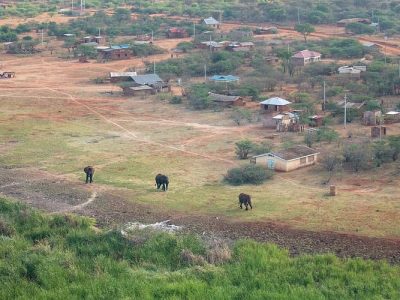
Ol Pejeta Conservancy in Laikipia, Kenya, holds the last two northern white rhinos on earth and more than 165 critically endangered black rhinos. On November 11 it published a story about paying school fees. Two students, Nancy Muthoni Muthui and Omar Iddi, were profiled as recipients of the conservancy’s scholarship program. Nancy was one of 100 students selected, competing against 232 other applicants.
The announcement does not say who funds it. That turns out to be answerable, and the answer runs a long way from Laikipia.
What the scholarship actually changed
For Nancy, the obstacle was not money in the ordinary sense. She had already been selected for Masii Girls’ School in Machakos, several hours from her home, and the distance made attending it impractical. The scholarship let her take a place at a high school closer to home instead. She plays volleyball, reads, and wants to be a civil engineer building roads in Kenya.
Omar Iddi comes from Depatas, just north of the conservancy. His father died when he was young and his mother raised the family. The scholarship covered the fees at Thome Boys High School, where he is now in Form Four, serves as his biology class senator and assists his teacher during experiments. He wants to be a nurse, train in the United States, and come back.
Both profiles are written by the conservancy, and both read as the conservancy intends. That is not a criticism. It is the standard shape of this material, and the facts inside it, the application numbers and the school names, are checkable and specific in a way that most of it is not.
Which zoos pay for this?
None that we could verify, and the chain is worth setting out because tracing it took three documents the announcement itself did not link.
Ol Pejeta’s own description of its institutional partners names the Kenya Wildlife Service, the Arcus Foundation, Fauna & Flora, and the governments of the United Kingdom and the United States. That is a government agency, a private foundation, an international conservation NGO and two national aid budgets. Not a zoo among them. The conservancy also describes a deliberately commercial model, combining tourism and cattle ranching so that it can reinvest its own revenue, and it is one of only five conservancies in Africa holding IUCN Green List status.
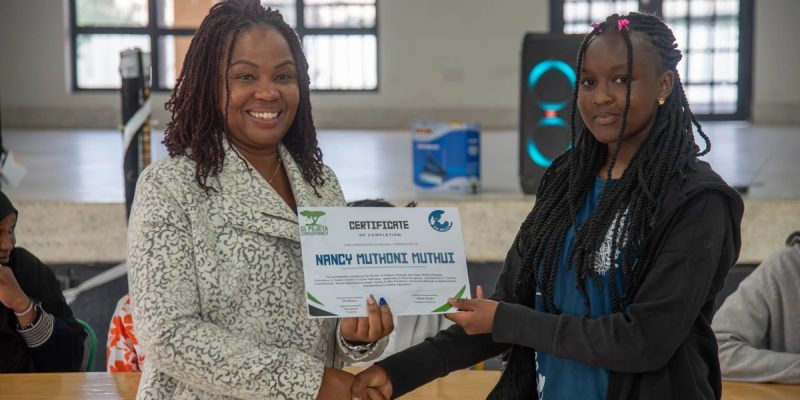
The scholarship partner is named nowhere in the article. It is named in the article’s own photograph. The certificate the student is holding carries a second logo beside the conservancy’s, reading PA-MOJA, and is signed by that organization’s president alongside Ol Pejeta’s head of community development.
PA-MOJA, whose name is Swahili for “together,” describes itself as a non-profit providing scholarships and educational opportunities to students living around Ol Pejeta in order to support wildlife conservation. It states that it operates under the Langley School District Foundation, a charitable foundation attached to a public school district in British Columbia, Canada, established in 2001. PA-MOJA says its donated funds go to the student scholarship program at Ol Pejeta, and that the partnership dates to 2006.
So the trace ends at a Canadian school district foundation. No accredited zoological institution appears anywhere along it.
Why the negative is the interesting part
Ol Pejeta is not a place the zoo world has ignored. Najin and Fatu, the two surviving northern white rhinos, were born at Dvůr Králové Zoo in the Czech Republic, in 1989 and 2000. They arrived at Ol Pejeta on December 20, 2009, with two males, Sudan and Suni, and the zoo states that it still owns both surviving females. On a story about those two animals, Dvůr Králové Zoo would plainly have earned its place: it bred them, it owns them, and its veterinary staff have examined them in Kenya.
On this story it has not, and neither has any other zoo. That is the distinction we try to hold. A funder trace runs per project, not per organization. The fact that accredited institutions are deeply involved in one program at a conservancy tells you nothing about who pays for another one on the same ground, and assuming otherwise is how a plausible connection gets printed as a real one.
For scale on the wider question, the Association of Zoos and Aquariums reports that its 235 accredited members spent roughly $372.4 million on conservation across 139 countries in 2025. No published breakdown isolates the African share of that, and we will not estimate one. What this particular trace shows is that the money behind 100 school places near one of the most zoo-connected conservancies in Africa came from somewhere else entirely.
The argument the program is making
Both organizations describe the scholarships as conservation spending rather than charity attached to it. PA-MOJA’s stated reasoning is that supporting local students helps the surrounding community see the value of the conservancy, and therefore support the wildlife on it. Ol Pejeta frames it as cultivating human potential alongside protecting endangered species.
Whether that logic holds is a fair question, and neither organization publishes the kind of long-run data that would settle it. What is on the record is that the partnership is twenty years old, that it has put hundreds of students through school, and that this year it had more than twice as many applicants as places. We have covered the conservancy’s technical and vocational training work before, and it sits in the same argument.
Quick answers
- What is the Ol Pejeta Conservancy scholarship program?
It pays secondary school fees for students from the communities around the conservancy in Laikipia, Kenya. In the group profiled on 11 November 2026, 100 students were selected; the conservancy says one recipient, Nancy Muthoni Muthui, competed against 232 other applicants.
- Who actually funds the scholarships?
The announcement names no funder. The certificate in the announcement photo carries a second logo, PA-MOJA, and PA-MOJA states that it is a non-profit providing scholarships to students living around Ol Pejeta, that its donated funds go to the scholarship program at the conservancy, and that it operates under the Langley School District Foundation, a charitable foundation attached to a public school district in British Columbia, Canada. It dates the partnership to 2006.
- Which zoos fund the Ol Pejeta scholarships?
None that we could verify. Ol Pejeta names its institutional partners as the Kenya Wildlife Service, the Arcus Foundation, Fauna and Flora, and the governments of the United Kingdom and the United States. None is an accredited zoological institution, and no zoo appears anywhere in the scholarship funding chain.
- Is any zoo involved with Ol Pejeta at all?
Yes, on different work. Najin and Fatu, the last two northern white rhinos, were born at Dvur Kralove Zoo in the Czech Republic in 1989 and 2000 and moved to Ol Pejeta on 20 December 2009 along with two males, Sudan and Suni. The zoo states that it still owns both surviving females. That is a separate program from the scholarships, which is the whole point of tracing funding per project rather than per organization.
- Why does a wildlife conservancy pay school fees?
Both organizations describe it as conservation spending rather than charity alongside it. PA-MOJA states that supporting local students helps the surrounding community see the value of the conservancy and therefore support wildlife conservation. Ol Pejeta frames it as cultivating human potential alongside protecting endangered species.
- How does Ol Pejeta fund its own operations?
It describes a deliberately commercial model combining wildlife conservation, tourism, community development and cattle ranching, so that it can reinvest its own revenue and absorb external shocks. It is one of only five conservancies in Africa holding IUCN Green List status.