
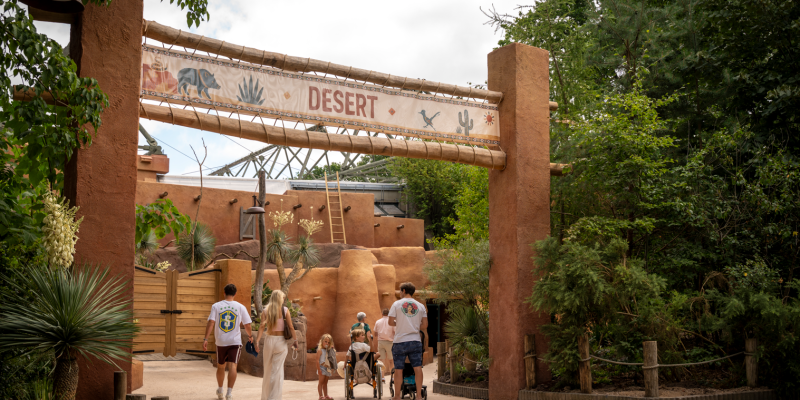
Burgers’ Zoo in Arnhem reopened its Desert hall on Thursday, July 9, 2026, after a renovation the zoo describes as months long. The rebuilt hall has brand new animal enclosures, a new route for visitors to walk, and a new main entrance.
The Dutch zoo marked the reopening by introducing gopher tortoises into a mixed reptile enclosure.
What the Desert is
Burgers’ Zoo calls the Desert the largest covered rock desert in the world. It is one of the zoo’s ecodisplays, the large enclosed biome halls the facility is built around, and it recreates the Sonoran and Mojave deserts of the southwestern United States and northern Mexico.
The planting is the part visitors tend to remember: agaves, yuccas, opuntias, and saguaro cacti standing several meters tall. For an American reader there is something particular about it, a Dutch building in Gelderland holding an indoor Arizona.
What changed
The zoo lists three things: gloednieuwe dierverblijven, brand new animal enclosures; a new visitor route through the hall; and a new main entrance to the Desert.
Animals are being moved back in gradually. Burgers’ Zoo said introductions would happen stapsgewijs, step by step, over the weeks and months after the reopening, rather than all at once on opening day. That is normal practice for a rebuilt habitat, where each species has to be given time to settle before the next arrives.
The zoo did not publish a construction cost or a floor area for the renovated hall, and no staff member was quoted by name in the announcement.
The tortoises
The gopher tortoise, Gopherus polyphemus, is a burrowing tortoise from the southeastern United States, so it sits slightly outside the Sonoran and Mojave geography the hall represents. It is a keystone species in its own range: the burrows it digs are used by hundreds of other species, which is why its decline matters out of proportion to its numbers. The IUCN Red List rates it Vulnerable.
Why this counts as expansion news
A reopening after months of closure is a capital project, and for a zoo built on a handful of very large enclosed habitats, taking one of them offline for most of a year is a significant commitment. Burgers’ Zoo has been working on more than one at once: in August it announced it was developing the world’s largest seagrass aquarium for its Ocean hall.
Two of the zoo’s flagship displays under redevelopment in the same year is a scale of investment worth noting, particularly at a facility that does it without the public funding a state-owned German zoo such as the Wilhelma can draw on.
Source: Burgers’ Zoo, July 9, 2026.
Quick answers
- When did Burgers' Zoo reopen the Desert?
Thursday, July 9, 2026, after a renovation the zoo describes as months long.
- What changed in the Desert hall?
Brand new animal enclosures, a new visitor route through the hall, and a new main entrance.
- What is the Desert?
An ecodisplay at Burgers' Zoo in Arnhem, which the zoo calls the largest covered rock desert in the world. It recreates the Sonoran and Mojave deserts of the southwestern United States and northern Mexico, planted with agaves, yuccas, opuntias and saguaro cacti several meters tall.
- Which animals moved in?
Gopher tortoises were introduced into a mixed reptile enclosure at the reopening. Burgers' Zoo said further introductions would happen step by step over the weeks and months afterward.