
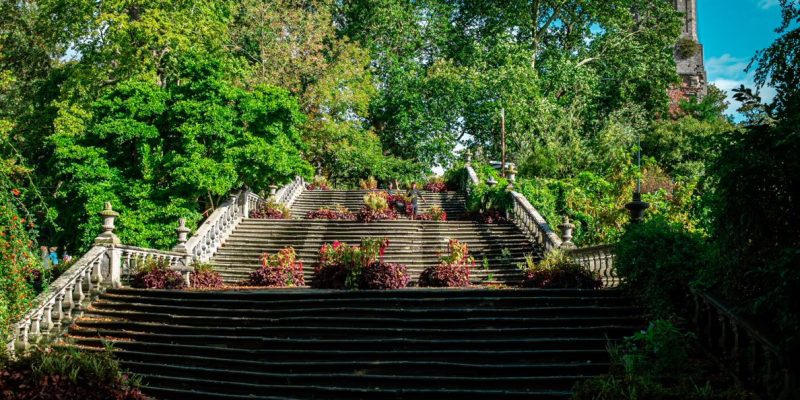
Pairi Daiza has finished restoring the monumental staircase of the former Cambron Abbey, the 1776 stone stair that crosses the Dendre inside the Belgian park’s grounds. The work took nearly two months and, the park says, replaced none of the original material.
The staircase is one of the few pieces of the abbey still standing at the scale its builders intended. Three flights of steps, stone balustrades, and dimensions that have nothing modest about them: Pairi Daiza describes it as evidence of one of the most prosperous stretches in Cambron’s history, and a long way from the austerity usually associated with the Cistercians who built it.
Why did a staircase need rescuing?
Two reasons, and one of them is the park itself. The stair is now walked by millions of Pairi Daiza visitors a year, footfall on a scale nobody in 1776 designed for. On top of that, time, water and vegetation had done the usual damage to open masonry.
The repair was carried out by four specialist craftsmen from the Centre region of Hainaut, working with Pairi Daiza’s infrastructure teams and a structural engineer. Part of the blue stone, along with steps and balustrades, was taken down and restored in a workshop before being reassembled on site by hand. The brick walls were repaired, the joints redone, and the structure reinforced. Cracks in the stone were filled with blue-stone powder, so that the repair matches the material it sits in rather than announcing itself.
Blue stone, pierre bleue, is the hard gray-blue limestone quarried in Hainaut and used across Belgian building for centuries. It matters here because the powder used to fill the cracks comes from the same rock as the steps, which is what lets a repair disappear instead of showing as a patch.
Pairi Daiza’s stated goal was stability and safety without altering the staircase’s character, and the park’s summary of the outcome is that no original material needed to be replaced.
The emperor and the staircase
The stair has a story attached to it, and the park is careful about how it tells it. In 1783, seven years after the staircase went up, Emperor Joseph II classified Cambron among the monasteries he considered useless and suppressed the abbey, part of a reform aimed at contemplative religious communities he judged to serve no purpose in society.
By tradition, on seeing the staircase the emperor is supposed to have called it one of the finest in Europe while wondering aloud whether it would actually lead to paradise. Pairi Daiza states plainly that the authenticity of the remark has not been established, and offers it as an illustration rather than a fact: the gap between the Cistercian ideal of simplicity and what Cambron had become by the end of the eighteenth century.
Nearly 250 years later the staircase is still the most visible surviving piece of that chapter, and it is now the route visitors take through the site.
The park published the restoration on its news pages: Pairi Daiza restores the monumental staircase of Cambron Abbey. Restoring rather than replacing is a run of work several European parks have taken on this year. Tierpark Hagenbeck in Hamburg returned its Art Nouveau entrance gate to its original site in August, and Tiergarten Schonbrunn reopened its restored Engelstor the same month.
Quick answers
- What did Pairi Daiza restore?
The monumental staircase of the former Cambron Abbey, built in 1776, which crosses the Dendre inside the park's grounds. It has three flights of steps and stone balustrades. The park announced the completed restoration on September 3, 2026.
- Why did it need work?
Two reasons. The stair is now walked by millions of Pairi Daiza visitors a year, far beyond the footfall it was designed for, and time, water and vegetation had damaged the open masonry.
- How was it repaired?
Four specialist craftsmen from the Centre region of Hainaut worked for nearly two months with the park's infrastructure teams and a structural engineer. Blue stone, steps and balustrades were dismantled, restored in a workshop and reassembled by hand. Brick walls were repaired, joints redone and the structure reinforced, and cracks were filled with blue-stone powder so the repair matches the surrounding stone.
- Was any of the original stone replaced?
No. Pairi Daiza says no original material needed to be replaced, and that the aim was stability and safety without altering the staircase's character.