
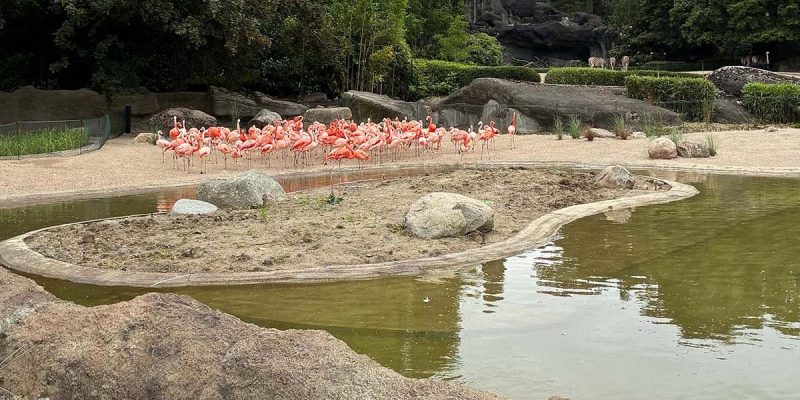
Hamburg’s Tierpark Hagenbeck reopened its flamingo pond at the Africa panorama on July 9, 2026, after a full modernization of the heritage-listed water feature. The birds moved back onto the outdoor pool in time for the start of the Hamburg school holidays, and the centerpiece of the rebuild is not anything a visitor can see: a filtration plant that runs all year.
The pond sits at the foot of Hagenbeck’s Africa panorama, the open, barless landscape view that the park’s founder built his reputation on, and it is one of the most photographed spots on the site. It is also, in German heritage law, denkmalgeschützt, meaning it is a protected structure and cannot simply be replaced. The rebuild had to work inside what was already there.
Why a flamingo pond lives or dies on water quality
Flamingos are filter feeders. They take in water and strain food out of it through the fine lamellae inside that down-curved bill, which means the water in the enclosure is not just something the birds stand in, it is where their meals come from. They also spend a large part of the day preening. Dirty water is a health problem for a flamingo in a way it is not for a bird that feeds on land.
That is the problem the new plant is built to solve, and the park explained the mechanism rather than leaving it at “better water.”
“Wir haben eine sehr aufwendige Filteranlage installiert, die ganzjährig reinigt. Damit sparen wir uns die vierteljährliche Reinigung. Die Trommelfilter und die Skimmer reinigen mechanisch, Biofilter und eine Pflanzenklärzone sorgen für eine biologische Reinigung,” said Tobias Taraba, Hagenbeck’s head of animal management: “We have installed a very elaborate filtration system that cleans year-round. That saves us the quarterly cleaning. The drum filters and the skimmers clean mechanically, biofilters and a planted clarification zone provide biological cleaning,” in a statement translated from German.
Those are two different jobs. The drum filters and skimmers are mechanical: they physically pull solids and surface debris out of the water. The biofilter and the planted zone are biological, using bacteria and plant roots to consume the dissolved waste that a screen cannot catch. A set of flow pumps keeps the water moving through both stages through the whole year. Taraba said the system replaces a cleaning cycle the park previously had to run every three months.
What it cost, and who paid
The project was funded by the Stiftung Hagenbeck, the park’s foundation, with a contribution of around one million euros. Hagenbeck said the pond was extensively refurbished and designed on sustainable principles, and adapted specifically to what flamingos need.
“Die neue Filteranlage sorgt für eine deutlich verbesserte Wasserqualität und schafft beste Voraussetzungen für eine artgerechte Haltung. Gleichzeitig bieten wir unseren Gästen die Möglichkeit, die Tiere in einer naturnah gestalteten Umgebung zu beobachten,” said Walter Wolters, managing director of Tierpark Hagenbeck: “The new filtration system produces significantly improved water quality and creates the best conditions for species-appropriate husbandry. At the same time we are giving our guests the chance to watch the animals in a naturalistic setting,” in a statement translated from German.
Which flamingos?
The release does not say. It refers throughout to “die Flamingos” and to the flamingo group as a whole without naming a species, and we are not going to guess from a photograph. Hagenbeck’s own animal lexicon lists three flamingo species in the collection: the Chilean flamingo and the Cuban flamingo, both at enclosure 45, and the greater flamingo at enclosure 55. Which of them are on the rebuilt Africa panorama pond, and in what numbers, was not stated.
Hagenbeck has had a busy year of work on its historic fabric. The park’s Art Nouveau entrance gate returned to its original location and reopened to visitors in August, a separate project on the same theme of restoring rather than replacing.
The full announcement is on the park’s press pages: Flamingos zurück am Afrika-Panorama.
Quick answers
- When did Tierpark Hagenbeck's flamingo pond reopen?
July 9, 2026, in time for the start of the Hamburg school holidays. The flamingos moved back onto the outdoor pool at the Africa panorama after a full modernization of the heritage-listed pond.
- What was actually rebuilt?
The centerpiece is a filtration plant that runs year-round. Drum filters and skimmers do the mechanical cleaning, pulling solids and surface debris out of the water, while a biofilter and a planted clarification zone do the biological cleaning. Flow pumps keep water moving through both stages all year.
- Why does water quality matter so much for flamingos?
Flamingos are filter feeders. They take water in and strain food out of it through the fine lamellae inside the down-curved bill, so the water in the enclosure is where their meals come from, not just something they stand in. They also preen for a large part of the day.
- What did it cost?
Around one million euros, contributed by the Stiftung Hagenbeck, the park's foundation. Hagenbeck's head of animal management, Tobias Taraba, said the new system also replaces a cleaning cycle the park previously had to run every three months.
- Which flamingo species live on the pond?
Hagenbeck did not say. The release refers only to the flamingo group as a whole. The park's own animal lexicon lists three flamingo species in the collection: the Chilean flamingo and the Cuban flamingo at enclosure 45, and the greater flamingo at enclosure 55.