
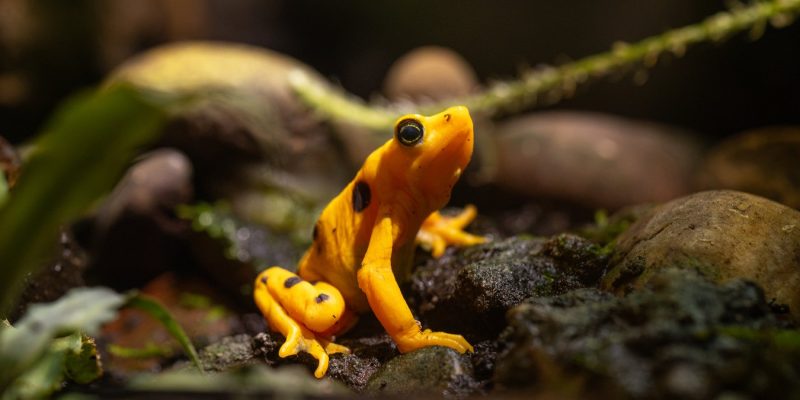
The Fort Worth Zoo has a clutch of 49 Panamanian golden frogs, announced on August 14, National Golden Frog Day in Panama. It is only the second time the zoo has bred the species successfully, and the first in ten years.
That gap is the story. A decade between successful clutches measures how hard this animal is to reproduce, and 49 frogs at one institution is a meaningful addition to a population that exists almost nowhere else.
The golden frog is a toad, and it is functionally gone from the wild
Atelopus zeteki is a true toad, a member of the family Bufonidae, despite the common name everyone uses. In Panama it is a national symbol, which is the sense in which the zoo’s own headline calls it a symbol of luck.
The zoo describes it as thought to be extinct in the wild. The formal position is close but not identical, and the difference is worth stating. AmphibiaWeb records the IUCN Red List category as Critically Endangered and the species as possibly extinct in the wild. The category has not been moved to Extinct in the Wild, because that determination requires exhaustive survey evidence that an animal is gone and the Red List does not make it lightly. In practice the zoo and the assessment are describing the same situation with different degrees of finality.
What emptied the streams was chytridiomycosis, a skin disease caused by the fungus Batrachochytrium dendrobatidis. AmphibiaWeb records a decline of more than 80 percent in a decade, most likely from that disease, and the last golden frogs were taken into captive breeding facilities in 2006 to keep them from being infected. The reason they still live indoors is that the fungus is still in the water they came from.
Forty-nine frogs, and why the number is fragile
The zoo does not publish its husbandry protocol, and the number itself carries the point. Fort Worth has held golden frogs for years and had bred them once before. Ten years passed between that clutch and this one. Whatever the sequence is, it is narrow enough that people who have done it before can go a decade without doing it again.
Fort Worth’s associate curator of ectotherms, Vicky Poole, has spent thirty years on this species. She is a founding member and the coordinator of Project Golden Frog, a collaboration among United States zoos and aquariums that oversees the managed population at North American facilities, coordinates research and advises on husbandry and conservation work inside Panama.
Ectotherm is the working word for an animal whose body temperature tracks its surroundings rather than being generated internally, which is why a curator of ectotherms is really a curator of environments. For a golden frog, the room is the animal’s physiology.
What is happening in Panama
At the El Valle Amphibian Conservation Center, the zoo’s partner in Panama, part of the golden frog population has been moved from indoor holding into new open-air enclosures that expose the frogs to real weather while keeping them screened from the outside world. It is research rather than release: the point is to compare how frogs grow in semi-natural conditions against those raised in controlled ones, and to build the evidence base a reintroduction would need.
ZooReviews covered that move in July, when the Maryland Zoo announced the same study. It is a genuinely collaborative project, which is why it keeps being announced by different partners, and Fort Worth is one of them.
What has to be true before a golden frog goes home?
Three things, roughly. There have to be enough frogs, from enough different founders, that releasing some does not endanger the insurance population. Somebody has to know how the animals fare outside a climate-controlled room, which is what the El Valle enclosures are measuring. And the fungus problem has to be answerable, whether through resistant individuals, treated sites or habitat where the pathogen load is survivable.
The 49 frogs in Texas are the first of those three, and the least discussed. A release program is arithmetic before it is anything else, and arithmetic needs frogs.
Sources: Fort Worth Zoo, “The Fort Worth Zoo supports a groundbreaking study for a critically endangered symbol of luck,” August 14, 2026; AmphibiaWeb, Atelopus zeteki.
Quick answers
- How many Panamanian golden frogs did the Fort Worth Zoo breed?
Forty-nine, announced on August 14, 2026. It is the zoo's second successful breeding of the species and its first in ten years.
- Is the Panamanian golden frog extinct in the wild?
The IUCN Red List category is Critically Endangered, with the qualifier possibly extinct in the wild. The last golden frogs were taken into captive breeding facilities in 2006 to protect them from chytrid fungus, and none have been documented in the wild since.
- Is the Panamanian golden frog actually a frog?
No. Atelopus zeteki is a true toad, a member of the family Bufonidae, despite its common name.
- What is happening at El Valle in Panama?
Part of the golden frog population at the El Valle Amphibian Conservation Center has been moved from indoor holding into screened open-air enclosures, so researchers can compare growth in semi-natural conditions against controlled ones. It is research, not release.