
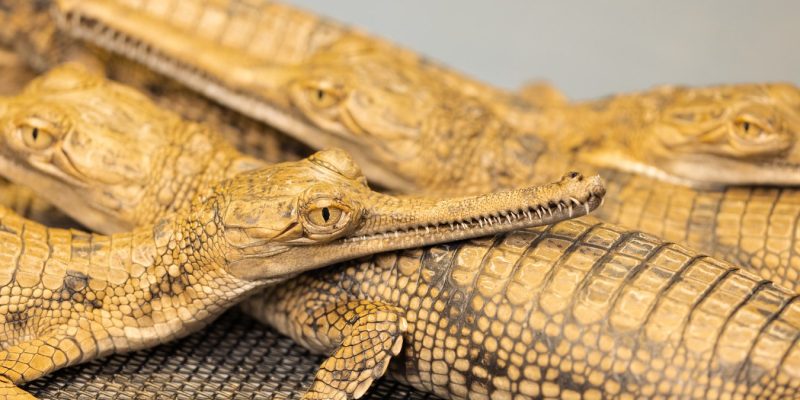
Eight gharials hatched at the Fort Worth Zoo this summer, between June 3 and June 26, from clutches laid by two different females. The hatch takes the zoo’s juvenile gharial population from 5 to 13 in a single season, and it is the fourth consecutive year the zoo has hatched this critically endangered crocodilian.
No other institution in North America has produced multiple gharial offspring, and none has repeated the achievement in consecutive years. Fort Worth has now done it four times in a row.
What changed this year was a heated log
There is no single breakthrough behind the number. The zoo has been adjusting the same handful of variables a little at a time for more than fifteen years, and this season it added extra heated nesting logs to the adults’ outdoor habitat and kept fine-tuning incubator temperatures for the eggs. Staff will not credit any one of those changes. They believe the run of success is cumulative, the compounding of small husbandry decisions made year over year.
Temperature is not a comfort setting here. In gharials, as in most crocodilians and many turtles, the sex of an embryo is set by how warm the nest is while it develops, not by chromosomes at fertilization. Move the incubator a degree and you change the ratio of males to females in the clutch. That makes the thermostat a population-management tool, which is why a program trying to build a genetically useful group of young animals pays such close attention to it.
A habitat built in 2010 to make eggs happen
The adult gharial habitat sits just outside the zoo’s herpetarium, the Museum of Living Art, and it was designed in 2010 with breeding rather than display as the brief. Its water temperature is regulated. Its waterfront slopes gently, because a gharial’s legs are short and a steep bank is a barrier between the water it lives in and the dry sand it needs. Heat coils run under that sand to hold it warm enough that a female will actually lay in it.
Those are unglamorous features and they are the reason there are thirteen juveniles on the property. A gharial that never finds sand at the right temperature never nests, and a nest that never reaches the right temperature never hatches.
“It’s very rewarding to have another year achieving the healthy hatchings of these unique and vulnerable crocodiles,” said Vicky Poole, associate curator of ectotherms at the Fort Worth Zoo. “Every successful hatch gives our team another opportunity to refine our techniques and deepen our understanding of this remarkable species. The knowledge we gain through this work is an important part of the Fort Worth Zoo’s contribution to gharial conservation that we can share with our partners around the world.”
What a gharial actually is
The gharial is one of the largest crocodilians alive, and the least like the animal most people picture. Its snout is long and needle-thin, an instrument for catching fish rather than for holding large prey, and it spends most of its life in cool water. A male can reach 16 feet and close to 1,500 pounds. Females stay slightly smaller. This year’s hatchlings are just over 12 inches, and their snouts will keep elongating as they grow.
The hatchlings are behind the scenes for now while keepers monitor their growth. Guests can see juveniles from earlier years inside the Museum of Living Art, which the zoo says is the only place in North America where the public can watch young gharials at all.
How close to gone is the gharial?
The zoo describes the species as critically endangered, and the IUCN Red List agrees: Critically Endangered. ZSL’s EDGE of Existence project, which builds its rankings on that assessment, puts the wild population at fewer than 250 adults and the decline at up to 98 percent since the 1940s.
The reasons are structural rather than dramatic. The zoo names habitat destruction, pollution and river fragmentation. EDGE adds the damming of rivers across the gharial’s range, which alters habitat significantly for an animal that cannot readily disperse to another waterway, along with overfishing that thins its prey, accidental capture in gill nets, hunting for body parts used in traditional medicine, and the collection of eggs for food.
That is the arithmetic a captive population is measured against. Thirteen juveniles at one zoo in Texas is not a solution to a river system, but a genetically diverse group of young gharials in professional care, plus fifteen years of documented notes on what temperature does what, is the kind of thing that has to exist before anyone can put animals back.
Where this fits in the zoo’s run
Fort Worth first drew notice for this work when it hatched gharials two years running in 2024. Two more seasons have followed. The zoo’s stated goal has not changed in fifteen years: reproduce the species reliably, grow the population, and widen the gene pool, which is why the detail about two separate females’ clutches matters more than the headline number of eight.
If you want to see one, the juveniles are in the Museum of Living Art, growing into their snouts.
Sources: Fort Worth Zoo, “A record-breaking eight critically endangered gharial crocodiles have hatched at the Zoo,” September 9, 2026; ZSL EDGE of Existence, Gharial (Gavialis gangeticus).
Quick answers
- How many gharials hatched at the Fort Worth Zoo in 2026?
Eight, between June 3 and June 26, from clutches laid by two different females. That took the zoo's juvenile gharial population from 5 to 13.
- Is the Fort Worth Zoo the only place breeding gharials in North America?
It is the only institution in North America to have produced multiple gharial offspring, and the only one to have repeated it in consecutive years. 2026 was the fourth year in a row.
- How endangered is the gharial?
The IUCN Red List assesses the gharial as Critically Endangered. ZSL's EDGE of Existence puts the wild population at fewer than 250 adults, after a decline of up to 98 percent since the 1940s.
- Can visitors see the gharials?
Not the 2026 hatchlings, which are behind the scenes. Juveniles from earlier years are in the Museum of Living Art, the zoo's herpetarium, which the zoo says is the only place in North America where the public can see young gharials.