
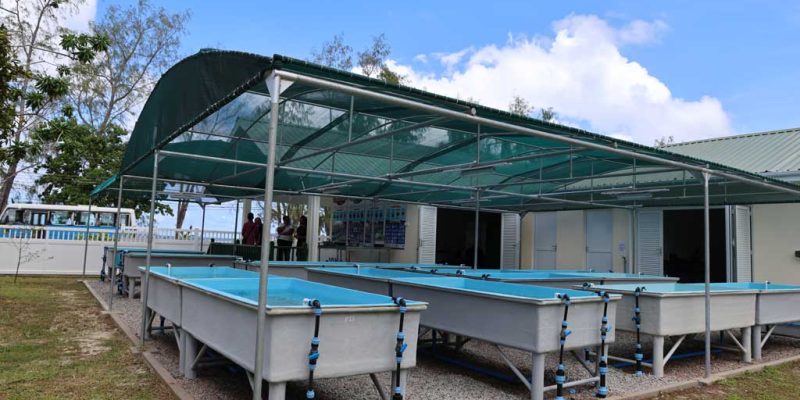
Africa’s first land-based coral breeding laboratory has produced roughly 800,000 coral embryos from a single species and settled about 65,000 new corals from them. The lab sits inside Nature Seychelles’ Assisted Recovery of Corals facility on Praslin Island, and on September 1, 2026 the organization’s chief executive made the case that it should now be treated as a national asset rather than the tail end of a finished project.
The species that spawned was Acropora tenuis cf. macrostoma. It was the first spawning event recorded at the lab, which became operational in November 2025.
What the facility is
The Assisted Recovery of Corals facility, ARC for short, opened on May 9, 2025 at Nature Seychelles’ Centre for Ocean Restoration Awareness and Learning at Amitie on Praslin. It was described at the opening as Africa’s first land-based aquaculture facility built for climate change adaptation and conservation, and it builds on fifteen years of reef restoration work by the same organization.
Most reef restoration to date has been coral gardening: break a healthy colony into fragments, grow them out, put them back. It works, and it produces genetic clones. The ARC lab is built for the other approach, controlled sexual reproduction, which is slower and much harder and which produces corals that are not identical to their parents. That genetic variety is the entire point, because it is where heat tolerance has a chance to come from.
Nature Seychelles says the lab is the result of technical expertise brought in from Coral Spawning International and others, with imaging support from Canon that lets researchers document the reproductive process closely enough to be useful.
Why it matters more this year than last
Because the recovery windows are closing. Six days after the commentary, Nature Seychelles reported on the Global Coral Reef Monitoring Network’s latest global assessment, which found average global hard coral cover fell from 30.2 percent across 1980 to 2009 to 27.3 percent across 2020 to 2024, a decline of about 9.5 percent, driven mainly by climate-induced heat stress.
The number that matters more is the interval. Disturbances that used to arrive roughly every ten years now arrive every five to six, which does not give a reef long enough to get back on its feet before the next one lands.
“After decades of studying coral reefs, what concerns me most isn’t the current loss of hard coral cover; it’s that we’re steadily eroding the conditions they need to recover,” said Dr Manuel Gonzalez Rivero, the assessment’s lead author.
Dr Nirmal Shah, Nature Seychelles’ chief executive, has argued that ARC could grow into a national coral bank holding rare, threatened and heat-resilient genotypes, on the reasoning that repeated bleaching can wipe out a locally important colony before anyone has secured its genetic diversity. A draft Seychelles Marine Biotechnology Investment Plan identifies the facility as supporting one of five potential biotechnology business lines for the country.
Who paid for it
The facility was established under a regional coral reef restoration project covering Seychelles and Mauritius, funded by the Adaptation Fund through the United Nations Development Programme and by the two governments. Nature Seychelles then used its share as leverage, drawing additional investment from the Seychelles Conservation and Climate Adaptation Trust, the shipping group CMA CGM and Canon.
There is no accredited zoo or aquarium anywhere in that list. We checked, because on this beat the money behind a conservation facility usually runs back to one, and here it does not. Nature Seychelles has built Africa’s only facility of its kind on climate adaptation funding, a national government, a marine conservation trust, a shipping company and a camera manufacturer.
That is worth stating plainly rather than reaching for a connection. The zoo and aquarium sector has done a great deal of the foundational work on breeding coral in closed systems, and our own coverage of elkhorn coral spawning at the Florida Aquarium is the same science on the other side of the Atlantic. But the institutions doing that work are not the ones funding Praslin, and saying otherwise would be tidier than it is true.
What comes next
Outplanting. The next phase moves the lab-raised juveniles onto the reef and expands local technical capacity, which is the step that decides whether 65,000 settled corals is a laboratory result or a restored reef. Nature Seychelles has also floated a second use for the facility, supplying corals to what it calls Blue Barrier structures, underwater coastal defenses designed to be colonized rather than to sit inert.
The infrastructure and the proof of concept exist. The open question, as the organization frames it, is investment.
The commentary is published by Nature Seychelles.
Quick answers
- What did the Seychelles coral lab produce?
About 800,000 coral embryos from Acropora tenuis cf. macrostoma, its first recorded spawning, with roughly 65,000 corals successfully settling. The lab became operational in November 2025.
- How is this different from coral gardening?
Coral gardening grows fragments, which are genetic clones of the parent colony. The ARC lab uses controlled sexual reproduction, which produces genetically varied offspring and so a chance at greater heat tolerance.
- Who funds the ARC facility?
The Adaptation Fund through UNDP and the Seychelles and Mauritius governments, with further investment from SeyCCAT, CMA CGM and Canon. No accredited zoo or aquarium appears among the funders.
- When did the facility open?
May 9, 2025, at Nature Seychelles' Centre for Ocean Restoration Awareness and Learning at Amitie on Praslin. It was described at the opening as Africa's first land-based facility of its kind.