
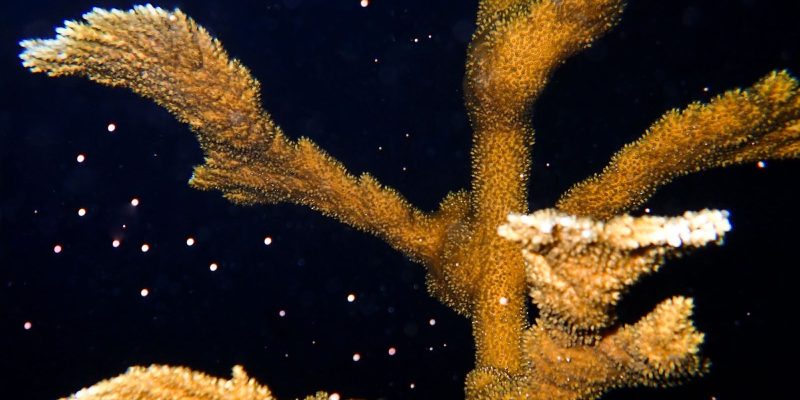
Four coral scientists from The Florida Aquarium spent twelve nights in the Upper Florida Keys this summer working alongside eleven other research and conservation organizations, and came back with 61,000 elkhorn coral larvae and 101 genetic crosses that had never existed before. The aquarium announced the results on September 4, 2026.
The teams worked offshore of Tavernier over elkhorn colonies grown by Reef Renewal USA in an ocean-based nursery, collecting eggs and sperm from the corals and combining them into new pairings, some of them from parent colonies that had never produced offspring on their own.
“This is what coral conservation looks like: long nights, precise science, and a team of people who are willing to show up when the opportunity comes,” said Keri O’Neil, director and senior scientist of The Florida Aquarium’s Coral Conservation Program. “Collecting elkhorn coral spawn in the ocean is an extremely challenging and demanding task, but our teams were committed to seeing it through.”
Why elkhorn coral is worth twelve sleepless nights
Elkhorn coral, Acropora palmata, is the branching Caribbean species named for the resemblance its thick, flattened arms bear to elk antlers. It is listed as threatened under the Endangered Species Act, and NOAA Fisheries reports that the population now stands at less than 3 percent of its former abundance, after white band disease removed roughly 97 percent of it beginning in the 1980s. The marine heatwaves of 2023 and 2024 killed 89 to 100 percent of known wild and restored colonies in the Florida Keys.
What is left is countable. Fewer than 25 unique wild elkhorn colonies remain across Florida’s Coral Reef, and researchers have described the species as functionally extinct in the wild. Every spawning night is a chance to bank genetic combinations that may not be available again.
The parents were chosen for what they survived
Some of the colonies used this summer were picked because they came through the 2023 marine heatwave without bleaching and then held up through another hot summer in 2024. Whether that resilience can be passed to the next generation is what the aquarium’s scientists will now study.
“These are new combinations of genes that have never existed before,” O’Neil said. “Some come from parents that showed incredible resilience during extreme heat, others that were never able to make offspring before on their own. We’re excited about what we can learn from them and what they could ultimately mean for Florida’s Coral Reef.”
Where the 61,000 larvae went
Twenty thousand larvae stayed with The Florida Aquarium and are growing at its Coral Conservation and Research Center in Apollo Beach. The rest were sent to Mote Marine Laboratory and Aquarium, The Reef Institute and the University of Miami. All of the participating groups will raise their juveniles before the corals are eventually placed on Florida’s Coral Reef.
The Florida Aquarium has been building toward this since 2020, when the first large elkhorn fragments arrived for a laboratory breeding program. Its center has now spawned fourteen coral species and supplied more than 50,000 young corals for restoration work in Florida.
The collaboration also included the University of Miami, Reef Renewal USA, SECORE International, the Phillip and Patricia Frost Museum of Science, Nova Southeastern University, the Smithsonian Marine Station, Biscayne National Park and AECOM. All of the work was done under permits issued by the Office of National Marine Sanctuaries.
Across the state the same problem is being worked from another angle: Mote Marine Laboratory recently screened 154 coral genotypes for disease resistance and found twelve that held up. Breeding for heat and screening for disease are two halves of the same effort to give Florida’s reef a stock that can survive the conditions it now faces.
Quick answers
- How many elkhorn coral larvae were produced?
61,000, along with 101 new genetic crosses, over twelve nights of spawning work in the Upper Florida Keys.
- How rare is elkhorn coral in Florida?
Fewer than 25 unique wild colonies remain across Florida's Coral Reef, and researchers have described the species as functionally extinct in the wild. NOAA Fisheries puts the population at less than 3 percent of its former abundance.
- Where did the larvae go?
Twenty thousand stayed at The Florida Aquarium's Coral Conservation and Research Center in Apollo Beach. The rest went to Mote Marine Laboratory and Aquarium, The Reef Institute and the University of Miami.
- Why were these parent colonies chosen?
Some came through the 2023 marine heatwave without bleaching and held up through another hot summer in 2024. Scientists will study whether that resilience passes to the next generation.