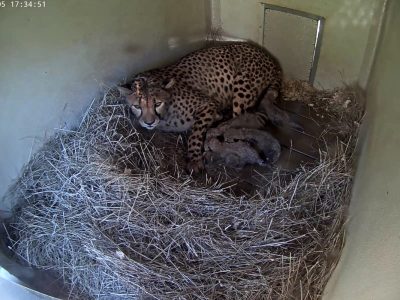

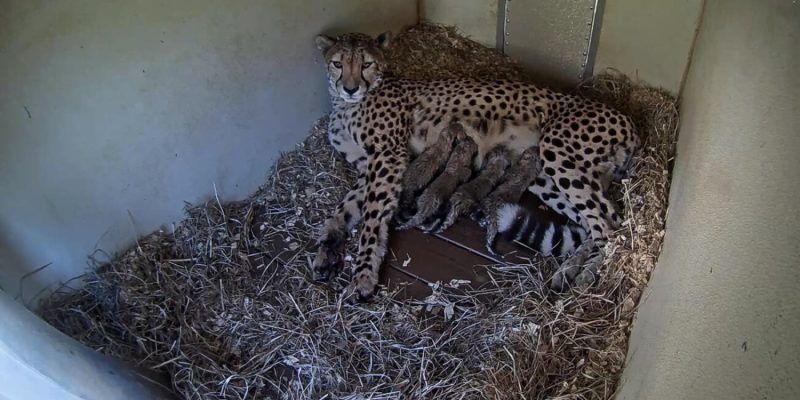
Four cheetah cubs were born on October 17 and 18, 2025 at the Front Royal, Virginia campus of the Smithsonian’s National Zoo and Conservation Biology Institute, and the litter carries two milestones with it. It is the 20th cheetah litter born at Front Royal, and its mother, five-year-old Amabala, was herself born there on camera in 2020.
The cubs are strong, active, vocal and eating well. Their father is Flash, an eight-year-old male with three surviving cubs from an earlier litter.
Twenty litters is harder than it sounds
Cheetahs (Acinonyx jubatus) are famously difficult to breed. The females cycle unpredictably and the behavior that signals readiness is subtle enough that experienced biologists can miss it.
“Cheetahs can be challenging to breed, in part because female reproductive cycles can be sporadic and their behavior is often very difficult to interpret,” said Adrienne Crosier, a carnivore biologist at NZCBI who leads the cheetah Species Survival Plan. “It’s taken our team of keepers, veterinary staff and biologists thousands of man-hours to produce 20 litters. For that 20th litter to be Amabala’s is an exciting, full-circle moment for us.”
What a Species Survival Plan actually decides
A Species Survival Plan, or SSP, is the mechanism that keeps a zoo population genetically healthy across institutions rather than inside any one of them. Working with the Association of Zoos and Aquariums population management center, scientists and animal care staff decide which animals should breed with which, weighing genetic makeup, health and temperament.
Flash is genetically valuable within the North American cheetah population, which is why these four cubs are expected to matter to the breeding program well beyond this year.
Front Royal does that work as part of the Cheetah Breeding Center Coalition, a group of ten cheetah breeding centers across the United States pooling effort toward a self-sustaining North American cheetah population under human care.
Hands off, cameras on
Amabala is a first-time mother, so staff stayed out of the den entirely and let her bond with and raise her cubs. They watched through the Cheetah Cub Cam, ready to step in if the situation called for it. That is the whole design: the least intervention that still catches a problem early.
The camera has a second job. Amabala’s litter is the fifth to be broadcast on the Cheetah Cub Cam, and the fact that a cheetah born on that camera is now raising cubs in front of it is the clearest picture anyone could ask for of what a breeding program looks like when it works over years rather than seasons.
Why cheetah litters are worth counting
Cheetahs live in small, isolated populations, mostly in sub-Saharan Africa, with many of their strongholds inside eastern and southern African parks. Human conflict, poaching, and the loss of both habitat and prey have pushed the wild population down to an estimated 7,000 to 7,500 animals. The International Union for Conservation of Nature considers the species vulnerable to extinction.
Against a number that size, four cubs in Virginia are not the answer. They are part of the reason the answer is still available: a genetically managed population, held across ten centers, with people who have learned how to breed a notoriously difficult cat and twenty litters of evidence that they can.
For more of the beat, see our coverage of mountain lion cubs at the Phoenix Zoo and Amur leopard cubs going outdoors at Utah’s Hogle Zoo.
Quick answers
- Why are cheetahs difficult to breed?
Female cheetahs cycle sporadically and their behavior is hard to interpret, so timing a pairing takes long observation. It has taken the Front Royal team thousands of hours to produce 20 litters.
- What is a Species Survival Plan?
An Association of Zoos and Aquariums program that manages a species as one population across institutions. Scientists and animal care staff decide which animals breed based on genetic makeup, health and temperament.
- How many cheetahs are left in the wild?
An estimated 7,000 to 7,500, mostly in small isolated populations in sub-Saharan Africa. The International Union for Conservation of Nature considers the species vulnerable to extinction.