
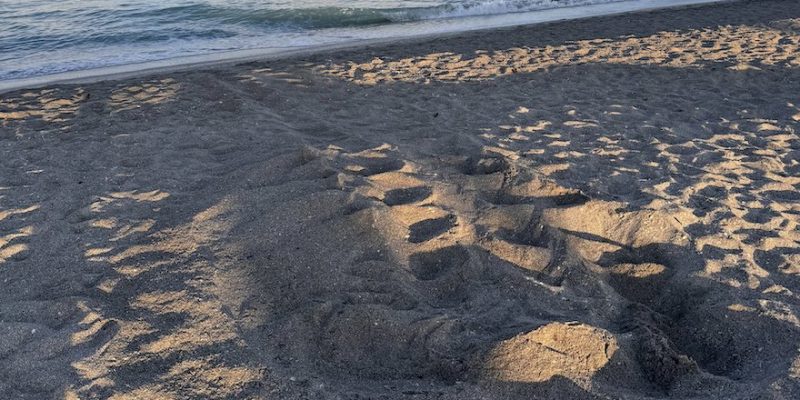
A loggerhead came ashore on Venice Beach, Florida, on Monday, April 27, 2026, dug a nest and went back into the Gulf. Mote Marine Laboratory’s Sea Turtle Patrol found the crawl that morning and logged it as the first nest of the season on the 35 miles of shoreline the program watches. It was also the opening entry of Mote’s 45th consecutive year of monitoring these beaches.
The patrol had already been walking for twelve days. Mote’s Sea Turtle Conservation and Research Program starts its daily surveys on April 15, two weeks ahead of the official May 1 start of nesting season, on the reasonable theory that the turtles have not read the calendar.
Who actually walks the beach
Staff biologists and interns, and more than 300 volunteers. From April 15 through October 31 they cover the same stretch every morning, from Longboat Key south to Venice, reading the sand for the tractor-tread drag mark that means a female hauled out overnight.
“The success of our monitoring efforts is made possible by the dedication of our volunteers, interns, and staff,” said Melissa Macksey, Senior Biologist and Data Manager of the program. “Their consistent efforts are vital to protecting nesting sea turtles and advancing our long-term research.”
Each nest found is marked with yellow stakes and flagging tape, which is less about decoration than about keeping beach rakes, chairs and feet off a patch of sand that will not look like anything for two months. The team then records nest density, where on the beach the female chose to dig, how many eggs hatch, how many hatchlings actually make it out of the sand, and the weather that surrounded all of it.
They also track phenological shift, which is the term for a species changing the timing of a life event rather than the place of it. If loggerheads begin nesting earlier decade over decade, that shows up only in a dataset that has been collected the same way for 45 years, which is exactly what this program is.
What the last full season looked like
2025 was the biggest on record here. Mote documented 5,736 nests across those 35 miles, a historic count for the program, and part of a broader rise in nest numbers along local beaches in recent years.
The same season set a second record that nobody wanted. Mote logged 717 disorientation events, the most it has ever recorded. A disorientation is what happens when a hatchling, or a nesting female, uses the wrong light. Turtles emerge at night and steer toward the brightest open horizon, which on a dark beach is the sea. Add a porch light, a parking lot or a beachfront window and the brightest horizon is inland, and a hatchling crawls away from the water instead of into it.
This is why the advice from Mote is as specific as it is: shield or switch off outdoor lights visible from the beach and close the drapes after dark from May through October, stack beach furniture at the dune line or take it home, and fill in any holes dug during the day. It is also why the program asks people not to use flashlights or fishing lamps on the sand at night.
Which turtles nest here
Loggerheads are the species the patrol sees most on this coast, followed by green sea turtles. Sarasota County occasionally gets a Kemp’s ridley or a leatherback nest as well, which is a genuine rarity this far around the Gulf. The Kemp’s ridley is the same species the New England Aquarium follows to Texas at the other end of its range.
How endangered is the loggerhead?
It depends which list you are reading, and the two say different things because they are counting different units.
NOAA Fisheries recognizes nine distinct population segments of loggerhead worldwide under the U.S. Endangered Species Act. Five are listed as endangered and four as threatened. The one that nests in Florida, the Northwest Atlantic Ocean DPS, is listed as Threatened, which is what Mote’s release says and is correct. The IUCN Red List, version 2026-1, assesses the loggerhead (Caretta caretta) globally as Vulnerable, with a decreasing population. Both are accurate; they are simply different lists with different vocabularies, and the ESA one is scoped to a population rather than the species.
Neither number is the interesting one on a Venice morning in April. The interesting one is 5,736, and whether this year beats it. Mote posts preliminary weekly counts through the season and a reviewed final total after October 31, and the 2026 tally is still being added to as of this writing.
Mote’s marine science shows up in our pages in other forms too, from its Keys-wide coral rescue during a summer heat event to its reef restoration research. The turtle patrol is the quietest of it, and at 45 years running, the longest.
Source: Mote Marine Laboratory and Aquarium, Mote’s Sea Turtle Patrol Documents First Local Sea Turtle Nest of 2026 Season, published April 27, 2026. Listing status from NOAA Fisheries and the IUCN Red List, version 2026-1.
Quick answers
- When does sea turtle nesting season start in Sarasota County?
Officially May 1, running through October 31. Mote Marine Laboratory's Sea Turtle Patrol begins daily surveys on April 15, two weeks early.
- Which sea turtles nest on these Florida beaches?
Loggerheads most often, then green sea turtles. Sarasota County also gets occasional Kemp's ridley and leatherback nests.
- What is a sea turtle disorientation?
When a hatchling or nesting female steers toward artificial light instead of the open horizon over the sea and crawls inland. Mote recorded 717 disorientation events in 2025, its highest ever.
- How endangered is the loggerhead sea turtle?
NOAA Fisheries lists nine distinct population segments under the U.S. Endangered Species Act, five endangered and four threatened. The Northwest Atlantic Ocean population that nests in Florida is listed as Threatened. The IUCN Red List, version 2026-1, assesses the species globally as Vulnerable.