
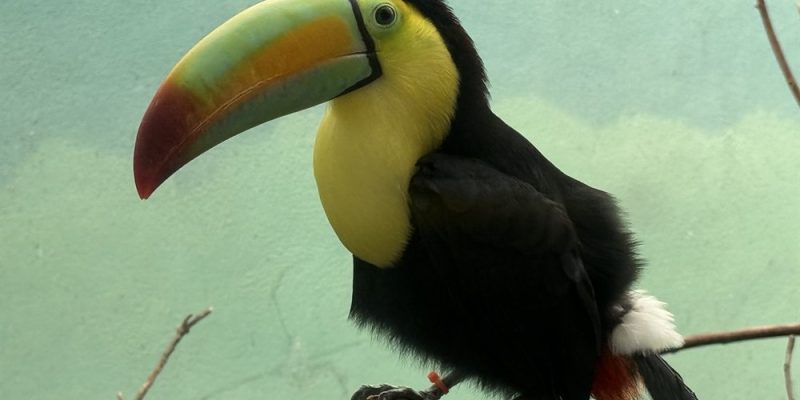
Fourteen juvenile keel-billed toucans were found hidden in the dashboard of a vehicle at the Otay Mesa border crossing in California. They had been sedated and bound to restrict their movement and keep them quiet. They were, in the Bronx Zoo‘s words, in extremely poor condition.
All fourteen survived. The zoo announced their rehabilitation in April 2026, several months after federal authorities handed them over.
What the care actually involved
The birds were three to four months old, ten males and four females. Bronx Zoo staff assisted the U.S. Fish and Wildlife Service with the rescue, and the birds then went through several months of treatment coordinated between the zoo’s Ornithology and Zoological Health departments.
Two of them had fractured legs, not from rough handling, but from malnutrition. A growing bird deprived of nutrition builds weak bone, and weak bone breaks under ordinary use. Both birds recovered.
“These toucans arrived in a severely compromised state after enduring stressful and inhumane conditions during illegal transport,” said Chuck Cerbini, curator of ornithology at the Bronx Zoo. “This case highlights both the harm and cruelty of wildlife trafficking and the critical role accredited zoos play in giving rescued wildlife a second chance.”
Why none of them went home
This is the part that tends to surprise people. Fourteen healthy birds of a species native to Mexico and Central America, and not one was returned to the wild.
The zoo’s phrasing is careful: for multiple reasons, it is not possible to return birds that have been subject to these conditions. Confiscated animals usually cannot be traced to a specific wild population, so releasing them risks putting the wrong genetics in the wrong place. They may carry pathogens picked up in transport or captivity. And birds taken young and handled by people often lack what they would need to survive.
So the alternative is placement. Ten toucans went to other AZA-accredited institutions through a Species Survival Plan, joining conservation breeding and education programs. Four stayed at the Bronx Zoo, two males visible in World of Birds, and two off-exhibit as a future breeding pair.
The larger trade
Keel-billed toucans are listed as Near Threatened by the IUCN. They are conspicuous, spectacular and in demand, which is the whole problem.
“This highlights the ongoing problem of illegal trade in live wildlife for the global pet trade, which harms species’ populations in the wild, undermines the rule of law, and harms the conservation programs of countries where the species are native,” said Susan Lieberman, WCS vice president for international policy. She added that caring for seized animals is vital, and that preventing the crime and curbing demand matter just as much.
That second half is the uncomfortable part. Fourteen rehabilitated toucans is a good outcome for fourteen birds and does nothing to the market that produced them.
The same pipeline runs through zoos on other continents: São Paulo Zoo has just taken in nine Amazon parrots hatched from eggs seized at a Rio airport.